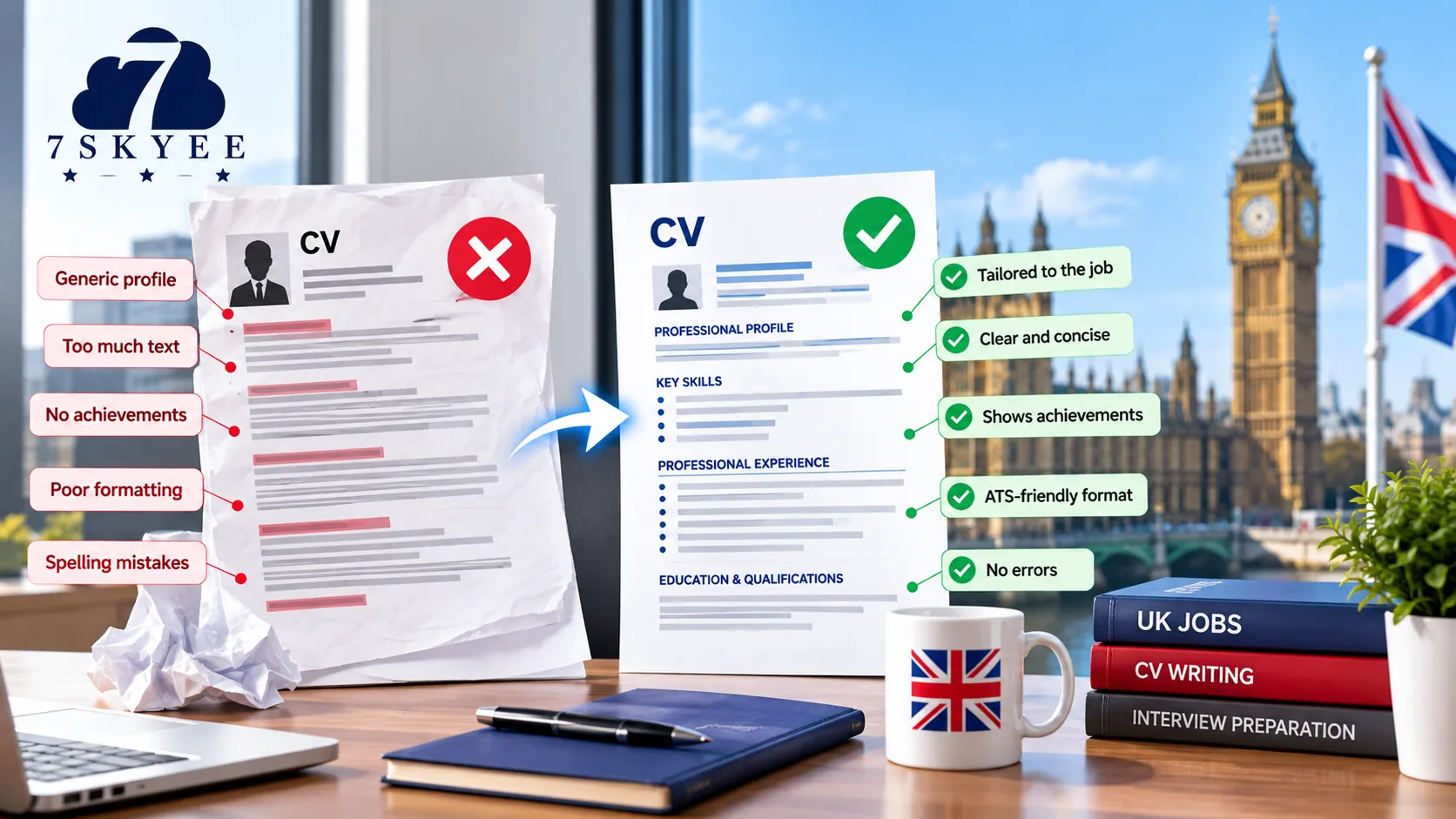
A strong CV can open the door to an interview. But even experienced professionals can make simple mistakes that weaken their application before a recruiter gets the opportunity to understand their experience.
Some problems are obvious, such as spelling mistakes or incorrect contact details. Others are less obvious: using the same CV for every application, focusing on responsibilities instead of achievements, using a complicated layout or failing to explain how your experience matches the role.
For UK job applications, your CV should be clear, relevant, accurate and targeted to the position.
If you are unsure about the basic structure of a UK CV, start with How to Write a CV for Jobs in the UK: A Complete Guide.
Below are some of the most common CV mistakes UK recruiters may notice — and what you can do instead.
1. Sending the Same CV for Every Job
One of the biggest mistakes is using one generic CV for every application.
Different employers are looking for different combinations of:
Skills
Experience
Qualifications
Industry knowledge
Technical capabilities
Leadership experience
Personal attributes
A CV that works for one role may not communicate your suitability for another.
How to fix it
Read the job description before applying.
Identify the employer's main requirements and adjust your:
Professional profile
Key skills
Relevant experience
Achievements
Keywords
You do not need to rewrite your entire career history for every application.
Instead, change the emphasis to match the opportunity.
2. Writing a Generic Personal Profile
Your personal profile is one of the first sections a recruiter may read.
A common mistake is writing something that could describe almost any candidate.
Weak example
Hardworking and motivated professional looking for a challenging opportunity where I can develop my skills and contribute to the success of the organisation.
There is nothing particularly wrong with the sentence, but it tells the recruiter very little.
Better approach
Digital marketing professional with eight years of experience across SEO, paid media and content strategy, delivering measurable growth for B2B and consumer brands. Experienced in managing integrated campaigns, analysing performance and working with cross-functional teams.
The second version immediately communicates:
Profession
Experience
Specialisation
Capabilities
Professional value
How to fix it
Write your profile around:
Who you are + what you specialise in + relevant experience + value you bring.
3. Listing Responsibilities Instead of Achievements
This is one of the most common CV weaknesses.
Many candidates simply copy their job description into their CV.
For example:
Responsible for managing a team of 12 employees.
Responsible for preparing monthly reports.
Responsible for managing customer relationships.
These statements explain what you were employed to do.
They do not explain what you achieved.
A stronger approach
Managed a 12-member team across three regional accounts, improving customer retention by 15% within 12 months.
The second example demonstrates responsibility and impact.
Ask yourself:
What changed because of my work?
That question can help you turn ordinary job descriptions into stronger CV achievements.
4. Not Including Measurable Achievements
Whenever possible, quantify your results.
For example:
Instead of:
Improved sales performance.
Write:
Increased regional sales by 22% over 12 months through account expansion and targeted business development.
Instead of:
Reduced costs.
Write:
Reduced annual operating costs by 14% by renegotiating supplier contracts and improving procurement processes.
Numbers give the recruiter evidence of your contribution.
Useful measurements can include:
Revenue
Cost savings
Percentage growth
Team size
Customer numbers
Project value
Time saved
Productivity improvements
Delivery times
Conversion rates
Not every achievement needs a number, but use one when it genuinely strengthens the story.
5. Making Your CV Too Long
More information does not automatically make a CV stronger.
A CV should contain the information that helps the employer understand your suitability for the role.
Experienced professionals sometimes make the mistake of including every position, project and responsibility they have ever had.
Instead, prioritise:
Recent experience
Relevant experience
Significant achievements
Skills required for the target role
Qualifications that matter to the position
For senior professionals, a longer CV can sometimes be appropriate because there may be substantial leadership or specialist experience to communicate.
The objective is not to hit an arbitrary page count.
The objective is to make the most relevant information easy to find.
6. Using an Overly Complicated CV Design
A highly designed CV may look impressive, but visual complexity can create problems.
Be cautious with:
Multiple columns
Large graphics
Text boxes
Charts
Skill bars
Decorative icons
Excessive colours
Information inside images
Complicated tables
For applications that may be processed through an ATS, simple formatting is generally safer.
For detailed guidance, read How to Make Your CV ATS-Friendly for UK Jobs.
A professional CV does not need to be visually complicated.
Good spacing, clear headings, readable typography and consistent formatting can create a polished result.
7. Ignoring ATS Requirements
Even if an employer uses an ATS, that does not mean your CV should be filled with keywords.
The better approach is to make the document:
Easy to read
Clearly structured
Relevant to the vacancy
Accurate
Keyword-aware
Easy for recruitment software to interpret
Use standard headings such as:
Professional Profile
Key Skills
Professional Experience
Education
Qualifications
Certifications
Avoid hiding important information inside graphics or complicated layouts.
UK JobHelp advises candidates to use relevant keywords from the job advert and avoid formatting elements such as pictures, tables and diagrams that can make CVs harder for an ATS to read.
8. Keyword Stuffing Your CV
The opposite problem is adding too many keywords.
For example:
Project Management | Project Manager | Project Planning | Project Delivery | Project Leadership | Project Management Skills
This does not demonstrate project management ability.
It simply repeats terminology.
Better approach
Use the relevant terminology naturally within your professional profile, skills and experience.
For example:
Led a £2.5m technology transformation project involving five cross-functional teams, delivering the programme within budget and ahead of schedule.
This provides context and evidence.
Keywords should support your experience, not replace it.
9. Spelling and Grammar Mistakes
Small errors can create a poor first impression.
Examples include:
Incorrect job titles
Misspelt company names
Wrong dates
Grammar mistakes
Inconsistent punctuation
Incorrect qualifications
Misspelt industry terminology
A spelling mistake can also affect ATS keyword recognition.
For example:
Stakeholder Managment
instead of:
Stakeholder Management
can cause an avoidable problem.
How to fix it
Before submitting your CV:
Run a spelling and grammar check.
Read it slowly.
Check every employment date.
Check company names.
Check qualifications.
Check your contact details.
Ask someone else to review it.
Never rely entirely on spell-check software.
10. Using the Wrong Contact Details
This sounds obvious, but it happens.
Check that your CV contains:
Correct phone number
Professional email address
Current location
Correct LinkedIn URL, if included
One incorrect digit in your phone number can prevent a recruiter from contacting you.
Use a professional email address rather than an informal or outdated one.
For example:
is generally more appropriate than an old personal address with nicknames or unnecessary numbers.
11. Including Unnecessary Personal Information
A professional UK CV should focus primarily on your qualifications, skills and professional experience.
You generally do not need to include details such as:
Date of birth
Age
Marital status
Number of children
Religion
Personal identification information
Photograph
The exception is where specific information is genuinely relevant to the role or application requirements.
The focus should remain on:
What can you contribute to the employer?
12. Using an Unprofessional Email Address
Your email address is a small detail, but it contributes to your overall professional presentation.
An address such as:
coolboy1988@example.com
does not create the same impression as:
james.smith@example.com
If your current email address is informal, consider creating a separate professional email account for job applications.
13. Failing to Explain Employment Gaps
An employment gap does not automatically make your CV unsuitable.
People take career breaks for many legitimate reasons, including:
Family responsibilities
Relocation
Further education
Redundancy
Travel
Starting a business
Personal circumstances
Career transition
The mistake is not necessarily having the gap.
The problem can be leaving the timeline unclear.
How to fix it
Be honest about the dates.
If you undertook relevant activities during the period, such as:
Freelancing
Volunteering
Professional training
Consulting
Further education
Projects
you may include them where they strengthen your application.
Do not invent employment to hide a gap.
14. Including Outdated or Irrelevant Experience
Your early career may have been important, but that does not mean every detail needs equal space.
If you have 15 or 20 years of experience, spending half a page describing an entry-level position from many years ago may not be the best use of space.
Give greater emphasis to:
Recent positions
Relevant positions
Leadership responsibilities
Major achievements
Specialist expertise
Older experience can often be summarised unless it is directly relevant to your target position.
15. Not Showing Career Progression
Recruiters often want to understand how your career has developed.
If you have progressed from:
Executive → Senior Executive → Manager → Senior Manager
make that progression clear.
Promotions can demonstrate:
Performance
Increased responsibility
Leadership capability
Professional development
Employer confidence
Do not hide important career progression inside a long block of text.
Make it easy to understand.
16. Using Too Many Buzzwords
Words such as:
Dynamic
Results-driven
Strategic
Passionate
Innovative
Hardworking
Proactive
can be useful occasionally.
But when a CV contains too many generic adjectives, they lose their impact.
Instead of saying:
I am a highly motivated, dynamic and results-driven leader.
Show it:
Led a 25-member team through a business transformation programme that reduced operating costs by 18%.
Evidence is stronger than adjectives.
17. Not Showing Transferable Skills During a Career Change
Career changers often make the mistake of focusing entirely on what they have not done.
For example:
I have no direct experience in project management.
Instead, identify relevant transferable experience.
You may already have experience in:
Managing stakeholders
Coordinating teams
Managing budgets
Delivering deadlines
Solving problems
Planning projects
Managing suppliers
Reporting results
The key is to connect your previous experience with the requirements of the new role.
18. Having a Weak LinkedIn Profile
Your CV and LinkedIn profile should generally tell a consistent professional story.
Check that:
Job titles are consistent
Employment dates are accurate
Your career direction makes sense
Your headline reflects your professional focus
Your profile supports the type of roles you are targeting
If your CV describes you as a senior finance professional but your LinkedIn headline still says "Finance Executive seeking opportunities", the two profiles may create confusion.
Your online professional presence should reinforce your CV rather than contradict it.
19. Using the Wrong File Name
Avoid filenames such as:
CV_Final_Final.pdf
or:
New Resume 2026.pdf
Use something professional and identifiable.
For example:
James-Smith-CV.pdf
or:
James-Smith-Marketing-Manager-CV.pdf
This small detail makes your application look more organised.
20. Not Checking the Final CV Before Applying
Never assume that the CV you saved is the same as the CV you intended to submit.
Open the final file and check it from beginning to end.
Look for:
Formatting problems
Missing pages
Broken links
Incorrect dates
Spelling mistakes
Inconsistent spacing
Wrong contact information
Unnecessary blank sections
Old versions of your professional profile
This final review can prevent simple mistakes from undermining an otherwise strong application.
A Quick UK CV Mistakes Checklist
Before applying for a UK job, ask yourself:
Relevance
Have I tailored the CV to this specific role?
Does my profile match the position?
Have I prioritised relevant experience?
Content
Have I demonstrated achievements?
Have I included measurable results where appropriate?
Have I avoided unnecessary information?
ATS
Are standard headings used?
Are relevant keywords included naturally?
Is the layout simple?
Have I avoided excessive graphics, tables and text boxes?
Professionalism
Is the CV free from spelling and grammar mistakes?
Are the dates accurate?
Is my email address professional?
Is my LinkedIn profile up to date?
Presentation
Is the document easy to scan?
Is the formatting consistent?
Is the filename professional?
Have I followed the employer's application instructions?
If you can answer yes to these questions, your CV is already in a much stronger position.
The Biggest CV Mistake: Not Making Your Value Clear
There is one mistake behind many of the problems discussed above:
The CV does not clearly communicate why the candidate is suitable for the job.
A recruiter should not have to search through several paragraphs to understand your relevance.
Your CV should make it easy to see:
What you do.
What you are good at.
What you have achieved.
Why your experience is relevant to this role.
That is the purpose of a strong CV.
Final Thoughts
A successful UK CV is not about making your career history look impressive on paper.
It is about presenting the right evidence in the right way for the opportunity you want.
Avoid generic profiles. Tailor your CV. Focus on achievements rather than responsibilities. Keep the structure clear. Use relevant keywords naturally. Remove unnecessary information. Proofread carefully.
And remember that a CV does not need to be perfect before you start applying — but it should be relevant, accurate, professional and focused.
If you want to understand the complete structure of a strong UK CV, read How to Write a CV for Jobs in the UK: A Complete Guide.
If you want to understand how to optimise your CV for recruitment technology as well as human readers, read How to Make Your CV ATS-Friendly for UK Jobs