A well-written CV helps employers understand your experience, relevant skills and suitability for a role. In the UK job market, it should be clear, focused and tailored to the opportunity rather than simply listing everything you have done.
Whether you are applying for your first job, progressing in your current profession or changing careers, your CV needs to communicate your value quickly. Recruiters may have many applications to review, so relevant achievements, a logical structure and easy-to-read formatting matter.
This guide explains how to write a professional UK CV in 2026, including the recommended structure, personal profile, employment history, skills, qualifications and common mistakes to avoid.
If you are applying for a specific vacancy, you should also learn how to tailor your CV to a job description in the UK.
1. What Is a UK CV?
A CV, or curriculum vitae, is a document that summarises your professional background, employment history, skills, qualifications and relevant achievements.
In the UK, a standard job application CV is usually concise and tailored to the position. Academic, research and some specialist roles may require a more detailed format.
A typical UK CV includes:
Contact details.
A professional profile.
Relevant skills.
Employment history and achievements.
Education and qualifications.
Additional information relevant to the role.
The order and emphasis may vary depending on your experience and the vacancy. A recent graduate may place more emphasis on education and projects, while an experienced professional may prioritise employment history and achievements.
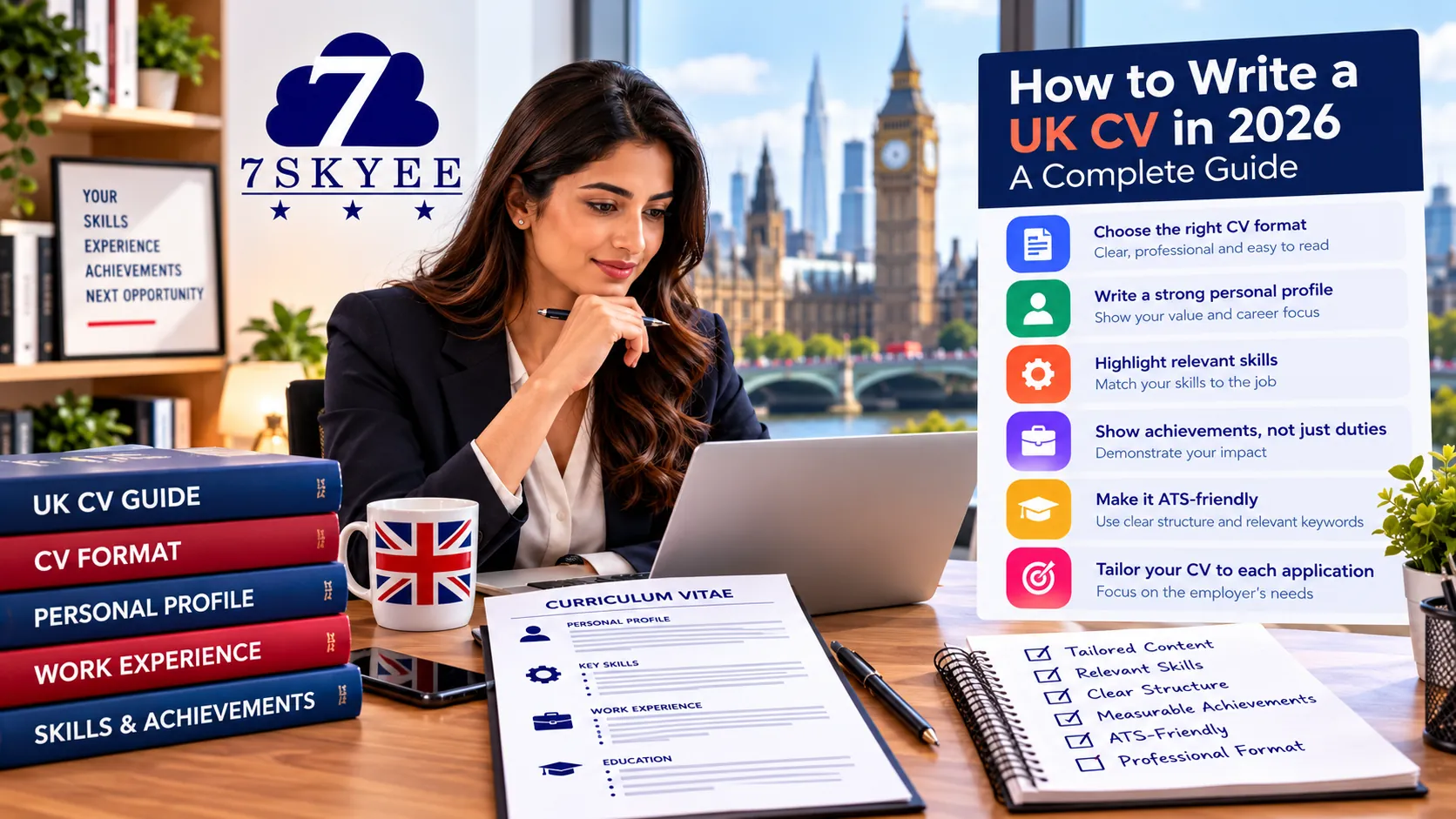
2. Choose the Right UK CV Format
For most professional applications, a reverse-chronological CV is a sensible starting point. It presents your most recent experience first, helping recruiters understand your current responsibilities and career progression.
A typical structure is:
Name and contact details.
Professional profile.
Key skills.
Employment history.
Education and qualifications.
Additional relevant information.
You can adjust the order to suit your circumstances. For example, a graduate with limited employment history may place relevant education, placements or projects before employment.
Avoid choosing a complicated design simply to make your CV look different. Clear headings, consistent formatting and relevant content are usually more useful than decorative elements.
3. Add Your Contact Details
Place your contact details near the top of the CV so that employers can identify you and contact you easily.
Include:
Your full professional name.
A suitable telephone number.
A professional email address.
Your town or general location, where relevant.
A LinkedIn profile URL, if it is current and supports your application.
A full home address is generally unnecessary for a standard UK CV. You should also normally leave out your date of birth, marital status, photograph and other personal details that are not relevant to the role.
Do not include sensitive personal information simply because a template provides space for it.
4. Write a Strong CV Personal Profile
Your personal profile is a short introduction that summarises your professional background, key strengths and career focus.
It should give the reader a clear reason to continue reading. Avoid generic statements that could apply to almost any applicant.
Example for an experienced professional
“Customer service professional with experience handling complex enquiries, resolving customer issues and coordinating with internal teams. Strong communication and problem-solving skills, with a focus on delivering accurate information and positive customer outcomes.”
Example for a graduate
“Recent business graduate with academic experience in market research, data analysis and group projects. Organised and analytical, with an interest in applying research and communication skills in an entry-level business role.”
These are examples only. Your profile should reflect your actual background and the requirements of the job you want.
For more guidance, read our article on writing a professional personal profile for a UK CV.
5. Identify the Skills Relevant to the Job
Your skills section should reflect what the employer needs, not simply list every capability you have developed.
Review the job description and identify the most important technical, professional and transferable skills.
Depending on the role, these might include:
Project management.
Data analysis.
Customer relationship management.
Communication and stakeholder engagement.
Financial reporting.
Software or technical expertise.
Team coordination.
Problem-solving.
Planning and organisation.
Include skills you can demonstrate through your work, education or relevant projects. Where possible, support important skills with examples in your employment history.
For further guidance, read how to write a CV skills section for UK jobs.
6. Write Your Employment History Clearly
Your employment history should help recruiters understand what you did, the responsibilities you held and the contribution you made.
For each relevant role, include:
Job title.
Employer name.
Employment dates.
A short description of your responsibilities, where useful.
Relevant achievements.
List your most recent position first and work backwards. Give more space to recent, relevant experience and summarise older roles when their details are less important to your target application.
Use consistent date formatting throughout the document. If you have a gap in your employment history, prepare an honest, concise explanation if it is relevant to the application.
7. Describe Achievements, Not Just Responsibilities
A CV becomes more persuasive when it explains what you contributed rather than only describing your duties.
Compare these examples:
Responsibility-focused: “Responsible for managing customer enquiries and complaints.”
Achievement-focused: “Managed customer enquiries and complaints, coordinated with internal teams to resolve complex cases and helped improve the consistency of customer communication.”
The second example gives a clearer picture of the work involved and the contribution made.
Where accurate figures are available, you can include them to demonstrate scale or results. Never invent numbers or claim outcomes that you cannot substantiate.
8. Tailor Your CV to Each Application
Sending the same CV for every vacancy can make it harder for employers to see why you are suitable for a particular role.
Before applying:
Read the job description carefully.
Identify the essential skills and experience.
Prioritise the most relevant achievements.
Use appropriate terminology from the vacancy where it accurately describes your experience.
Adjust your profile and skills section to reflect the role.
Remove information that does not support your application.
Tailoring should clarify your genuine suitability, not misrepresent your background.
Read our detailed guide on how to tailor your CV to a job description in the UK.
9. Make Your CV ATS-Friendly
Some employers use applicant tracking systems (ATS) to collect and process applications. A straightforward, readable CV can help make your information easier for recruitment systems and people to interpret.
Consider the following practices:
Use clear section headings.
Choose a readable font.
Keep job titles and dates consistent.
Use straightforward bullet points.
Avoid relying on complex tables, graphics or text boxes to communicate essential details.
Include relevant keywords naturally.
Follow the employer's instructions for file format and submission.
An ATS-friendly format does not guarantee that your application will pass screening or lead to an interview. Your experience and suitability remain important.
For more detail, read how to make your CV ATS-friendly for UK jobs.
10. How Long Should a UK CV Be?
For many professional roles, two pages is a useful target. However, the appropriate length depends on your experience, career stage and the requirements of the position.
Graduates and early-career candidates: One or two pages may be sufficient.
Experienced professionals: Two pages often provide room for relevant responsibilities and achievements.
Senior professionals and executives: Two or three pages may be appropriate when the additional detail is relevant.
Do not remove important evidence simply to meet an arbitrary page limit. Instead, remove repetition, prioritise relevant experience and keep descriptions concise.
See our guide to how long a CV should be in the UK.
11. Include Education and Qualifications
List your education and qualifications in a clear, consistent format. Include the institution, qualification and completion date where relevant.
You may also include professional certifications, licences or relevant training, especially when they are requested in the job description.
Graduates can provide more detail about relevant modules, academic projects or placements if they help demonstrate suitability. Experienced candidates generally need to give more space to their professional achievements than to older academic details.
Only include qualifications and certifications you have actually obtained. If a qualification is in progress, label it accurately.
12. Address Career Changes and Employment Gaps
If you are changing careers, your CV should make the connection between your previous experience and your target role clear. Highlight transferable skills, relevant training and examples that demonstrate your readiness for the new direction.
If you have an employment gap, you do not need to provide unnecessary personal details. Where an explanation is appropriate, keep it factual and concise.
You can also use relevant training, volunteering, freelance work or projects to show how you have maintained or developed your skills during a transition.
If you are changing fields, our guide to writing a CV for a career change in the UK can help you position your experience.
13. Use Professional Formatting
Your CV should be easy to scan on screen and, where necessary, in print.
Use:
Consistent headings and spacing.
A readable font size.
Clear bullet points.
A logical order.
Consistent dates and punctuation.
Enough white space to separate sections.
Avoid unnecessary graphics, excessive colours and long blocks of text. A visually distinctive CV is not automatically a more effective CV.
Before submitting, check that the document displays correctly on different screens and that your contact details and formatting remain intact when exported.
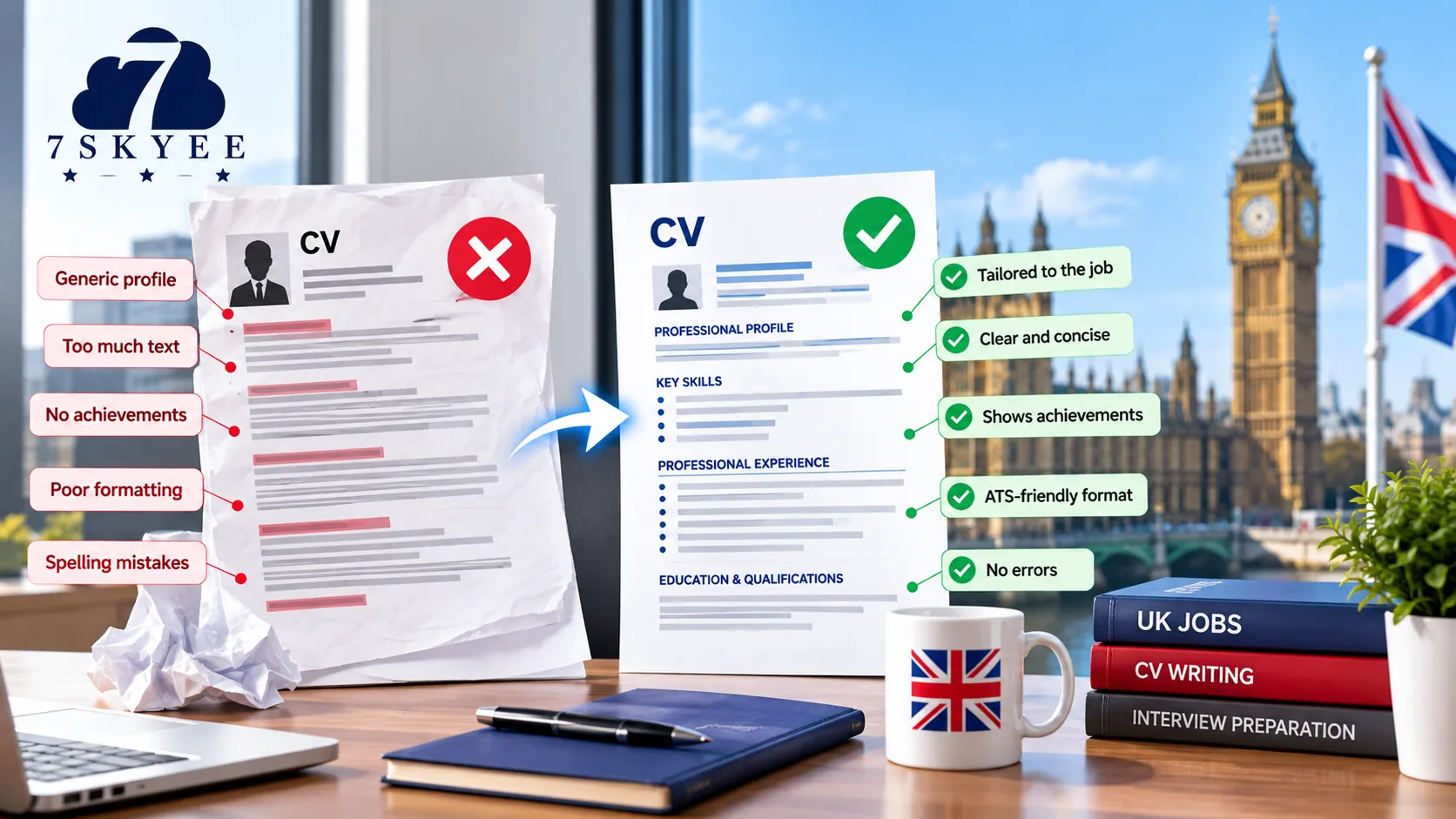
14. Common UK CV Mistakes to Avoid
Some of the most common problems include:
Sending the same CV for every application.
Using a generic personal profile.
Listing duties without explaining achievements.
Including irrelevant or outdated information.
Using an unprofessional email address.
Adding personal details that are not required.
Overloading the CV with keywords.
Using complicated formatting that affects readability.
Making unsupported claims or including inaccurate dates.
Failing to proofread the final document.
Review your CV from the employer's perspective. Can they quickly understand your experience, your strongest relevant skills and why you may be suitable for the vacancy?
Our guide to CV mistakes UK recruiters notice first explains how to identify and correct these issues.
15. Final UK CV Checklist
Before submitting your application, check that:
Your CV is tailored to the vacancy.
Your contact details are correct.
Your profile summarises your relevant experience.
Your skills reflect the job requirements.
Your employment history is accurate and clearly structured.
Your achievements are supported by genuine examples.
Your education and qualifications are correctly listed.
The format is clear and readable.
You have checked spelling, grammar and dates.
You have followed the employer's application instructions.
Your file name is professional, such as
Firstname-Lastname-CV.pdf.
Final Thoughts
Writing a strong UK CV in 2026 is about presenting relevant experience clearly, supporting your strengths with evidence and tailoring your application to the role. You do not need an elaborate design or a long list of keywords. You need a professional document that helps the employer understand your suitability.
Review your CV regularly, keep your achievements up to date and adjust the emphasis when applying for different opportunities.
If you would like professional help with your CV, explore 7Skyee's UK CV Writing service