An employment gap does not have to prevent you from finding your next job. People take breaks from work for many reasons, including redundancy, caring responsibilities, health and wellbeing, further study, travel, family commitments or a decision to change careers.
The challenge is knowing how to present that period on your CV without making it the main focus of your application.
The most effective approach is to be honest, keep the explanation proportionate and show employers what makes you a suitable candidate today. You do not need to apologise for every gap or disclose private details that are not relevant to the role.
In this guide, we explain how to handle employment gaps on a UK CV, with practical examples for different circumstances.
If you are updating your CV after time away from work, our guide to writing a CV for jobs in the UK is a useful starting point.
1. Do Employment Gaps Matter to UK Employers?
An employment gap may prompt a recruiter to ask a question, particularly if the dates are unclear. However, a gap does not automatically make you unsuitable for a role.
Employers are generally interested in understanding your experience, capabilities, recent development and suitability for the position.
A gap may be less significant when you have relevant experience and can demonstrate that your skills remain appropriate for the job. For roles requiring current technical knowledge, professional registration or recent industry experience, you may need to explain how you have maintained the necessary competencies.
Your objective is not to hide the gap. It is to present your career history clearly and confidently.
2. Should You Mention an Employment Gap on Your CV?
There is no single approach for every situation. Consider the length of the gap, the structure of your CV and the information an employer needs to understand your experience.
For a short gap between jobs, you may not need to explain it separately. Your employment dates may already make the timeline clear.
For a longer break, a brief entry can help prevent confusion.
For example:
Career Break | January 2024 – December 2024
Took a planned career break for personal commitments before preparing to return to full-time employment.
Only use wording that accurately reflects your circumstances. You do not need to provide intimate personal details or explain every month of your time away.
If the gap involved relevant study, volunteering, freelance work or professional development, you can mention it where appropriate.
3. How to Explain Different Types of Employment Gaps
The best explanation depends on your circumstances. Keep it factual, concise and professional.
Career break for family or caring responsibilities
You may have taken time away from work to care for children, support a family member or manage other responsibilities.
A concise entry could be:
Career Break | March 2023 – August 2024
Took time away from employment to manage family responsibilities and am now ready to return to professional work.
You do not need to disclose detailed family circumstances. If you developed relevant skills or completed professional training during this period, mention them only if they strengthen your application.
Redundancy or organisational restructuring
Redundancy is a normal part of working life. You generally do not need to give a lengthy explanation.
For example:
Career Transition | September 2025 – January 2026
Following organisational restructuring, focused on securing a suitable next role and updating relevant professional skills.
If your previous role ended because of redundancy, you can also state that briefly when appropriate. Avoid criticising your former employer.
Time away for further education or training
If you took time away to study, make the development visible.
For example:
Professional Development | January 2024 – October 2024
Completed training in data analytics and strengthened practical skills in spreadsheet modelling, reporting and data visualisation.
Include the actual course, qualification or project where relevant. Do not imply that a short course is equivalent to a formal professional qualification.
Travel or a planned sabbatical
If you took a planned break to travel, a simple explanation may be sufficient.
For example:
Planned Career Break | June 2023 – February 2024
Took a planned break for travel before returning to pursue the next stage of my career.
You do not need to turn the experience into a list of personal adventures unless the experience is relevant to the role.
Health-related career break
You can usually keep a health-related explanation general.
For example:
Career Break | 2023–2024
Took time away from work for personal reasons and am now preparing to return to employment.
You are not required to include a diagnosis or detailed medical history in your CV. Consider any specific occupational requirements separately and seek appropriate advice if you are unsure what information you need to provide.
Long-term unemployment
If you have been looking for work for several months, avoid describing the period as though you have failed professionally.
You can use a simple, accurate entry:
Career Transition | January 2025 – Present
Focused on securing a suitable role, reviewing career objectives and maintaining relevant professional knowledge.
Only include activities you genuinely undertook. If you completed courses, volunteered, worked on projects or developed technical skills, these may provide useful additional evidence.
Freelance work or self-employment
If you completed paid projects, consulting assignments or self-employed work during the gap, include it in your employment history where relevant.
For example:
Freelance Marketing Projects | April 2024 – December 2024
Delivered independent marketing assignments involving content planning, campaign coordination and performance reporting.
Be accurate about the nature and scale of the work. Do not present occasional freelance assignments as a full-time position if that would be misleading.
4. How to Format an Employment Gap on Your CV
Consistency matters more than using a special format.
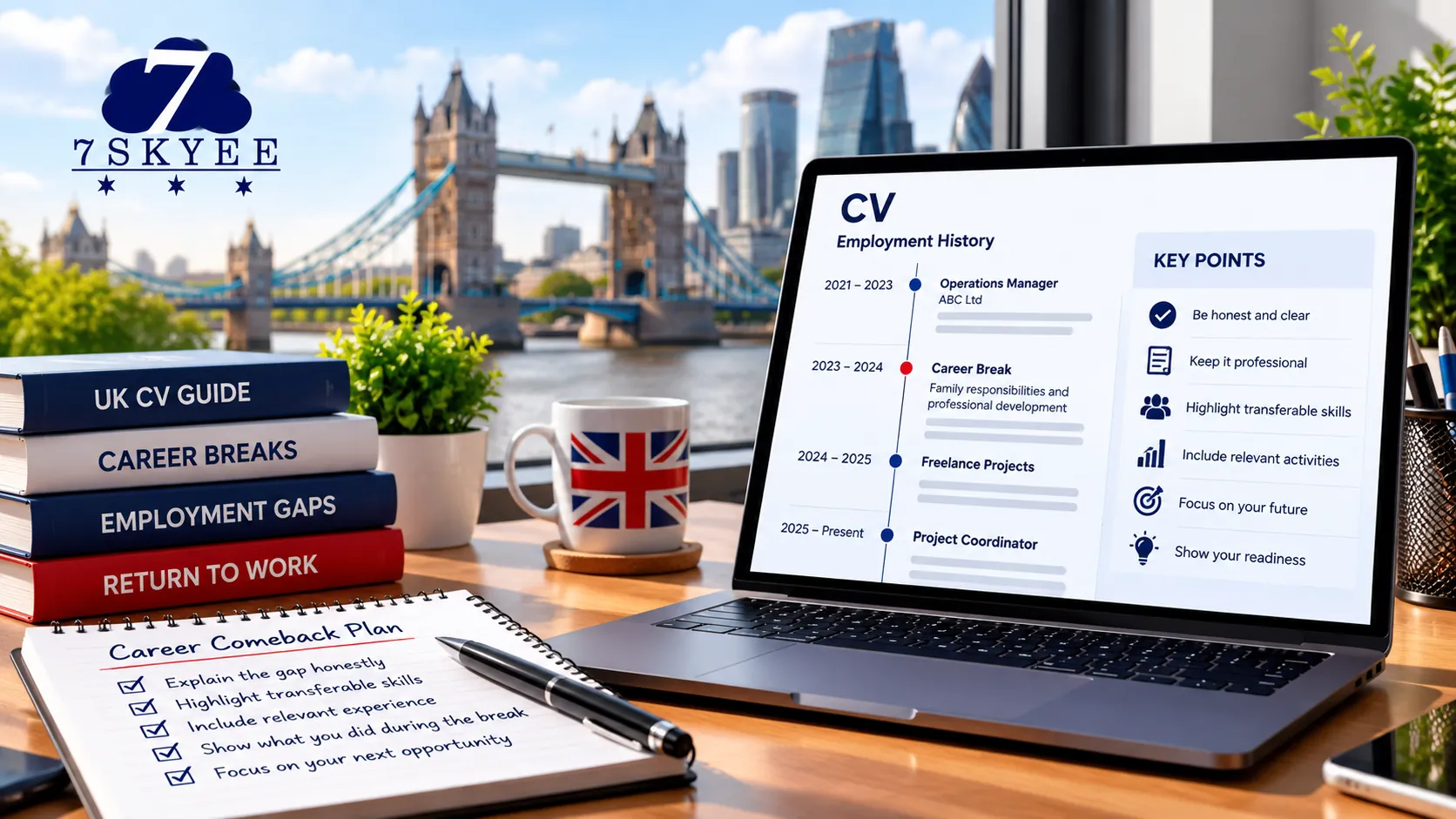
A simple reverse-chronological CV is suitable for many candidates returning to work. You can include a clearly labelled career break between employment entries where needed.
For example:
Operations Manager | ABC Ltd January 2021 – December 2023
Managed daily operational activities and resource planning.
Coordinated cross-functional teams and monitored service performance.
Introduced process improvements to support efficiency.
Career Break January 2024 – December 2024
Took a planned break for personal commitments.
Completed relevant professional development, if applicable.
Operations Manager | XYZ Ltd January 2025 – Present
Managed operational planning and team performance.
Coordinated improvement initiatives across departments.
Use your actual dates and responsibilities. The example is illustrative, not a template to copy regardless of your circumstances.
For more advice on organising your CV, read how long a CV should be in the UK.
5. Should You Use Years or Months for Employment Dates?
Use a consistent date format throughout your CV.
Month and year, such as March 2022 – October 2024, can make your career timeline clearer when you have several roles or a noticeable break.
Using years alone may be appropriate in some circumstances, but it can make shorter gaps less clear. Do not deliberately change date formats to mislead employers or conceal a gap.
Your dates should be accurate and consistent with the information you provide in application forms and background checks.
6. What If You Have a Long Employment Gap?
A gap lasting a year or longer may need a little more context, depending on your experience and the role you are pursuing.
You do not need to write a lengthy explanation. Instead, consider three points:
Give a brief, truthful description of the period.
Highlight relevant skills, training or activities, if any.
Show how your current capabilities align with the target role.
For example:
Career Break | 2022–2025
Took an extended career break for personal commitments. Now preparing to return to the workforce, with a focus on roles that draw on my previous experience in project coordination, stakeholder communication and process improvement.
This type of explanation keeps attention on your readiness and relevant experience without suggesting you must justify your personal life.
If you completed no formal training during the break, do not invent any. You can still highlight the relevant experience you gained before it.
7. How to Handle an Employment Gap When Changing Careers
If you are returning to work in a different field, you may need to address both your career break and your new direction.
Start by identifying skills from your previous career that apply to the role you now want.
For example, a former retail manager applying for a project coordination role may have experience in scheduling, resource management, team communication and operational planning.
Your profile might say:
Experienced retail manager transitioning into project coordination, bringing a strong background in operational planning, team coordination and process improvement. Now seeking to apply these transferable skills in a project-focused environment.
Keep the career break explanation separate if it needs to be mentioned. Your profile should primarily communicate your professional suitability.
Our guide to writing a CV for a career change in the UK explains how to position transferable experience.
8. What If You Did Not Develop New Skills During the Gap?
You do not have to manufacture a productive story about every period away from work.
Some breaks are for rest, recovery, caring responsibilities or dealing with circumstances that leave little time for professional development.
You can explain the period briefly and focus on the strengths and experience you bring to the role now.
If you want to refresh your knowledge before applying, consider activities that genuinely match your target career, such as:
Revisiting industry tools or systems.
Completing relevant training.
Working on a practical project.
Reviewing current professional standards.
Refreshing a portfolio or professional profile.
Only list activities once you have completed them, and describe your proficiency accurately.
9. How to Address Employment Gaps in an Interview
A recruiter may ask about a gap during an interview. Prepare a short explanation that you can deliver calmly.
A useful structure is:
Context: Explain the gap briefly.
Transition: State that the circumstances have changed, where relevant.
Readiness: Bring the conversation back to your suitability for the role.
For example:
“I took time away from employment to manage personal responsibilities. I am now ready to return to work and am focusing on roles where I can use my previous experience in operations and team management.”
You do not need to disclose private information beyond what you are comfortable sharing and what is appropriate to the situation.
Practise your response so you can answer confidently and then move on to discussing your skills and achievements.
If you are preparing to return to work, our UK interview coaching service may be useful for practising questions about career breaks and employment history.
10. Common Employment Gap Mistakes to Avoid
Trying to hide dates: Inconsistent dates can create more questions than a straightforward explanation.
Overexplaining personal circumstances: Your CV is a professional document, not a personal history.
Apologising for the gap: A career break does not automatically mean you have done something wrong.
Inventing activities: Never claim to have worked, studied or volunteered when you did not.
Using vague or misleading job titles: Label career breaks and independent projects accurately.
Ignoring the target role: The rest of your CV should still demonstrate your suitability for the vacancy.
Forgetting to update your skills: If your field has changed, check whether your knowledge and qualifications remain current.
For a wider review, read common CV mistakes UK recruiters notice.
11. Employment Gap CV Checklist
Before submitting your application, check that:
Your employment dates are accurate and consistent.
Any gap requiring clarification is explained briefly.
Your explanation is truthful and professional.
You have protected unnecessary private details.
Relevant training, volunteering or projects are included where appropriate.
Your most relevant skills and achievements are easy to find.
Your CV is tailored to the role.
Your profile reflects your current career direction.
You can explain the gap confidently in an interview.
You have checked spelling, grammar and formatting.
Final Thoughts
An employment gap is one part of your career history, not a complete measure of your professional value.
Be honest about your timeline, keep explanations proportionate and highlight the experience and capabilities that make you a strong candidate today. Whether your break involved redundancy, caring responsibilities, health, study or a planned career change, your CV should remain focused on your suitability for the role.
If you would like support presenting your experience clearly, explore 7Skyee's professional UK CV writing service.