Sending the same CV for every job application can make your experience look less relevant than it actually is.
A strong CV should show recruiters why your experience matches the particular role you are applying for. This does not mean rewriting your entire career history every time. It means identifying what matters most in the job description and making the most relevant parts of your experience easier to see.
For UK job applications, effective CV tailoring can also help make your CV clearer for both recruiters and applicant tracking systems (ATS).
If you are still working on the fundamentals, start with our guide to how to write a CV for jobs in the UK.
Why Should You Tailor Your CV?
Recruiters usually want to understand three things quickly:
What experience do you have?
What skills do you bring?
How closely does your background match the role?
A generic CV may contain all the right information but still fail to communicate relevance.
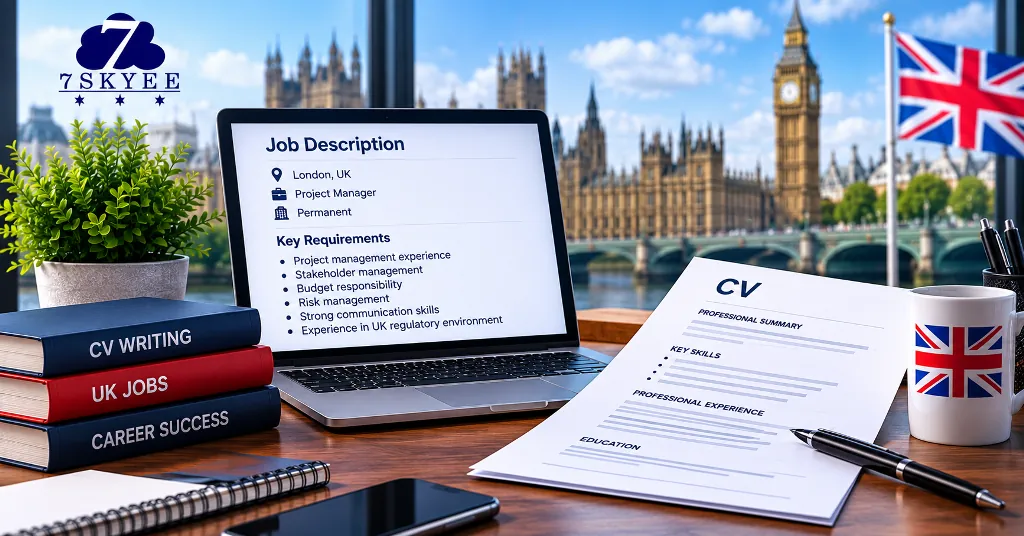
For example, imagine a Project Manager vacancy asking for:
project planning
stakeholder management
budget control
risk management
team leadership
If your CV simply says:
Managed various projects and worked with internal teams.
It does not clearly demonstrate the requirements of the role.
A stronger version could be:
Managed £2m+ projects across multiple stakeholders, controlling budgets, project risks and delivery timelines while leading cross-functional teams.
The experience may be the same. The difference is how clearly it is positioned against the job requirements.
1. Start With the Job Description
Before changing your CV, read the job description carefully.
Do not immediately start copying phrases into your CV. First, understand what the employer is actually looking for.
Look for:
required qualifications
technical skills
professional experience
industry knowledge
responsibilities
leadership requirements
software or systems
certifications
behavioural competencies
key achievements or outcomes
Pay particular attention to requirements that appear repeatedly or are emphasised in the job description.
These are often the areas you should consider highlighting in your CV.
2. Identify the Most Important Requirements
Not every requirement deserves equal space on your CV.
Separate the job description into three groups:
Essential requirements
These are requirements the employer specifically expects, such as:
professional qualifications
years of experience
specific technical skills
sector experience
particular systems or tools
Important requirements
These may not be absolute requirements but could strengthen your application.
Desirable requirements
These are useful additional skills or experiences but should not dominate your CV if they are less relevant to the role.
This exercise helps you decide what deserves prominence.
3. Match Your Experience With the Role
Once you understand the requirements, review your own experience.
Ask yourself:
Where have I already demonstrated this requirement?
For example, if the job description asks for:
Experience managing cross-functional teams.
Look through your employment history for situations where you:
led teams
coordinated departments
managed stakeholders
delivered projects across functions
worked with senior leadership
You may already have strong evidence. The problem may simply be that it is buried within a generic description.
Your goal is to bring the most relevant evidence forward.
4. Tailor Your Professional Profile
Your professional profile is one of the first sections recruiters are likely to read.
Instead of using the same profile for every application, adapt it around the target role.
Generic
Experienced professional with extensive experience across operations, project management and business development.
More targeted
Senior Operations Manager with 12+ years' experience leading manufacturing operations, continuous improvement and cross-functional teams within high-volume environments.
The second version immediately establishes:
seniority
function
experience level
relevant areas of expertise
target environment
Your profile should reflect what you are applying for, not simply everything you have done.
5. Prioritise the Right Skills
Your skills section should support the role you are targeting.
If a job description repeatedly mentions:
stakeholder management
project delivery
risk management
budgeting
team leadership
then these areas should be clearly represented in your CV if you genuinely have the relevant experience.
Do not add skills simply because they appear in the vacancy.
Your CV should remain truthful.
A good rule is:
Use the employer's language where it accurately describes your own experience.
This makes your CV more relevant without turning it into a collection of copied keywords.
6. Focus Your Achievements on What Matters
Responsibilities tell recruiters what you were expected to do.
Achievements show what you actually delivered.
When tailoring your CV, prioritise achievements that demonstrate the capabilities required by the job.
For example, if the vacancy focuses on cost reduction:
Less relevant:
Responsible for managing production operations.
More relevant:
Reduced production costs by 12% through process improvements and supplier negotiations.
If the role focuses on team leadership:
Led a 45-member operations team across three shifts, improving productivity while maintaining safety and quality standards.
Your achievements should provide evidence that you can perform the responsibilities described in the vacancy.
7. Tailor Your Employment History
You do not necessarily need to rewrite every role on your CV.
Instead, adjust the emphasis.
For your most recent and relevant positions, give greater space to experience that directly relates to the target role.
For older or less relevant positions, you can often provide a shorter summary.
This is particularly useful for experienced professionals who may have 15, 20 or 30 years of experience.
Your CV should not become a complete record of everything you have ever done.
It should become a focused representation of the experience most relevant to your target role.
For more guidance on CV length, read How Long Should a CV Be in the UK?.
8. Use Keywords Naturally
Keywords matter because recruiters and ATS software need to understand the content of your CV.
However, keyword stuffing can make a CV difficult to read.
For example, if a job description repeatedly refers to:
Supply Chain Management
you could naturally mention it in relevant sections such as:
Professional Profile
Core Skills
Employment History
Achievements
But do not repeat the phrase unnecessarily throughout the CV.
Instead, use relevant terminology where it genuinely reflects your experience.
This approach helps maintain both keyword relevance and human readability.
For more guidance, see our article on how to make your CV ATS-friendly for UK jobs.
9. Do Not Copy the Job Description
Tailoring your CV does not mean copying the employer's wording line by line.
Recruiters can recognise generic or copied content.
Instead:
Identify the requirement.
Find evidence from your experience.
Describe that experience in your own words.
Use relevant terminology naturally.
For example, if the job description says:
Manage relationships with key stakeholders across the organisation.
And you have genuinely done this, your CV could say:
Managed relationships with senior stakeholders across Operations, Finance, Procurement and Commercial functions.
The concept is aligned with the vacancy, but the statement is based on your actual experience.
10. Tailor Your CV Without Changing Your Career Story
There is an important difference between tailoring and rewriting your career history.
You should never:
invent experience
exaggerate achievements
add qualifications you do not have
claim responsibility for projects you did not manage
insert keywords that do not accurately describe your background
Instead, tailoring means deciding which genuine parts of your experience deserve the most attention.
Think of your CV as a spotlight.
You are not changing your career story.
You are directing attention towards the parts that are most relevant to the opportunity.
11. A Simple CV Tailoring Example
Imagine you are applying for a Senior Project Manager position.
The job description highlights:
project management
stakeholder management
budget control
risk management
team leadership
Your original CV might say:
Managed multiple engineering projects and worked with different departments to ensure successful completion.
A tailored version could say:
Led multi-disciplinary engineering projects from planning through delivery, managing budgets, project risks, senior stakeholders and cross-functional teams.
The second version provides stronger alignment with the vacancy while remaining truthful.
That is the purpose of CV tailoring.
12. Check Your CV Before Applying
Before submitting your application, compare your CV with the job description again.
Ask yourself:
Relevance
Does my CV clearly show why I am suitable for this particular role?
Keywords
Have I included relevant terminology from the job description where it genuinely applies?
Evidence
Have I demonstrated important skills through examples and achievements?
Profile
Does my professional profile reflect the role I am applying for?
Experience
Have I prioritised the most relevant parts of my career?
ATS readability
Is the document easy for ATS software and recruiters to read?
Accuracy
Is everything accurate and supported by my actual experience?
If the answer to these questions is yes, your CV is likely to be much more targeted.
UK CV Tailoring Checklist
Before submitting your CV, check:
I understand the main requirements of the job description.
My professional profile reflects the target role.
My most relevant skills are clearly visible.
My strongest relevant achievements are easy to find.
I have used relevant job-description keywords naturally.
My employment history emphasises relevant experience.
I have not copied the job description.
I have not added skills or experience I do not genuinely have.
My CV is easy to read.
My CV is ATS-friendly.
I have checked spelling and grammar.
I have reviewed the CV specifically for this vacancy.
Final Thoughts
A strong CV is not necessarily the CV that contains the most information.
It is the CV that makes the most relevant information easiest to understand.
Tailoring your CV allows you to connect your actual experience with the requirements of a specific role. Instead of asking the recruiter to work out why you are suitable, you make that connection clear.
For UK job applications, focus on relevance, evidence, clarity and natural use of keywords.
If you are unsure whether your CV is positioned correctly, our guide to common CV mistakes UK recruiters notice is a useful next step.
Need Professional CV Support for the UK?
Your CV should reflect your experience, career level and target roles.
Get Professional CV Support from 7Skyee
Our UK CV writing service focuses on clear positioning, relevant achievements, ATS-aware structure and professional presentation.