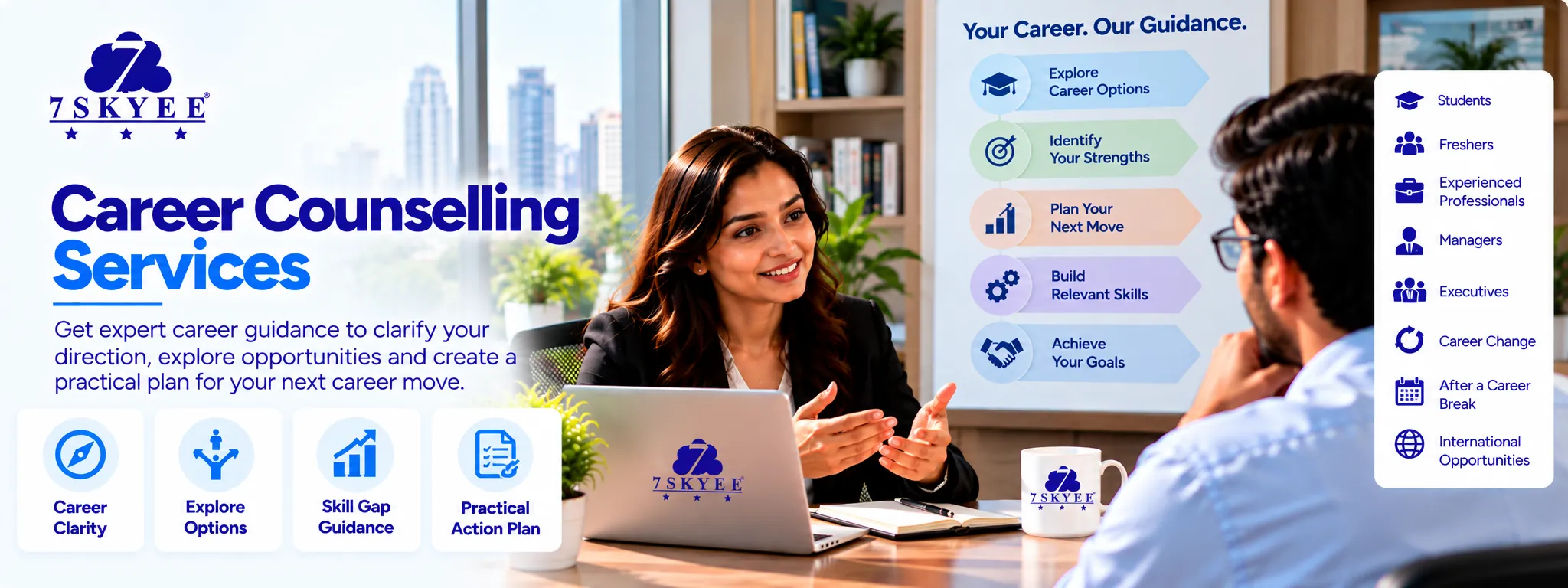
Career decisions can become difficult when you are unsure about your next step, considering a career change, or trying to understand which opportunities best match your experience and goals.
7Skyee provides professional career counselling for students, freshers, experienced professionals, managers and senior executives.
Our approach combines career guidance with practical recruitment and job-market experience to help you understand your options, evaluate possible career directions and create a realistic plan for your next move.
Why Career Counselling Matters
A career decision is rarely just about choosing a job title.
Your experience, skills, interests, qualifications, career goals and long-term priorities all influence whether a particular career path is right for you.
Career counselling can help you:
Understand your current career position
Clarify your professional goals
Explore suitable career options
Identify transferable skills
Evaluate a potential career change
Understand skill gaps
Plan your next career move
Develop a practical job-search strategy
The objective is not to make the decision for you, but to help you make a more informed career decision.
Career Counselling for Different Career Stages
Students
Students may have many career options but limited exposure to the professional world.
Career counselling can help students explore potential career directions based on their interests, strengths, education and future objectives.
Topics may include:
Career exploration
Education and qualification choices
Industry awareness
Career paths
Skill development
First-job planning
Long-term career direction
Freshers
Starting your first job can be challenging when you are unsure which roles or industries to target.
Career counselling can help you understand:
Which roles may suit your background
Which industries to explore
What skills employers look for
Whether additional certifications may be useful
How to begin your job search
How to build your professional profile
Experienced Professionals
Career decisions become more complex as your experience grows.
You may be considering a better role, a new industry, a different function or a completely new career direction.
Career counselling can help you evaluate:
Career progression
Job changes
Industry changes
Functional transitions
Leadership opportunities
Skill development
Long-term career objectives
Managers
Managers often reach a point where their next career decision requires more strategic thinking.
You may be considering:
Moving into senior management
Expanding your functional responsibilities
Changing industries
Moving into a specialist role
Transitioning into a broader leadership position
Career counselling can help you evaluate these options against your existing experience and future goals.
Senior Professionals and Executives
At senior levels, career decisions can involve much more than finding another job.
You may be considering executive leadership, consulting, entrepreneurship, international opportunities, board-level roles or a transition into another industry.
Career counselling can help you examine your experience, strengths and professional objectives and identify potential directions for your next stage.
Career Counselling for Career Change
Changing careers requires careful planning.
You may want to move:
From one industry to another
From one function to another
From technical to managerial roles
From employment to entrepreneurship
From one professional specialisation to another
Into a completely new career field
A career transition should be based on an understanding of your transferable skills, existing experience and the requirements of your target career.
Career counselling can help you identify the gap between where you are today and where you want to go.
Career Counselling for Job Change
Not every career problem requires a complete career change.
Sometimes the right next step may simply be a different organisation, role, industry or level of responsibility.
If you are considering a job change, counselling can help you examine:
Current career satisfaction
Growth opportunities
Role responsibilities
Industry prospects
Skills and experience
Leadership opportunities
Compensation considerations
Long-term career direction
This can help you distinguish between a job-change decision and a career-change decision.
Career Counselling After a Career Break
Returning to work after a career break can create uncertainty about suitable roles and how to position your previous experience.
Career counselling can help you:
Identify suitable career options
Assess your transferable skills
Identify relevant skill gaps
Plan your return to work
Prepare for the job-search process
Develop a clear professional narrative
The focus is on your current capabilities and future direction rather than simply the period away from employment.
Career Counselling for International Career Opportunities
Professionals considering international opportunities may need to evaluate whether their existing experience, qualifications and skills align with their target market.
Career counselling can help you think through:
Target countries or markets
Suitable roles
Transferable skills
Industry alignment
Professional positioning
Additional skills or certifications
International job-search strategy
For professionals considering markets such as the UK or Australia, career planning can be an important first step before investing significant time and resources into an international job search.
Career Assessment and Direction
Sometimes the biggest challenge is simply knowing what you want to do next.
Our counselling discussions can help you examine:
Your professional experience
Strengths
Interests
Skills
Achievements
Career preferences
Work experience
Short-term objectives
Long-term goals
From there, we can explore potential career directions and the practical steps associated with each option.
Identify Your Career Skill Gaps
Your target career may require skills that you do not currently use in your role.
Career counselling can help identify potential gaps in areas such as:
Technical skills
Digital skills
Management
Leadership
Communication
Industry knowledge
Certifications
Functional expertise
Understanding these gaps can help you decide where to focus your development efforts.
Career Counselling and Job Search Strategy
Career direction and job search strategy are closely connected.
Once you have greater clarity about your target career, you can develop a more focused approach to:
Target roles
Target companies
Resume positioning
LinkedIn positioning
Networking
Job applications
Interview preparation
Professional development
This helps move career planning from general discussion towards practical action.
Career Counselling for Different Career Goals
Your objective may be very specific.
You may want to:
Find Your First Job
Understand where to start and which roles may provide a suitable entry point.
Get Promoted
Identify the skills, experience and positioning required for your next level.
Change Industry
Explore how your existing experience can transfer into another sector.
Change Function
Evaluate whether your skills can support a move into another professional function.
Increase Career Growth
Identify potential career paths that offer greater responsibility and development.
Return to Work
Create a practical plan for restarting your professional career.
Move Internationally
Evaluate your career positioning for opportunities in another country or market.
What Our Career Counselling Covers
1. Career Assessment
Understand your current professional position, experience, strengths and objectives.
2. Career Direction
Explore possible career paths that align with your background and goals.
3. Career Options
Compare different career directions and understand the implications of each.
4. Skill Gap Analysis
Identify skills or qualifications that may be useful for your target direction.
5. Career Transition Planning
Develop a practical approach for moving from your current career position towards your desired direction.
6. Job Search Strategy
Understand how to approach the job market once your career direction is clearer.
7. Action Plan
Define practical next steps so that you leave the counselling process with a clearer plan.
Career Counselling vs Career Coaching
Career counselling and career coaching can overlap, but they often address different needs.
Career counselling generally focuses on understanding your situation, evaluating career options and providing guidance around career decisions.
Career coaching may place greater emphasis on ongoing development, accountability, performance and achieving specific professional goals.
Depending on your situation, you may benefit from one or a combination of these approaches.
Why Choose 7Skyee for Career Counselling?
7Skyee brings 17+ years of recruitment experience to career guidance.
This provides a practical perspective on how careers, job roles, candidate profiles and recruitment requirements connect.
Our approach focuses on helping you understand:
Where you are today
Where you want to go
What options may be available
What skills you may need
What practical steps you can take next
The goal is to provide practical career guidance rather than generic career advice.
Explore Our Career Services
Career counselling can be combined with other services depending on your needs.
Resume Writing
Once your career direction is clear, create an ATS-friendly resume aligned with your target roles.
Interview Coaching
Prepare for interviews with structured preparation, mock interviews and role-specific guidance.
Personal Recruiter
If you are actively looking for relevant opportunities, explore our dedicated Personal Recruiter service.
Career Counselling by City
Explore career counselling services for your location:
FAQs
Who can take career counselling?
Career counselling can be useful for students, freshers, experienced professionals, managers and senior executives at different stages of their careers.
Can career counselling help me choose a career?
Career counselling can help you understand your options, evaluate different career paths and develop a more structured approach to your decision.
Can experienced professionals take career counselling?
Yes. Experienced professionals may use career counselling to evaluate career progression, job changes, industry transitions, functional changes or leadership opportunities.
Can career counselling help with a career change?
Yes. Counselling can help you evaluate your transferable skills, potential career directions and the development required for a transition.
Can career counselling help after a career break?
Yes. It can help you evaluate suitable career options, identify skill gaps and create a structured return-to-work plan.
Is career counselling available online?
Yes. Career counselling can be conducted online, allowing you to access the service regardless of your location.
Does career counselling guarantee a job?
No. Career counselling provides guidance, career clarity and practical planning. It does not guarantee employment or a specific career outcome.
Take the Next Step in Your Career
You do not always need to make a career decision alone.
Whether you are starting your career, looking for growth, considering a career change, returning after a break or planning your next leadership move, professional career counselling can help you understand your options and create a clearer path forward.
Understand your options. Plan your next move. Build your career with purpose.