
Choosing the right career path is not always about finding the one job you will love forever.
For many professionals, the real challenge is figuring out what direction makes sense next.
You may have a job but feel that your career has stopped progressing. You may be considering a new industry, wondering whether to move into management, or trying to understand which skills are worth developing.
Sometimes you simply know that you want something different—but you don't know exactly what that should be.
That uncertainty is normal.
A practical career decision should consider more than interests or salary. Your strengths, experience, skills, goals, personal priorities and the opportunities available in the market all matter.
The right career path is usually not discovered through one perfect answer. It is built by understanding where you are, where you want to go and what realistic routes can take you there.
How Do You Know Which Career Path Is Right for You?
There is no universal career path that is right for everyone.
A career that is excellent for one person may be completely unsuitable for another.
For example, someone who enjoys solving technical problems may thrive in technology or engineering, while another professional may be more motivated by people management, sales, consulting or creative work.
The right career path should therefore answer four questions:
What am I good at?
What kind of work do I want to do?
What do I want my career to become?
Does the market offer realistic opportunities in that direction?
When these four areas overlap, you have a stronger foundation for making a career decision.

Why Choosing a Career Path Is Difficult
Career decisions become complicated because professionals rarely make them in isolation.
You may have to consider:
Current salary
Family responsibilities
Location
Job stability
Existing experience
Financial commitments
Qualifications
Industry demand
Career progression
Personal interests
Work-life balance
There is also a psychological challenge.
After spending several years in one profession, changing direction can feel like wasting everything you've already built.
It usually isn't.
Your career experience can provide transferable skills, professional maturity, industry knowledge and credibility that can be valuable in your next role.
The objective is to understand how to use those assets.
Start With What You Already Know About Yourself
Before searching for career options, start with your current situation.
Ask yourself:
What do I enjoy doing?
Think about the actual activities you perform—not just your job title.
Do you enjoy:
Solving problems?
Working with people?
Analysing information?
Building things?
Negotiating?
Teaching?
Managing teams?
Creating?
Selling?
Planning?
Working independently?
The answers can reveal patterns.
What do I dislike?
This is equally important.
If you dislike constant client interaction, a career requiring intensive relationship management may not be suitable even if it pays well.
If you dislike repetitive work, a highly process-driven role may eventually frustrate you.
Understanding what you don't want can narrow your choices.

Understand Your Strengths and Skills
Your career path should make use of your strengths.
But don't confuse strengths with things you happen to be good at.
You may be good at something because you've practised it for years, but that doesn't necessarily mean you want to build your future around it.
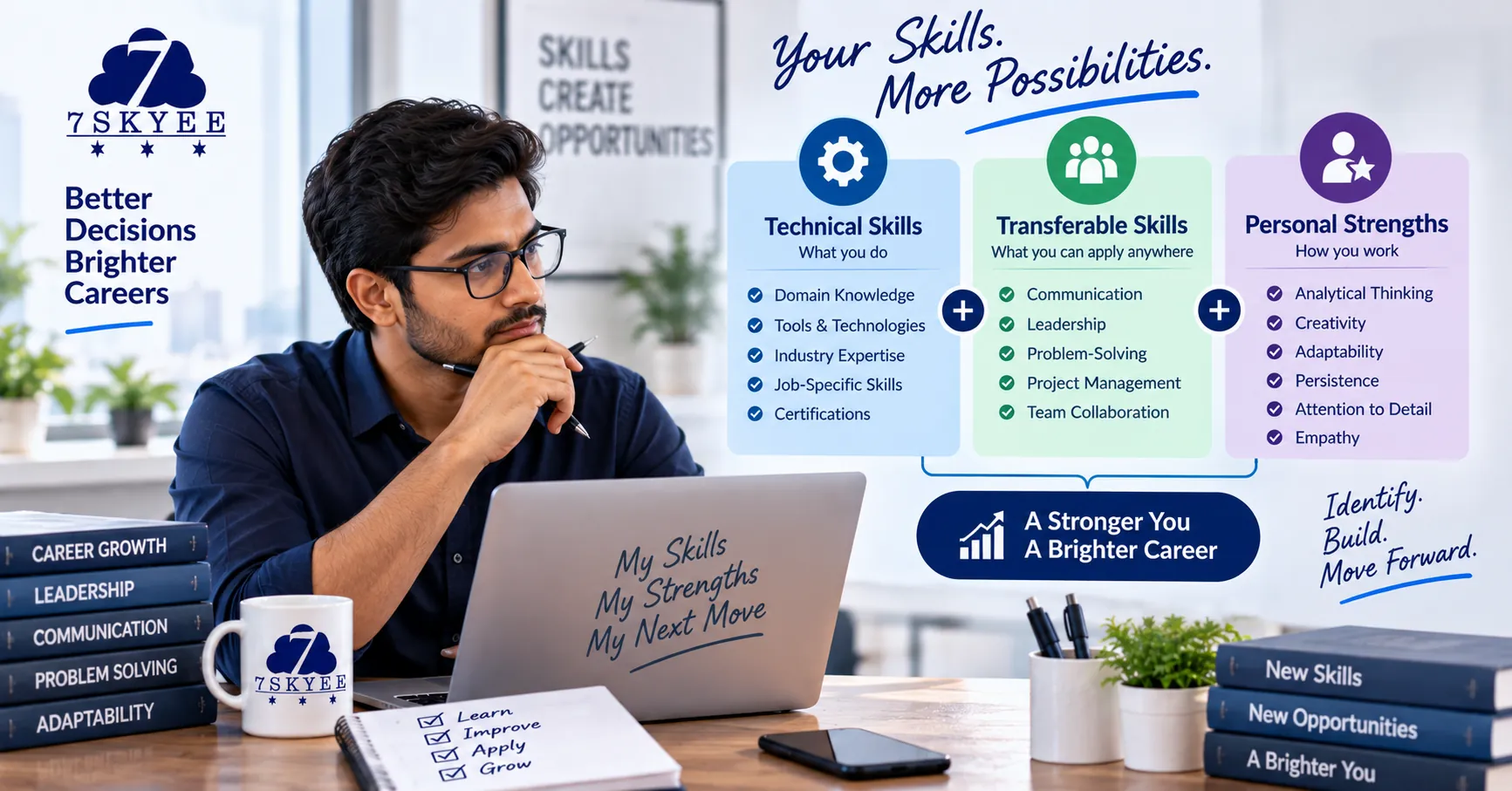
Consider three categories.
Technical Skills
These are skills specific to your profession.
Examples include:
Financial analysis
Coding
Recruitment
Accounting
Digital marketing
Engineering
Data analysis
Transferable Skills
These can be useful across multiple careers.
Examples include:
Communication
Leadership
Negotiation
Project management
Problem-solving
Stakeholder management
Team management
Presentation
Personal Strengths
These relate to how you work.
For example:
Structured thinking
Curiosity
Persistence
Empathy
Decision-making
Attention to detail
Adaptability
Understanding all three gives you a more complete picture of your professional profile.
Look Beyond Your Current Job Title
One of the biggest career-planning mistakes is assuming that your current job title determines your future.
It doesn't.
A job title describes your current position.
Your skills and experience describe what you may be capable of doing next.
Consider a professional working in recruitment.
Their experience may include:
Candidate assessment
Client management
Negotiation
Business development
Interviewing
Team leadership
Market research
That experience could potentially support different career directions within or adjacent to recruitment and HR.
Similarly, an engineer may have developed:
Analytical thinking
Project management
Stakeholder communication
Problem-solving
Technical expertise
Those capabilities may be relevant beyond traditional engineering roles.
This is why career planning should begin with capability, not just job title.

Identify What Kind of Work You Actually Enjoy
"Follow your passion" sounds attractive, but it is rarely enough to build a practical career plan.
Instead, identify the type of work that gives you energy.
For example, perhaps you enjoy:
People + Problem Solving
This could point towards consulting, management, HR, sales or client-facing roles.
Technology + Analysis
This could point towards technology, data, analytics or technical product roles.
Creativity + Communication
This could support marketing, content, design or communications.
Planning + Leadership
This could support project management, operations or management roles.
Your interests shouldn't be considered separately from your capabilities.
The goal is to find the intersection between what you enjoy and what you can realistically become good at.
Consider Your Career Goals
Your career path should also reflect where you want to be in the future.
Ask yourself:
Do I want to become a specialist?
You may prefer deep expertise in one professional area.
Do I want to become a manager?
You may want to move from individual contribution into people and business leadership.
Do I want to become an executive?
Your development may need to increasingly include strategy, commercial understanding, leadership and organisational impact.
Do I want greater flexibility?
Your priorities may favour careers or employers that offer different working arrangements.
Do I want to build something of my own?
Entrepreneurship requires a different combination of skills and risk tolerance.
Your answer doesn't need to be permanent.
Career goals can change as your circumstances change.
Don't Ignore the Job Market
A career path should be personally suitable—but it also needs to be economically realistic.
Before choosing a direction, research actual opportunities.
Look at current job descriptions and identify:
Common job titles
Required qualifications
Technical skills
Soft skills
Experience requirements
Salary ranges
Locations
Career progression
Employer demand
This is where a recruitment perspective becomes particularly valuable.
A career may sound attractive in theory but have limited opportunities for someone with your current background.
Conversely, you may discover that a career you had never considered offers a surprisingly strong match with your existing skills.
Don't choose a career only because it sounds interesting. Research where it can realistically take you.
Explore Career Options That Match Your Profile
Once you understand your strengths, interests and goals, create a shortlist.
Don't immediately select one career.
Start with perhaps three to five realistic options.
For example:
Current background: Marketing
Possible directions:
Digital Marketing
Product Marketing
Brand Management
Growth Marketing
Marketing Analytics
Then compare them.
Ask:
Which one uses my existing skills?
Which requires the smallest skill gap?
Which offers good long-term growth?
Which matches the work I enjoy?
Which has realistic opportunities?
Which fits my desired lifestyle?
Which aligns with my income expectations?
This makes career planning more objective.
Compare Career Paths Before Choosing One
A simple comparison framework can help.
FactorCareer Option ACareer Option BCareer Option CInterestExisting SkillsTransferable ExperienceSkill GapMarket DemandEarning PotentialGrowth PotentialLifestyle FitEntry DifficultyLong-Term Fit
You don't need to assign complicated scores.
The purpose is to make the differences visible.
A career path that initially looks exciting may become less attractive once you consider the required retraining or limited opportunities.
Another option may emerge as the stronger choice because it combines your existing experience with a manageable transition.
Think About Your Long-Term Career Growth
A good career path should not only answer:
“What job can I get next?”
It should also answer:
“What can this job help me become?”
Consider the next three to five years.
Could the role help you develop:
Leadership?
Technical expertise?
Industry knowledge?
Commercial experience?
Strategic thinking?
International exposure?
Management experience?
A stronger professional network?
Think of each role as a building block.
Your next job doesn't have to be your final destination.
It should ideally move you closer to the career you want to build.
Career Path vs Job Title: Why the Difference Matters
A job title can change while your broader career direction remains consistent.
For example:
Business Analyst → Senior Business Analyst → Product Manager → Product Director
These may look like different jobs, but they can form a logical career progression.
Similarly:
Recruiter → Senior Recruiter → Recruitment Manager → Talent Acquisition Head
is a career path rather than a collection of unrelated jobs.
When evaluating an opportunity, don't ask only:
"What is the title?"
Ask:
"What skills, exposure and opportunities will this role give me next?"
That question can produce much better career decisions.
How to Identify Your Skill Gaps
Once you have selected a potential direction, compare your current profile with real job descriptions.
Create two lists.
What I Already Have
Include:
Skills
Experience
Qualifications
Achievements
Industry knowledge
What the Target Career Requires
Include:
Technical skills
Certifications
Experience
Tools
Domain knowledge
Leadership capabilities
The difference between these lists is your skill gap.
Then decide which gaps actually matter.
Not every requirement in a job description deserves months of preparation.
Some skills may be essential.
Others can potentially be developed after entering the role.
Create a Practical Career Development Plan
Once you understand your target direction, turn it into an action plan.
Step 1: Define the target
Choose a specific direction rather than saying, "I want a better career."
Step 2: Understand the destination
Research actual roles and employers.
Step 3: Assess your current position
Understand your strengths and limitations.
Step 4: Identify skill gaps
Determine what you genuinely need to develop.
Step 5: Build relevant experience
Consider projects, responsibilities, training or internal opportunities.
Step 6: Reposition your professional profile
Your resume and LinkedIn profile should reflect the direction you're pursuing.
Step 7: Build your network
Connect with professionals already working in your target area.
Step 8: Test the market
Start exploring relevant opportunities and see how employers respond to your profile.
Step 9: Adjust
Your career plan should evolve as you learn more.
Common Mistakes When Choosing a Career Path
Choosing Based Only on Salary
Money matters, but a high salary cannot compensate indefinitely for work that doesn't fit your skills or goals.
Following Someone Else's Career
Your friend's successful career may not be right for you.
Choosing Based Only on Passion
Interest matters, but it should be considered alongside skills and market opportunities.
Ignoring Your Existing Experience
Your previous career may contain valuable assets that can support your next move.
Changing Direction Too Frequently
Exploration is useful. Constantly changing direction without building depth can make professional positioning difficult.
Taking Courses Without a Target
Don't collect qualifications simply because they appear popular.
Start with the career goal, then identify the skills and qualifications actually required.
Ignoring the Market
A career plan without market research is incomplete.
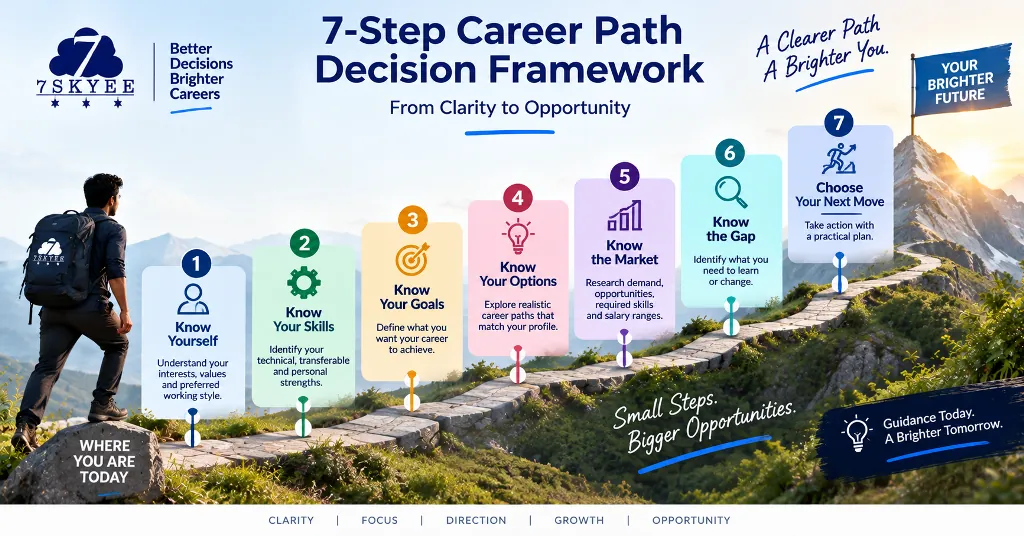
A 7-Step Career Path Decision Framework
If you're unsure where to start, use this framework:
1. Know Yourself
Understand your interests, strengths, values and preferred working style.
2. Know Your Skills
Separate technical, transferable and personal strengths.
3. Know Your Goals
Determine what you want your career to achieve.
4. Know Your Options
Identify realistic career directions based on your profile.
5. Know the Market
Research employers, roles, demand and requirements.
6. Know the Gap
Identify what you need to learn or change.
7. Choose Your Next Move
Don't try to solve your entire career in one decision.
Focus on the next logical step.
That may be a new role, additional training, an internal move, a new industry—or eventually a broader career change.
What If You Have More Than One Career Option?
You don't necessarily have to choose immediately.
If two or three options appear realistic, test them.
Talk to professionals working in those areas.
Read job descriptions.
Attend industry events.
Take on relevant projects where possible.
Research actual career progression.
You are trying to replace assumptions with evidence.
A career decision becomes easier when you understand what the work actually looks like.
When Career Counselling Can Help
Sometimes the problem isn't a lack of information.
It's that you have too many possibilities and no clear way to evaluate them.
Career counselling can provide a structured way to examine your:
Career history
Strengths
Interests
Transferable skills
Goals
Career options
Skill gaps
Market considerations
Next steps
This can be particularly valuable when you're considering a major career decision but aren't sure whether you should:
Stay → Change role → Change company → Change industry → Change career
The purpose of career counselling isn't to tell you what career you must choose.
It is to help you understand your options and make a decision that is more closely aligned with your profile and goals.
Career Path Checklist
Before choosing your next direction, ask yourself:
☐ I understand my strongest skills.
☐ I know which types of work I enjoy.
☐ I understand what I don't want from my career.
☐ I have identified my long-term career goals.
☐ I have considered my transferable skills.
☐ I have researched realistic career options.
☐ I have looked at actual job descriptions.
☐ I understand the skill gaps involved.
☐ I have considered salary and financial expectations.
☐ I have considered lifestyle and location requirements.
☐ I understand the potential career progression.
☐ I have a practical next step.
If several of these remain unclear, more career exploration may be useful before making a major decision.
The Right Career Path Doesn't Have to Be Perfect
There is no guarantee that one career choice will remain perfect for the rest of your professional life.
Your interests can change.
Industries can change.
Technology can change.
Personal priorities can change.
Your career path can change too.
The goal isn't to predict your entire working life.
It is to make a well-informed next decision.
Start with what you know about yourself.
Understand what you're good at.
Identify what you want.
Research what the market offers.
Then find the path where those factors overlap.
Your existing experience doesn't have to hold you back.
It can become the foundation for your next move.
The right career path isn't necessarily the one that looks perfect from the outside. It's the one that makes sense for who you are, what you can offer and where you want to go.
Frequently Asked Questions
How do I choose the right career path?
Start by assessing your strengths, skills, interests and career goals. Then research realistic career options and compare them against market demand, skill requirements, earning potential and long-term growth.
What if I don't know what career I want?
Start by identifying what you enjoy, what you're good at and what you don't want from your working life. Research several realistic options rather than trying to find one perfect answer immediately.
Should I choose a career based on my interests?
Interests are important, but they should be considered alongside your skills, experience, career goals and actual opportunities in the job market.
Should salary influence my career choice?
Yes, but it shouldn't be the only factor. Consider earning potential alongside career growth, work type, stability, learning opportunities, lifestyle and long-term professional value.
Can I change my career path after several years of experience?
Yes. Experienced professionals often have transferable skills and industry knowledge that can support a transition. The best route depends on how closely the new direction aligns with your existing capabilities.
How do I know which skills I need for a new career?
Review several current job descriptions for the roles you're targeting. Look for recurring requirements and compare them with your existing skills and experience.
Is career counselling useful for working professionals?
It can be particularly useful when you're uncertain about your next direction, considering a career transition or trying to evaluate multiple options. A structured discussion can help you understand your strengths, options and next steps.
How often should I review my career path?
There is no fixed schedule. It can be useful to reassess your direction when your responsibilities, interests, industry, goals or career opportunities change significantly.


