
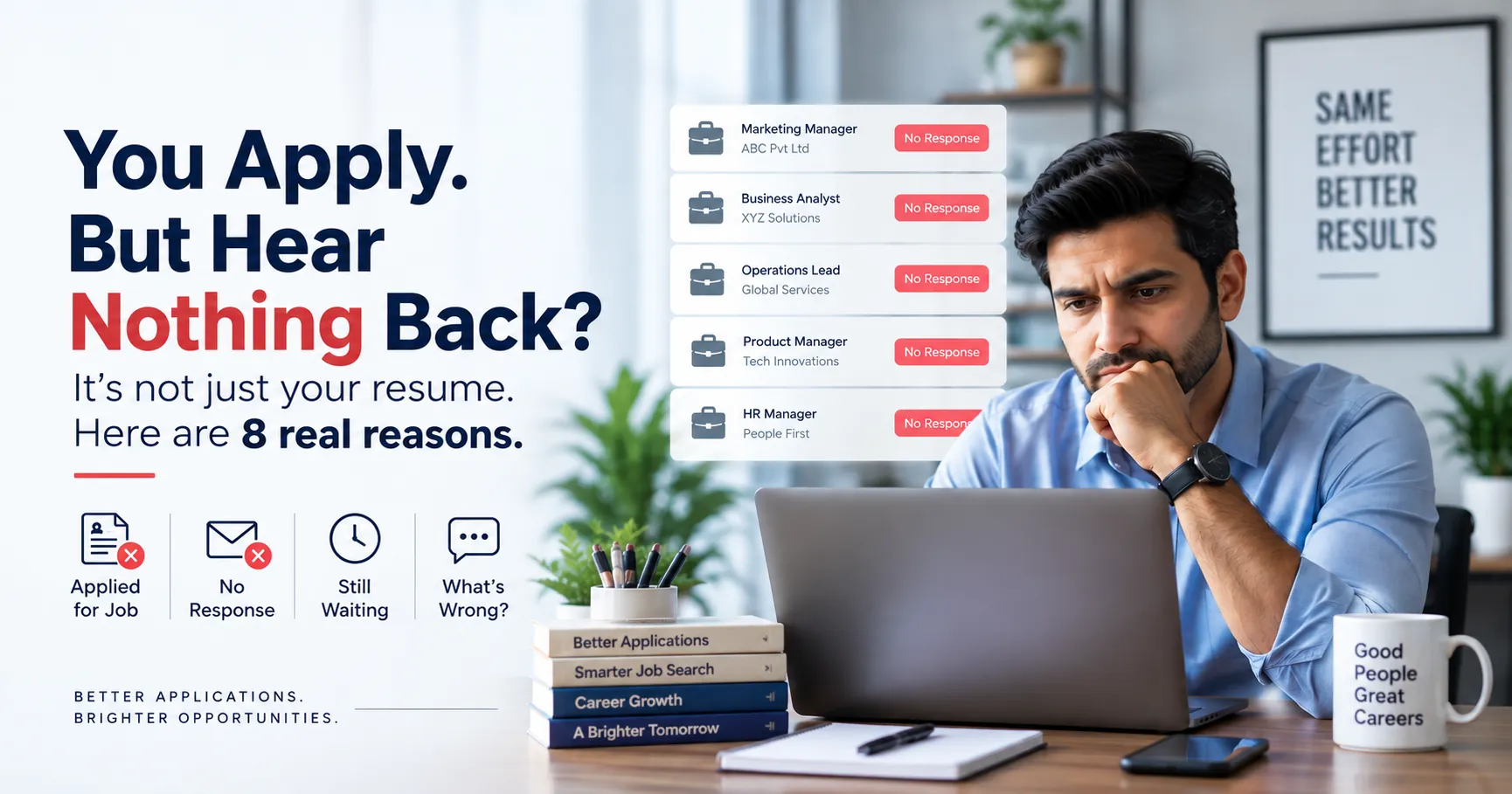
You apply for a job.
Your experience matches the description.
Your resume looks professional.
You submit the application.
And then… nothing.
No rejection.
No interview.
Sometimes, not even an acknowledgement.
After 20 or 30 applications, it is natural to start wondering:
“What am I doing wrong?”
But after years of recruitment, I can tell you something important:
Silence after a job application does not always mean you are not qualified.
Your resume may be perfectly reasonable, yet your overall job-search approach may still be reducing your chances of getting a response.
The problem can exist at several stages — from the jobs you choose to apply for, to how you position yourself, when you apply, what salary you expect and how visible you are to recruiters.
Here are 8 reasons your job applications may not be getting responses — beyond your resume.
1. You Are Applying to Too Many Jobs That Are Only “Somewhat Relevant”
One of the biggest mistakes I see is treating every vacancy that looks remotely suitable as an opportunity worth applying for.
A job description says:
“5–8 years of experience.”
You have 7 years.
So you apply.
But experience alone doesn't determine relevance.
The employer may actually be looking for someone with:
Specific industry experience
A particular functional background
Experience managing a certain type of team
Exposure to a particular market
Specific technical knowledge
Similar company or business-model experience
You may meet the experience requirement but still be a weak match.
Before applying, ask:
“If the recruiter receives 50 applications, why should mine be shortlisted?”
If you don't have a convincing answer, reconsider the application.
A smaller number of highly relevant applications can be more useful than sending hundreds of poorly matched ones.
2. You Are Applying at the Wrong Level
This is particularly common among experienced professionals.
For example, someone with 15 years of experience may apply for:
Manager
Senior Manager
General Manager
Head of Function
Consultant
all at the same time.
The problem is that each role may require a different positioning.
A candidate who has spent years leading a function may not be convincing for a role that is primarily individual-contributor based.
Similarly, someone with strong technical expertise may not automatically be suitable for a people-management position.
Your target role should make sense with your career story.
Ask yourself:
“Does this position represent a logical next step from where I am today?”
If the answer is unclear, recruiters may also struggle to understand your motivation.
3. You Are Applying Too Late
Job seekers often assume:
“If the vacancy is still online, I have the same chance as everyone else.”
Not necessarily.
A company may have already received a large number of applications.
A recruiter may already have identified several suitable candidates.
Interviews may already be underway.
The vacancy may remain online while the hiring process is progressing.
This doesn't mean you should never apply to an older vacancy.
It means you should not build your entire job search around vacancies that have already attracted significant competition.
A better approach:
When you find a role that genuinely matches your profile:
Review → Prepare → Apply → Follow up appropriately
rather than saving it for later and applying after dozens of other candidates have already entered the process.
4. Your Application Looks Like Everyone Else's
You don't necessarily need a completely different resume for every vacancy.
But your application should make it obvious that you understand the role.
Imagine a company is hiring a:
Regional Sales Head – Industrial Products
Your resume says:
Sales professional with extensive experience in business development, team management, customer relationships and revenue growth.
That's not wrong.
But it is generic.
Now imagine your opening profile highlights:
Sales leader with 12+ years of experience across industrial products, distributor networks and regional business development, with responsibility for revenue growth across North and West India.
The second version immediately establishes relevance.
The question isn't:
“Is my resume good?”
The better question is:
“Does my application make sense for this particular role?”
That distinction matters.
5. Your Salary Expectations May Be Creating a Mismatch
Salary can become a screening factor even before an interview.
Suppose a company has a compensation range of ₹18–22 lakh.
A candidate expects ₹30 lakh.
Even if the candidate is technically suitable, the recruiter may decide that the opportunity isn't practical.
The opposite can also create questions.
If a senior professional with significant experience quotes an unusually low expectation, the recruiter may wonder whether the candidate fully understands the role or market.
Salary isn't just about the number.
Recruiters may consider:
Current compensation
Expected compensation
Role level
Industry
Location
Company size
Candidate experience
Internal salary structure
That's why it is useful to understand the market before deciding what you want from your next move.
And remember:
Your expected salary should be defensible, not simply aspirational.
6. Your Location or Work Preferences Don't Match the Opportunity
This is becoming increasingly important.
A candidate may apply for a role in Mumbai while being unwilling to relocate.
Another may apply for a fully on-site position while only considering remote work.
Someone may apply for a role requiring frequent travel despite having no interest in travelling.
These aren't necessarily weaknesses.
They are practical mismatches.
A recruiter may therefore decide not to proceed even when the candidate's professional background is strong.
Before applying, check:
Location
Relocation requirements
Work model
Travel requirements
Shift timings
Joining timeline
Work eligibility
Notice period
Don't ignore these details simply because the job title looks attractive.
7. You Are Depending Entirely on Job Portals
Job portals are useful.
But they should not necessarily become your entire job-search strategy.
If your approach is:
Open portal → Search jobs → Apply → Repeat
you are competing primarily within the application pool.
There are other ways professionals become visible:
LinkedIn networking
Recruiter relationships
Employee referrals
Direct company applications
Professional communities
Industry events
Former colleagues
Alumni networks
Recruitment consultants
Direct conversations with relevant hiring professionals
This becomes increasingly important as you move into more senior positions.
A senior role may attract fewer public applications but require a much more targeted search.
Think beyond:
“Where can I apply?”
Also ask:
“Where can the right employer discover me?”
That changes the way you approach your job search.
8. You Are Measuring Effort by Applications Instead of Progress
This may be the biggest mistake of all.
You apply to:
10 jobs.
Then:
25 jobs.
Then:
50 jobs.
Then:
100 jobs.
And you conclude:
“The market is terrible.”
Maybe.
But there is another possibility:
Your job-search funnel has a problem.
Think of the process like this:
Relevant Jobs
↓
Applications
↓
Recruiter Review
↓
Interview
↓
Offer
If you are applying to 50 relevant positions but receiving no interviews, don't simply apply to another 50.
Stop and diagnose the problem.
Ask:
Are the jobs genuinely relevant?
Is my positioning clear?
Does my resume demonstrate the right experience?
Am I applying at the right level?
Are salary expectations realistic?
Is my LinkedIn profile consistent with my resume?
Am I using channels beyond job portals?
This is where a job search becomes a strategy rather than a routine.
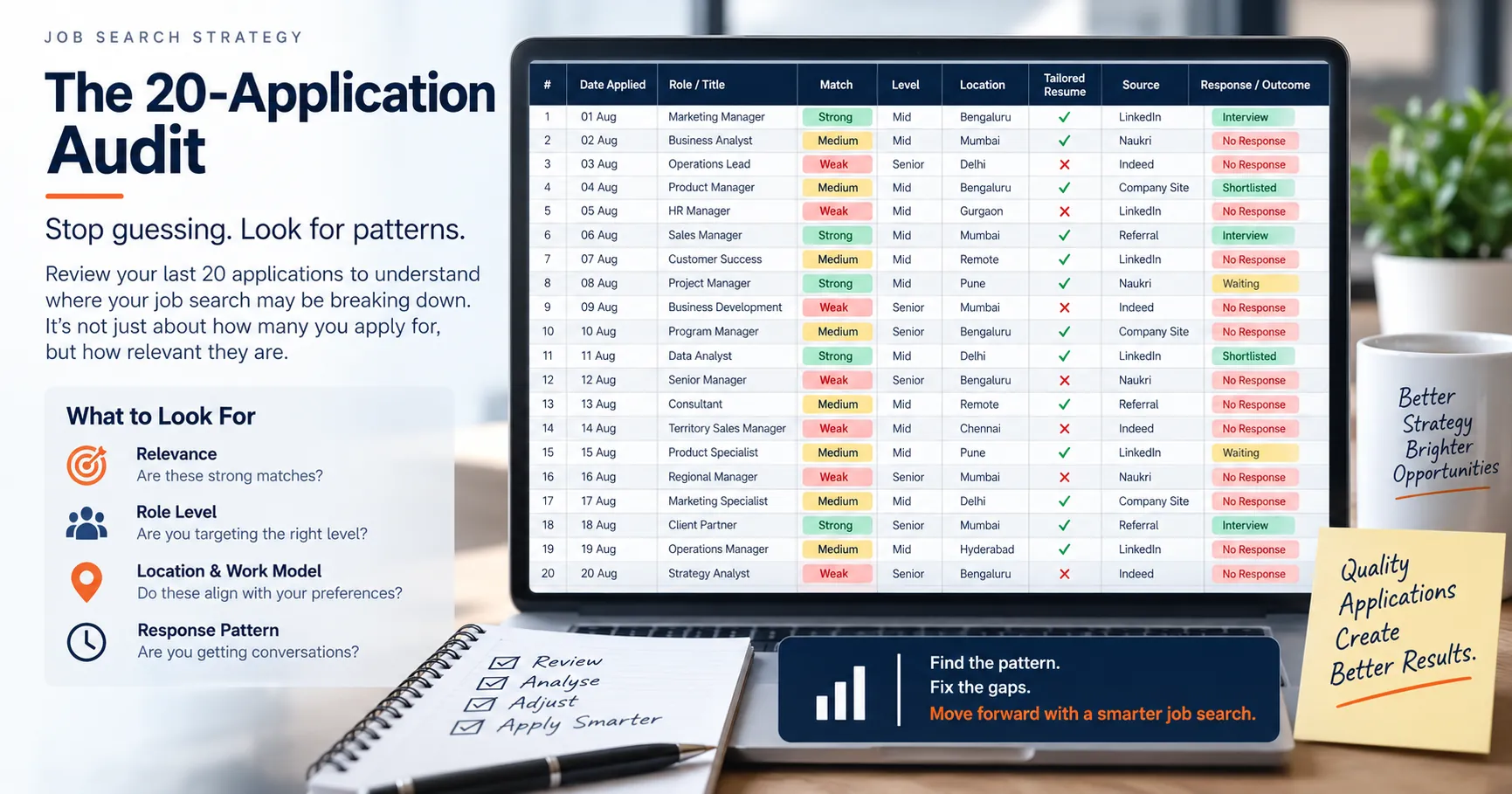
The 20-Application Audit
If you have been applying for jobs without getting meaningful responses, try this simple exercise.
Take your last 20 applications.
Create five columns:
QuestionYour ResultHow many were genuinely strong matches?How many matched your target role?How many matched your preferred salary range?How many matched your location/work preference?How many resulted in a recruiter conversation?
Then look for the pattern.
If most applications were weak matches:
Your targeting needs improvement.
If most were strong matches but there were no conversations:
Look closely at your positioning, resume, LinkedIn profile and application approach.
If you are getting conversations but no interviews:
Your screening or interview preparation may need attention.
If you are getting interviews but no offers:
The problem has moved further down the recruitment funnel.
This is much more useful than simply counting applications.
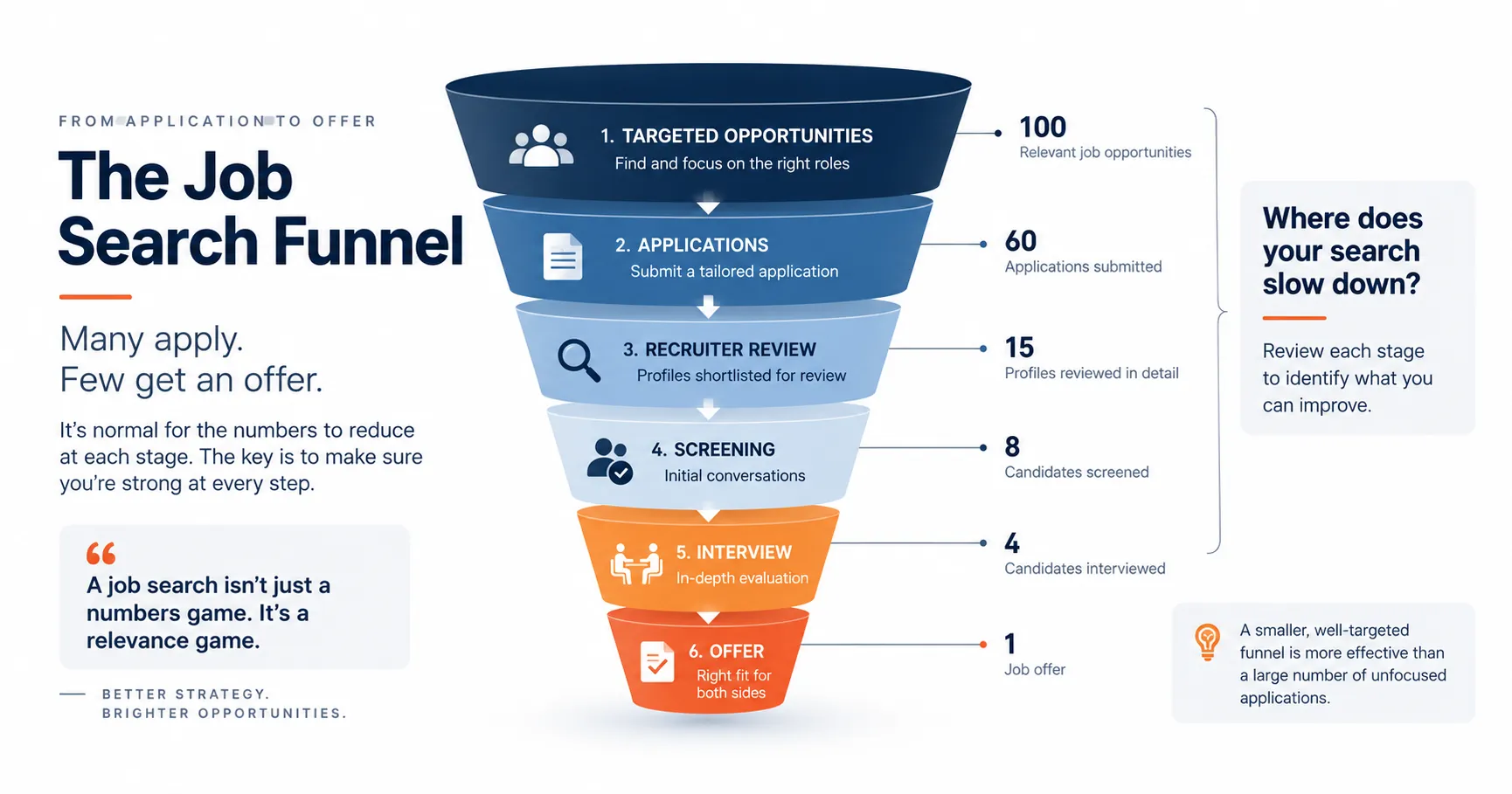
Your Job Search Is a Funnel
One of the easiest ways to understand what's happening is to think of your job search as a funnel.
Stage 1 — Targeting
Are you pursuing the right opportunities?
↓
Stage 2 — Application
Does your application clearly communicate relevance?
↓
Stage 3 — Recruiter Review
Can the recruiter quickly understand your background?
↓
Stage 4 — Screening
Can you explain your experience, motivation, salary expectations and career objectives?
↓
Stage 5 — Interview
Can you demonstrate your capability and fit?
↓
Stage 6 — Offer
Do the employer's expectations and your expectations align?
If your problem is at Stage 1, rewriting your resume may not solve it.
If your problem is at Stage 3, applying to more jobs may not solve it.
If your problem is at Stage 5, improving your interview preparation may be more useful.
The solution depends on where your funnel is breaking.
What Should You Do Now?
If your applications aren't getting responses, don't immediately conclude that your career profile is weak.
Instead, diagnose the situation.
Step 1: Define your target role
Be specific about the role, level, industry and location you want.
Step 2: Review your last 20 applications
Look for patterns instead of judging individual applications.
Step 3: Identify your strongest matches
Separate genuine opportunities from applications you submitted simply because you met the minimum experience requirement.
Step 4: Review your positioning
Your resume, LinkedIn profile and application should communicate a consistent professional identity.
Step 5: Check practical alignment
Review salary, location, work model, notice period and other requirements.
Step 6: Expand your search channels
Don't depend entirely on job portals.
Step 7: Measure conversations
Don't only track:
“How many jobs did I apply for?”
Also track:
“How many relevant recruiter conversations did I create?”
A Recruiter's Perspective
After years of recruitment, one thing becomes very clear:
Good candidates don't always get responses.
Recruitment is comparative.
A company may receive 60 applications.
Perhaps 15 candidates are qualified.
Maybe 8 have strong experience.
Perhaps 4 are closely aligned with the immediate requirement.
The recruiter has to decide which profiles should move forward.
So not being contacted doesn't necessarily mean:
“You aren't good enough.”
It may simply mean:
“Your profile wasn't the closest match for this particular requirement.”
That's an important distinction.
You should learn from repeated patterns, but you shouldn't allow every unanswered application to become a judgement about your career.
The Goal Is Not More Applications
The goal is better-targeted opportunities.
Instead of asking:
“How many jobs should I apply for every day?”
ask:
“Am I spending my time on opportunities where my experience has a genuine reason to stand out?”
That change in mindset can make your job search much more deliberate.
Your resume matters.
Your interview preparation matters.
Your LinkedIn profile matters.
But so do:
Targeting → Timing → Relevance → Positioning → Practical fit → Search strategy
Your next opportunity is not necessarily waiting for you at the end of another 100 applications.
It may come from 10 much better-targeted conversations.
Final Takeaway
If you're applying for jobs and hearing nothing back, don't immediately rewrite your resume or double the number of applications.
First ask:
Am I targeting the right jobs?
Am I applying at the right level?
Am I applying early enough?
Does my application clearly show relevance?
Are my salary and location expectations aligned?
Am I using enough channels to reach the right employers?
Where exactly is my job-search funnel breaking?
Once you identify the problem, you can work on the right solution.
Because a successful job search isn't simply about applying more.
It's about becoming easier to identify, easier to understand and easier to consider for the right opportunity.
Frequently Asked Questions
Why am I not getting responses to my job applications?
There can be several reasons. You may be applying to roles that aren't close enough to your experience, targeting the wrong level, applying late, having a salary or location mismatch, or relying too heavily on job portals. Your resume and positioning can also affect whether recruiters see your relevance quickly.
Why do recruiters not respond to job applications?
Recruiters may receive a large number of applications and prioritise candidates who most closely match the immediate requirements. Lack of response doesn't necessarily mean that you are unqualified.
Should I apply to more jobs if I am not getting responses?
Not automatically. First review your recent applications to determine whether the problem is targeting, positioning, resume relevance, practical fit or another stage of the hiring process.
How many jobs should I apply for each day?
There is no universal number. Application quality and relevance are generally more useful measures than simply counting applications. Focus on opportunities where your experience genuinely matches the employer's requirements.
Does applying early increase my chances?
Applying early can help you enter the recruitment process before an employer has reviewed a large pool of candidates, but it does not guarantee an interview. The relevance and quality of your application still matter.
Should I tailor my resume for every job?
You don't necessarily need to rewrite your entire resume for every application. However, your headline, summary, key skills and most relevant experience should clearly support the type of role you're targeting.
Should I use LinkedIn along with job portals?
Yes. LinkedIn, company career pages, referrals, recruiters, professional networks and direct applications can complement job portals and give you additional ways to become visible to employers.
What should I do if I have applied to many jobs without getting an interview?
Stop and audit your recent applications. Identify how many were strong matches, review your positioning and resume, check salary and location alignment, and examine whether you're using enough job-search channels. Then make changes based on the pattern you find.
When should I consider professional career support?
If you're repeatedly applying without knowing where your job search is breaking down, professional support can help diagnose your positioning, career direction, resume, interview preparation or overall search strategy. The appropriate support depends on the problem you're trying to solve.


