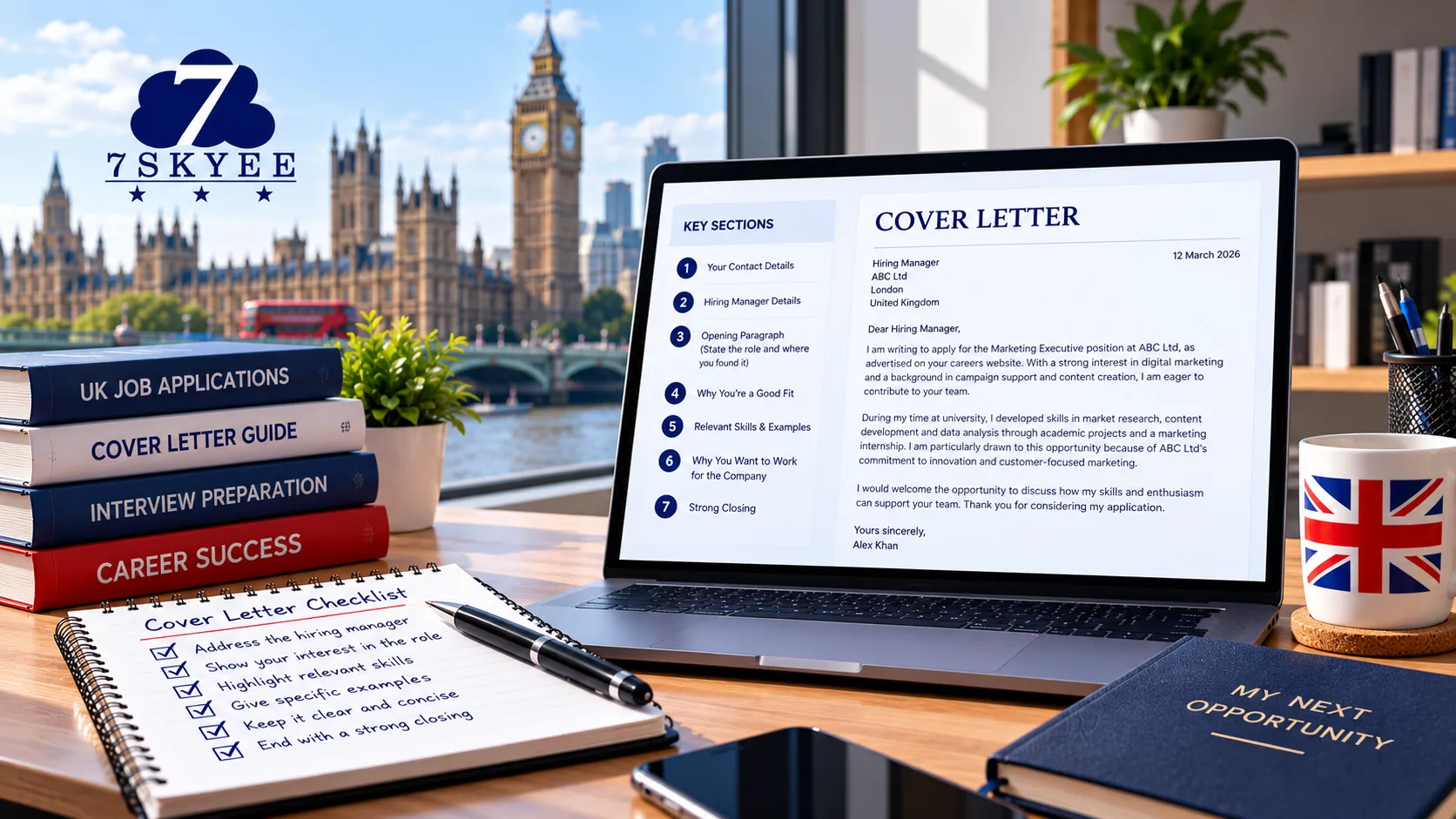
A well-written cover letter gives you an opportunity to explain why you are applying for a role and what makes you a suitable candidate.
Your CV presents your qualifications, skills and employment history. Your cover letter connects that information to the employer's requirements, showing how your experience relates to the position and why the opportunity interests you.
Not every UK vacancy requires a cover letter, so always follow the employer's application instructions. When one is requested—or the application process allows you to submit one—a tailored letter can help communicate your suitability more clearly.
This guide explains how to write a professional cover letter for UK jobs, with practical examples, a simple structure and advice for graduates, experienced professionals and career changers.
If you are preparing your CV at the same time, start with our guide to how to write a CV for jobs in the UK.
1. What Is a Cover Letter?
A cover letter is a short document submitted alongside your CV when applying for a job.
It typically explains:
Which role you are applying for
Why the opportunity interests you
Which relevant skills and experience you offer
How you could contribute to the organisation
Why the employer should consider your application
A cover letter should complement your CV rather than repeat it word for word.
Think of it as an opportunity to make a focused case for your suitability.
2. How Long Should a UK Cover Letter Be?
As a practical guideline, aim for around 250–400 words, unless the employer provides different instructions.
Your letter should be long enough to explain your motivation and provide relevant evidence, but short enough for a recruiter to scan quickly.
Use a few concise paragraphs, straightforward language and a professional tone.
Avoid lengthy introductions, unrelated personal information and repeated descriptions of responsibilities already covered in your CV.
3. What Is the Correct UK Cover Letter Format?
A professional cover letter usually follows this structure:
Your contact details
Date
Employer or hiring manager details, where available
Greeting
Opening paragraph
Relevant skills and evidence
Why you want to work for the organisation
Closing paragraph
Sign-off
If you are submitting your letter through an online application form or email, follow the employer's preferred format. You may not need to reproduce every address detail in a digital application.
Keep the layout consistent with your CV, and save the document in the format requested by the employer.
4. How to Start a Cover Letter
The opening paragraph should identify the role and establish your interest.
Avoid vague openings such as:
I am writing to apply for a suitable position in your esteemed organisation.
This does not identify the role or explain your interest.
A stronger opening is:
I am applying for the Marketing Executive position advertised on your careers website. My experience in content development, campaign coordination and market research has prepared me to contribute to your marketing team.
This immediately gives the reader useful context.
Where appropriate, mention a specific aspect of the role or organisation that genuinely interests you.
5. Explain Why You Are Suitable for the Role
The main body of your cover letter should connect your experience to the employer's requirements.
Review the job description and select two or three relevant strengths. Support them with examples rather than relying on broad claims.
For example, instead of writing:
I have excellent communication, leadership and organisational skills.
You could write:
In my current role, I coordinate work across several departments, manage competing deadlines and provide regular progress updates to stakeholders. This experience has strengthened my planning and communication skills, which are directly relevant to the requirements of this position.
Use genuine examples from employment, placements, volunteering, academic projects or other relevant activities.
For guidance on identifying the right evidence, read how to tailor your CV to a job description in the UK.
6. Show Why You Want to Work for the Employer
A good cover letter should explain why the particular opportunity interests you.
Avoid relying entirely on generic statements such as:
Your company is a leading organisation, and I would be delighted to join your team.
Instead, refer to something relevant that you have learned about the role or employer, such as:
The responsibilities of the position
The organisation's products or services
Its sector or customer base
A particular project or business priority
The opportunity to apply your experience in a relevant environment
For example:
I am particularly interested in this role because it combines customer insight with campaign planning. My experience analysing customer feedback and supporting marketing initiatives aligns closely with these responsibilities.
Only include details you have checked and can explain if asked.
7. How to End a Cover Letter
Your closing paragraph should reaffirm your interest and invite the employer to consider your application.
For example:
I would welcome the opportunity to discuss how my experience in project coordination and stakeholder management could contribute to your team. Thank you for considering my application.
Use an appropriate sign-off:
Yours sincerely — when addressing a named person by name.
Yours faithfully — when using a formal greeting such as “Dear Hiring Manager” or “Dear Sir or Madam”.
If the employer requests a different format or an online application does not require a formal sign-off, follow those instructions.
8. UK Cover Letter Example
The following example demonstrates how to structure a concise application. Replace the illustrative details with your own experience and the actual vacancy requirements.
Alex Khan London alex.khan@email.example
12 October 2026
Hiring Manager ABC Ltd
Dear Hiring Manager,
I am writing to apply for the Marketing Executive position advertised on your careers website. With experience supporting content development, campaign coordination and market research, I am interested in contributing to your marketing team's objectives.
In my recent experience, I have supported marketing activities, coordinated project deadlines and worked with colleagues to prepare content for different audiences. My academic projects have also helped me develop research, analytical and presentation skills. I would bring an organised approach, attention to detail and a willingness to learn to this position.
I am particularly interested in the opportunity to contribute to campaigns that combine customer understanding with clear communication. The responsibilities outlined in the vacancy closely match my interests and the skills I have been developing.
Thank you for considering my application. I would welcome the opportunity to discuss my suitability for the role.
Yours faithfully,
Alex Khan
This is an illustrative example, not a letter to submit unchanged. Make sure every statement reflects your actual background.
9. How to Write a Cover Letter With Limited Experience
If you are a graduate or applying for your first professional role, focus on relevant evidence rather than apologising for limited work experience.
You may be able to draw on:
University projects
Internships or placements
Part-time employment
Volunteering
Student society activities
Relevant coursework
Personal projects
For example:
Through my final-year research project, I developed skills in data analysis, research and presenting findings. I am keen to apply these capabilities in an entry-level business role while continuing to develop my professional experience.
For further guidance, see how to write a graduate CV in the UK.
10. How to Write a Cover Letter for a Career Change
When changing careers, explain the connection between your previous experience and the new role.
Focus on transferable skills, relevant training and evidence that you understand the responsibilities of the position.
For example:
My background in retail management has given me experience in team coordination, customer communication, performance monitoring and operational planning. I am now looking to apply these transferable skills in a project coordination role, supported by recent project management training.
Do not suggest that transferable experience replaces every technical qualification or requirement. Show how your existing skills align with the position and be transparent about relevant development still in progress.
Our guide to writing a CV for a career change in the UK explores this in more detail.
11. Should You Tailor Every Cover Letter?
Yes, where you choose or are required to submit a cover letter, tailor it to the vacancy.
You do not have to start from a blank page every time. You can use a consistent structure and adapt the relevant details.
Before sending your letter:
Confirm the correct job title.
Refer to the appropriate employer.
Identify the most relevant requirements.
Select specific examples from your experience.
Explain your interest in that opportunity.
Remove details that are unrelated to the vacancy.
A generic letter sent to multiple employers can weaken your application if it contains irrelevant details or fails to address the role.
12. Common Cover Letter Mistakes to Avoid
Repeating your CV: Use the letter to explain relevance rather than reproduce your employment history.
Using the wrong company or job title: Check the details carefully before submitting.
Making unsupported claims: Back up your strengths with genuine examples.
Writing too much: Keep the letter focused and readable.
Using an overly casual tone: Match the employer's context and maintain professional language.
Relying on generic praise: Explain why the actual role interests you.
Ignoring the application instructions: Follow the employer's requested format, length and submission method.
Sending the letter without proofreading: Check names, dates, grammar and spelling.
13. Cover Letter Checklist
Before submitting your application, confirm that:
I have used the correct job title and employer name.
My opening clearly states which role I am applying for.
I have explained why the opportunity interests me.
I have highlighted relevant skills and evidence.
My examples are accurate.
I have tailored the letter to the vacancy.
The letter complements rather than repeats my CV.
The tone is professional and natural.
I have checked spelling, grammar and formatting.
I have followed the employer's application instructions.
Final Thoughts
A strong cover letter helps employers understand why your experience is relevant to a particular opportunity. It should be clear, specific and focused on what you can contribute.
Use the job description to guide your message, provide evidence for your most important claims and explain your interest in the role. Whether you are a graduate, an experienced professional or changing careers, a tailored letter can strengthen your application when it is requested or appropriate.
For support presenting your experience consistently across your application, explore 7Skyee's professional UK CV writing service