
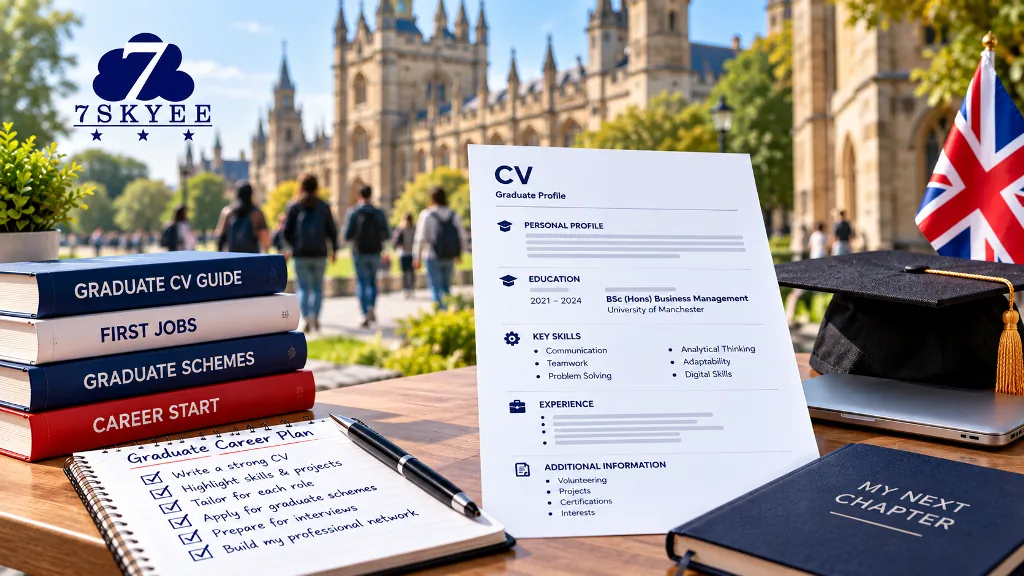
Writing your first graduate CV can feel challenging, particularly if you have limited paid work experience. You may be wondering what to include, how to present your degree and whether university projects, volunteering or part-time work are relevant.
The good news is that a graduate CV does not need years of employment history to make a strong impression.
Employers may also look for relevant knowledge, practical skills, evidence of initiative, communication and the ability to learn. Your task is to present the experience you genuinely have in a clear, professional and relevant way.
This guide explains how to write a graduate CV for UK jobs, including the personal profile, education, skills, projects, work experience and graduate scheme applications.
If you need an overview of the full document, start with our guide to how to write a CV for jobs in the UK.
1. What Should a Graduate CV Include?
A graduate CV will commonly include the following sections:
Contact details
Personal profile
Education and qualifications
Key skills
Work experience, internships or placements
University projects or relevant achievements
Volunteering, extracurricular activities or additional information, where relevant
You do not have to include every section if it adds little value. Choose the structure that best demonstrates your suitability for the role.
For example, a recent graduate applying for a technical position may place relevant projects and technical skills prominently. Someone applying for a graduate management scheme may emphasise leadership, teamwork, commercial awareness and university activities.
2. Start With the Right CV Structure
For most graduates, a clear, reverse-chronological CV is a practical choice. It makes your education and recent experience easy to follow.
If you have recently completed your degree and have limited employment history, place Education near the top, after your personal profile.
A simple structure could look like this:
Your Name Town or city | Professional email address | Telephone number | LinkedIn profile, if relevant
Personal Profile A short introduction explaining your degree, relevant capabilities and target role.
Education Degree, institution, dates and relevant details.
Key Skills Skills that match the vacancy.
Experience and Projects Internships, part-time employment, placements, university projects or relevant voluntary work.
Additional Information Relevant certifications, languages or professional activities.
Keep the layout consistent and easy to read. For advice on CV length, see how long a CV should be in the UK.
3. Write a Strong Graduate CV Personal Profile
Your personal profile introduces you to the recruiter. It should briefly explain your background, relevant strengths and career direction.
Avoid generic statements such as:
I am a hardworking and enthusiastic individual looking for a challenging opportunity in a reputed organisation.
This could describe almost any applicant.
Instead, mention your degree or field of study, relevant skills and the type of opportunity you are pursuing.
Example: Business Graduate
Business Management graduate with a strong foundation in business analysis, marketing and project coordination. Developed analytical, communication and teamwork skills through university projects and collaborative assignments. Seeking an entry-level business or operations role where I can contribute to team objectives while developing practical professional experience.
Example: Computer Science Graduate
Computer Science graduate with knowledge of programming fundamentals, database concepts and software development. Completed academic projects involving application development and problem-solving, with an interest in building reliable, user-focused technology solutions. Seeking an entry-level software development role to apply technical knowledge and continue learning.
Adapt the wording to your actual degree, skills and career objectives.
For more examples and guidance, read how to write a professional personal profile for a UK CV.
4. Present Your Education Effectively
Education is often one of the strongest sections of a graduate CV, especially when you have limited employment experience.
Include:
Degree or qualification
University or educational institution
Graduation year or expected completion date
Relevant modules, if useful for the role
Academic projects or dissertation, where relevant
Academic achievements, if they strengthen your application
For example:
BSc (Hons) Computer Science University of Example | 2022–2025
Relevant modules: Software Engineering, Database Systems and Data Analytics.
Final-year project: Developed a web-based application to manage appointments and user records.
Applied programming, testing and documentation skills throughout the project.
Only include modules and projects that are relevant to the opportunity. You generally do not need a long list of every subject studied.
If you have substantial professional experience from placements or employment, your experience may eventually deserve more space than your academic details.
5. Include University Projects and Practical Work
You can demonstrate professional capabilities without having held a full-time job.
University projects, dissertations, group assignments and practical coursework can provide useful evidence of your skills.
Describe each project in terms of:
Its purpose
Your specific contribution
The tools or methods you used
The outcome or what you learned
For example:
Market Research Project | University Assignment
Analysed customer survey responses to identify purchasing trends.
Used Excel to organise data and present findings.
Collaborated with a four-member team to prepare recommendations for a simulated business case.
This gives the recruiter more information than simply listing “research”, “Excel” and “teamwork”.
Make sure you distinguish academic work from paid professional experience.
6. Choose the Right Skills for Your Graduate CV
Employers value different skills depending on the role.
Common transferable skills include:
Written and verbal communication
Teamwork
Problem-solving
Planning and organisation
Time management
Research and analysis
Adaptability
Presentation skills
You may also need role-specific skills, such as programming, financial analysis, laboratory techniques, digital marketing or particular software.
Review the vacancy before deciding what to include.
For example, a graduate data analyst application may prioritise Excel, SQL, data interpretation and analytical thinking. A graduate HR application may place greater emphasis on communication, organisation, confidentiality and people-related knowledge.
Only list skills you can explain or demonstrate.
Our guide to writing a CV skills section for UK jobs explains how to select and present relevant capabilities.
7. Include Internships, Placements and Part-Time Jobs
Do not overlook part-time work simply because it is not directly related to your degree or target profession.
A retail, hospitality or customer service role may demonstrate reliability, communication, teamwork, time management and customer handling.
For example:
Customer Assistant | Example Retailer June 2024–September 2024
Assisted customers with product enquiries and resolved routine service issues.
Worked collaboratively with colleagues during busy trading periods.
Followed store procedures and supported accurate stock handling.
Where possible, prioritise the responsibilities most relevant to your target job.
If you completed an internship or placement related to your chosen career, give it more prominence and describe the tasks you performed.
8. How to Write a Graduate CV With No Work Experience
If you have never held a paid job, you can still prepare a credible CV.
Focus on relevant evidence from:
University assignments
Personal projects
Volunteering
Student societies
Sports or team activities
Short courses
Relevant technical practice
Responsibilities in community or student organisations
For example, organising a university event may demonstrate planning, coordination and communication. Developing a personal website may demonstrate technical initiative and practical problem-solving.
The key is to explain what you actually did, rather than relying on broad claims about your personality.
Avoid creating an employment section filled with activities that did not happen. Label projects, volunteering and training accurately.
9. Tailor Your CV to Each Graduate Job
Graduate applications can attract candidates with similar qualifications. Tailoring your CV helps make the most relevant parts of your background easier to identify.
Before applying:
Read the job description carefully.
Identify essential qualifications and skills.
Review the employer's responsibilities and expectations.
Prioritise relevant modules, projects and experience.
Adjust your profile and skills section where appropriate.
Check that your examples support your claims.
For instance, a graduate marketing role may call for campaign experience, research and content creation. A graduate operations role may place greater emphasis on process improvement, planning and data analysis.
You do not need to rewrite your entire CV for every application. You need to make sure the most relevant evidence is prominent.
Read our guide to tailoring your CV to a job description in the UK.
10. Make Your Graduate CV ATS-Friendly
Some employers use applicant tracking systems (ATS) to manage applications. Their systems and processes vary, so no particular format can guarantee shortlisting.
To help keep your CV readable:
Use clear headings such as Education, Skills and Experience.
Choose a simple, consistent layout.
Include relevant terminology from the vacancy where accurate.
Avoid putting essential information solely in images or graphics.
Use standard bullet points.
Check that dates, qualifications and contact details are clear.
Follow the employer's requested file format.
A polished CV should work for the recruitment process while remaining easy for a person to scan.
For more detail, read how to make your CV ATS-friendly for UK jobs.
11. Common Graduate CV Mistakes
Avoid these common problems:
Writing a generic personal profile: Explain your actual background and target role.
Listing skills without examples: Use projects, placements or activities to provide evidence.
Including irrelevant detail: Prioritise information that supports the vacancy.
Overstating experience: Present academic projects and training honestly.
Using complicated formatting: Clear presentation is more important than decorative design.
Ignoring spelling and grammar: Proofread your CV before submitting it.
Sending the same CV for every role: Review the job description and adjust your emphasis.
You can find more practical guidance in CV mistakes UK recruiters notice first.
12. Graduate CV Checklist
Before submitting an application, check that:
My contact details are accurate and professional.
My profile reflects my degree and career direction.
My education and qualifications are clearly presented.
Relevant modules and projects are included where useful.
My skills match the vacancy.
Internships, placements and part-time work are described accurately.
I have included relevant achievements or practical evidence.
My CV is tailored to the position.
The layout is clear and readable.
I have checked spelling, grammar and dates.
I have followed the employer's application instructions.
Final Thoughts
A graduate CV should not attempt to make you appear more experienced than you are. It should make the most of the experience, knowledge and potential you genuinely bring.
Present your education clearly, explain relevant projects, highlight transferable skills and tailor your application to the opportunity. Even without extensive employment history, you can create a professional CV that gives employers a clear reason to consider your application.
If you would like help positioning your qualifications and experience, explore 7Skyee's professional UK CV writing service