
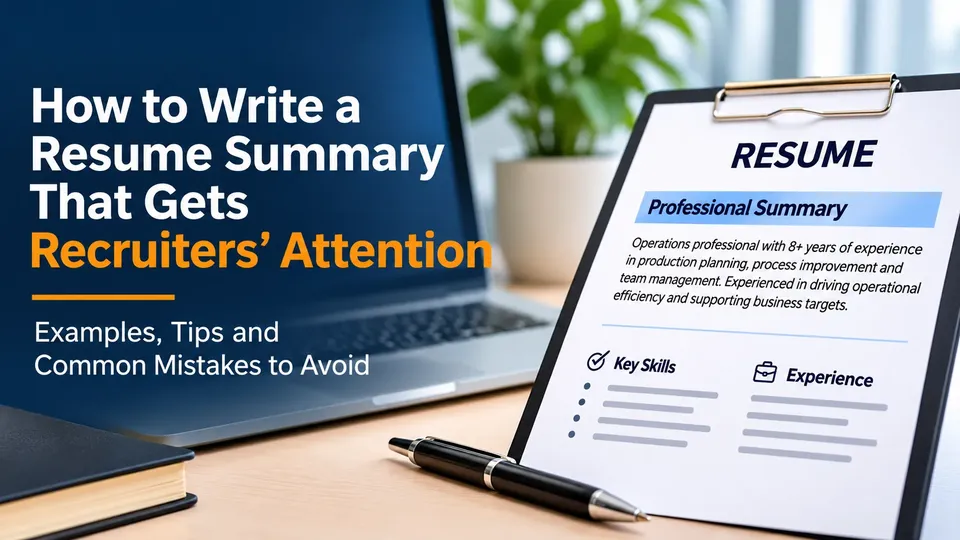
A resume summary is one of the first sections recruiters notice when reviewing a candidate's resume. It appears near the top of the document and provides a brief introduction to the candidate's professional background, key strengths and career value.
Yet many candidates either leave this section blank or fill it with generic statements that do little to distinguish them from other applicants.
Phrases such as "hardworking professional", "self-motivated individual" or "seeking a challenging opportunity" are common, but they rarely communicate what a candidate can actually contribute to an organisation.
A strong resume summary should answer three important questions:
Who are you professionally?
What relevant experience, expertise or achievements do you bring?
What value can you offer a potential employer?
Whether you are a fresher, an experienced professional or a senior manager, learning how to write an effective resume summary can improve how your professional profile is presented.
What Is a Resume Summary?
A resume summary is a short professional introduction placed below your name and contact information.
It highlights your experience, relevant skills, industry knowledge and significant achievements. Its purpose is to help recruiters quickly understand your professional background before they review the rest of your resume.
A good resume summary is:
Relevant to the position you are targeting.
Clear and concise.
Based on your actual experience.
Focused on professional strengths and achievements.
Written in professional, natural language.
Generally, a resume summary can be approximately three to five lines, depending on the candidate's experience and the complexity of the role.
It should not repeat the entire employment history or become a lengthy career autobiography.
Why Is a Strong Resume Summary Important?
Recruiters review applications to identify candidates whose experience and capabilities match the requirements of a vacancy.
A well-written summary helps establish that connection quickly.
1. Creates a Clear First Impression
Your summary introduces your professional identity before the recruiter reaches your employment history.
For example, describing yourself as an experienced finance professional with expertise in financial planning, budgeting and business reporting communicates more than simply writing "Finance Professional".
2. Highlights Your Relevant Experience
Candidates with several years of experience may have worked across multiple organisations and responsibilities.
A summary helps bring the most relevant parts of that experience together.
3. Establishes Your Professional Positioning
The summary should reflect the type of professional opportunity you are pursuing.
An Operations Manager, HR Business Partner, Software Engineer and Sales Director should not use the same generic introduction.
4. Supports Resume Relevance
Including appropriate terminology related to your profession and target role can help communicate your suitability.
However, keywords should be used naturally and accurately. Repeating job-description terms without demonstrating relevant experience does not create a strong resume.
How to Write an Effective Resume Summary
Use the following approach when preparing your professional summary.
Step 1: Identify Your Professional Identity
Start by defining your current professional position.
Examples include:
Human Resources Professional
Finance and Accounts Manager
Supply Chain Professional
Software Engineer
Marketing Specialist
Operations Manager
Choose a description that accurately reflects your background and the opportunity you are targeting.
Step 2: Mention Your Relevant Experience
Include your years of experience where they strengthen your professional positioning.
For example:
"Human Resources professional with 8 years of experience in talent acquisition, employee engagement and HR operations."
Avoid mentioning years of experience simply to fill space. The information should support your professional profile.
Step 3: Highlight Your Core Expertise
Select three to five relevant areas of expertise.
For example, an Operations Manager might highlight:
Production planning
Process improvement
Team management
Operational efficiency
Quality management
Prioritise skills that are relevant to the target position.
Step 4: Include Significant Achievements
A resume summary becomes more meaningful when it communicates professional contributions.
Where accurate information is available, include achievements such as:
Improved operational efficiency.
Managed large teams or business functions.
Delivered significant projects.
Increased sales or customer retention.
Reduced costs or process inefficiencies.
Use measurable results where possible, but never invent numbers or achievements.
Step 5: Align the Summary With the Target Role
A resume summary should not remain identical for every job application.
Review the job description and identify the experience and capabilities most relevant to the position.
Then adjust the emphasis of your summary without misrepresenting your background.
Resume Summary Examples for Different Career Stages
The following examples illustrate how the approach changes according to professional experience.
Resume Summary for Freshers
Freshers may not have extensive employment experience. Their summaries should focus on education, relevant skills, internships, projects and career interests.
Example:
"Recent graduate in Business Administration with a foundation in marketing, business communication and market research. Experienced in academic projects involving consumer behaviour and business analysis. Seeking an entry-level opportunity to apply analytical and communication skills while developing professional expertise."
What makes this effective?
It communicates educational background, relevant knowledge and career direction without pretending the candidate has extensive professional experience.
Resume Summary for Professionals With 3–5 Years of Experience
Example:
"Marketing professional with 4 years of experience in digital marketing, campaign coordination, content planning and performance analysis. Experienced in supporting multi-channel campaigns, monitoring engagement metrics and coordinating marketing initiatives. Strong understanding of digital platforms and data-driven marketing activities."
What makes this effective?
It identifies the professional area, experience level and relevant capabilities.
Resume Summary for Professionals With 5–10 Years of Experience
Example:
"Human Resources professional with 8 years of experience across talent acquisition, HR operations, employee engagement and workforce planning. Experienced in managing recruitment processes, coordinating with business stakeholders and supporting HR initiatives across organisational functions. Strong understanding of recruitment delivery and employee lifecycle management."
What makes this effective?
It presents a broader professional profile while highlighting the candidate's functional expertise.
Resume Summary for Managers
Example:
"Operations Manager with 12 years of experience in manufacturing operations, production planning, process improvement and team leadership. Experienced in managing operational performance, coordinating cross-functional teams and implementing process improvements to support productivity, quality and delivery objectives."
What makes this effective?
It communicates leadership responsibilities and operational expertise rather than simply listing routine duties.
Resume Summary for Senior Executives
Example:
"Senior business leader with extensive experience in strategic planning, business operations, organisational development and financial performance management. Experienced in leading cross-functional teams, managing complex business priorities and driving organisational initiatives aligned with long-term business objectives."
What makes this effective?
It establishes a leadership-oriented professional identity and focuses on strategic responsibilities.
Candidates should personalise this example with their actual industry, business scale and measurable accomplishments.
Common Resume Summary Mistakes to Avoid
Even experienced professionals sometimes weaken their resumes through unnecessary or generic language.
Using Generic Statements
Avoid descriptions such as:
Hardworking and dedicated individual.
Quick learner and team player.
Looking for a challenging position.
Seeking an opportunity to grow professionally.
These statements do not explain your specific professional value.
Writing an Extremely Long Summary
A resume summary should introduce your professional background, not repeat every responsibility from your employment history.
Keep it focused on the information most relevant to your target position.
Listing Too Many Skills
Including a long list of unrelated skills makes it difficult to identify your strongest capabilities.
Select the skills that genuinely support your target role.
Making Unsupported Claims
Statements such as "best performer", "industry expert" or "highly successful leader" should be supported by relevant experience or achievements.
Professional credibility is more valuable than exaggerated language.
Using the Same Summary for Every Application
A generic summary may not adequately communicate your suitability for different positions.
Make appropriate adjustments according to the role and employer requirements.
Resume Summary vs Resume Objective: What Is the Difference?
These two sections serve different purposes.
Resume SummaryResume ObjectiveFocuses on existing professional experienceFocuses on career directionHighlights expertise and achievementsExplains professional interests and goalsCommonly useful for experienced professionalsCan be useful for freshers and career changersCommunicates professional valueCommunicates intended career direction
For candidates with established professional experience, a summary is generally more useful because it provides evidence of their capabilities.
Freshers and career changers may benefit from a carefully written objective or a summary that explains their transferable skills and career direction.
How to Make Your Resume Summary ATS-Friendly
An effective summary should be readable by both recruitment systems and human reviewers.
Consider these practices:
Use a clear heading such as "Professional Summary".
Include relevant terminology from the target job description.
Avoid excessive abbreviations or unexplained technical terms.
Use natural sentences instead of unnecessary keyword repetition.
Keep the formatting simple and consistent.
Ensure that all information accurately reflects your background.
Remember that ATS compatibility is not determined by the summary alone. The overall resume structure, formatting, content and relevance also matter.
Should You Get Professional Help With Your Resume Summary?
Writing a professional summary can be challenging because candidates are often too close to their own work experience to identify which details matter most.
A professional review can help identify:
Which achievements deserve greater visibility.
Which skills are most relevant to the target position.
Whether the summary communicates a clear professional identity.
Whether the language is specific and credible.
Whether the content supports the candidate's career objectives.
If your current resume does not effectively communicate your professional value, consider exploring 7Skyee Professional Resume Writing Services.
The service focuses on presenting professional experience, achievements and career capabilities in a structured, recruiter-oriented resume.
You can also review the available resume writing packages and pricing to understand the support available.
Frequently Asked Questions
How long should a resume summary be?
A resume summary is generally around three to five lines. The appropriate length depends on your experience, professional background and the position you are targeting.
Should freshers include a resume summary?
Yes. Freshers can use a summary to communicate their educational background, relevant skills, internships, academic projects and career interests.
Should I include years of experience in my resume summary?
You can include your years of experience when they strengthen your professional positioning and are relevant to the target role.
Is a resume summary better than a career objective?
For experienced professionals, a resume summary is generally more effective because it highlights existing expertise and achievements. A career objective may be useful for freshers and candidates making a career transition.
Should I customise my resume summary for every job?
It is advisable to adjust your summary for relevant opportunities. Highlight the experience and skills that match the position without changing or exaggerating your actual background.
Can I use ChatGPT to write my resume summary?
AI tools can help organise information and prepare an initial draft. However, the final summary should be reviewed carefully to ensure that it accurately represents your experience, achievements and career goals.
Final Thoughts
Your resume summary should communicate your professional identity and establish why your experience is relevant to the opportunity you are pursuing.
Instead of relying on generic statements, focus on relevant expertise, meaningful achievements and a clear professional direction.
Whether you are starting your career, moving into management or pursuing a senior leadership position, a well-written summary can make your resume more focused and easier for recruiters to understand.
If you need help presenting your experience more effectively, explore 7Skyee Resume Writing Services and review the available packages.