
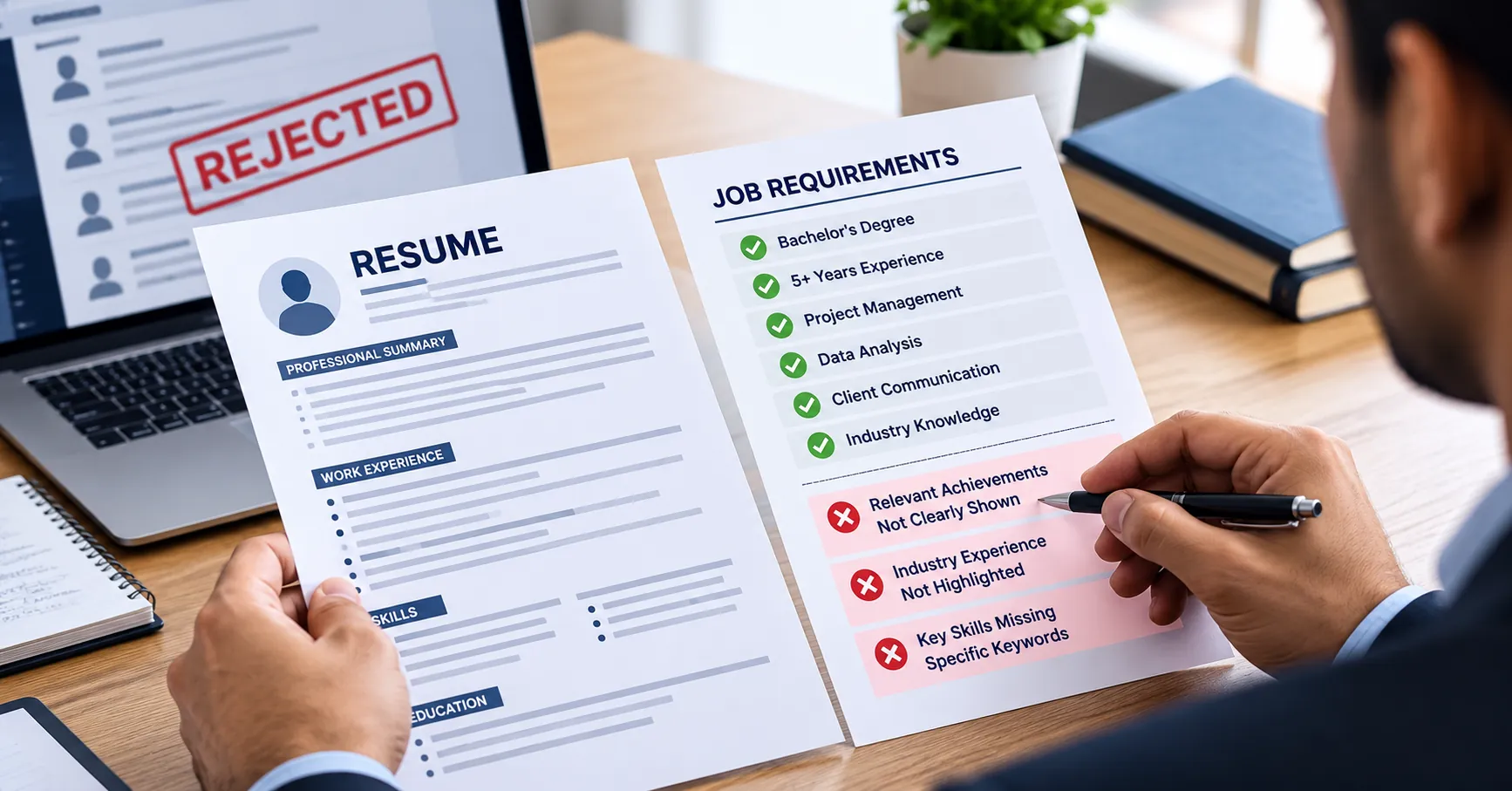
You can meet the education requirement.
You can have the required years of experience.
You can have most of the skills listed in the job description.
And your resume can still be rejected.
This is one of the most frustrating situations for experienced professionals.
You read the job description and think:
“I can actually do this job. Why am I not getting shortlisted?”
In recruitment, I see this situation regularly.
The problem is not always a lack of qualification.
Sometimes, the problem is that your resume does not make your relevance obvious enough.
A recruiter may have only a limited amount of time to decide whether a candidate deserves a closer look. If the connection between your background and the role is difficult to identify, another candidate whose relevance is easier to understand may move forward.
That does not necessarily mean that candidate is more qualified.
It means their resume communicated the fit more clearly.
The Difference Between Being Qualified and Looking Relevant
These two things are related, but they are not the same.
Imagine a company is hiring a Regional Sales Manager.
The job requires:
8+ years of sales experience
B2B sales
team management
channel development
revenue responsibility
experience across multiple territories
You have all of these.
But your resume says:
Sales professional with 10 years of experience handling customers and business development activities.
Technically, you may meet the requirement.
But the recruiter still has questions.
Did you manage a team?
Did you own revenue?
Did you manage multiple territories?
Did you handle channels?
Did you work in B2B?
What size of business were you responsible for?
Your experience may contain the answers.
Your resume simply hasn't made them visible.
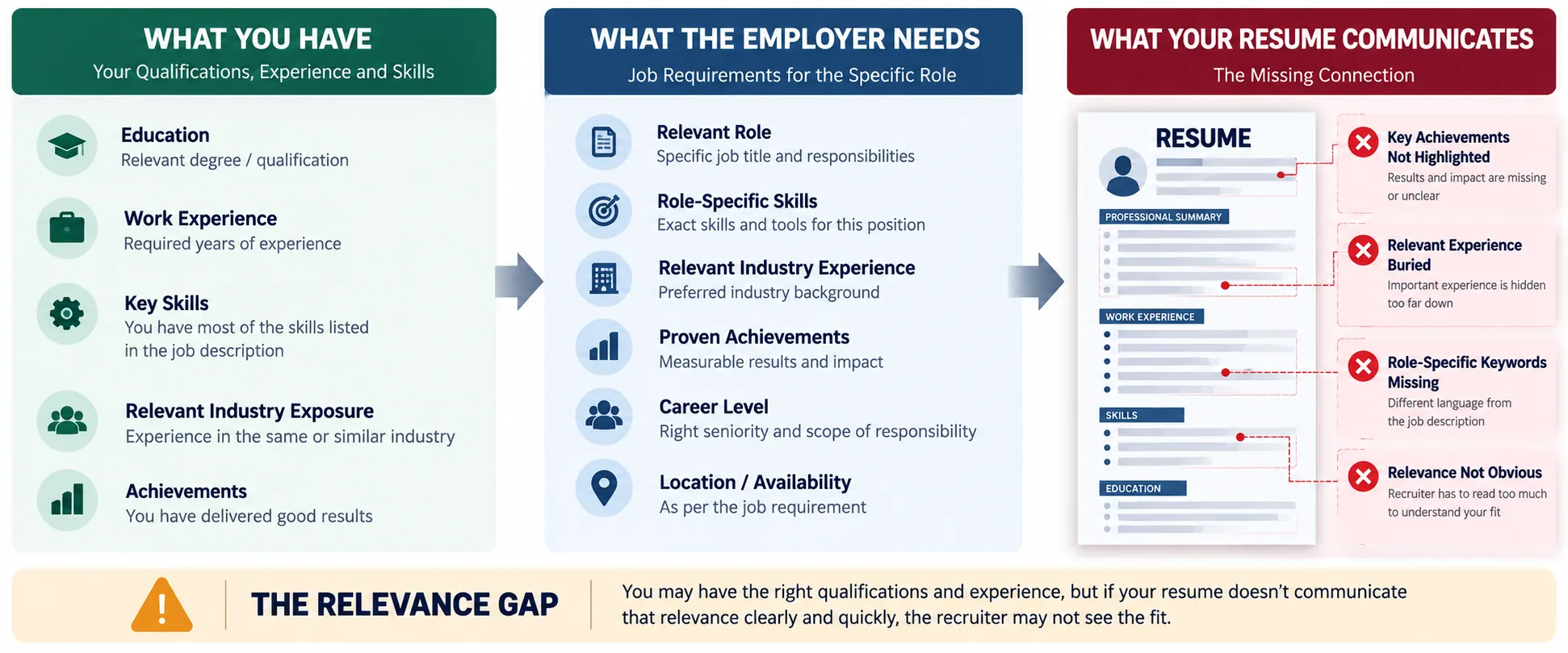
That is the relevance gap.
1. Your Resume Describes Your Career — But Not the Job You're Applying For
One of the most common problems I see is a resume that reads like a career history rather than a targeted application.
It tells me:
“This is everything I have done.”
But the recruiter is asking:
“Which parts of this experience are relevant to this particular vacancy?”
Those are two different questions.
A strong resume doesn't need to hide your broader experience. It needs to prioritize the experience that matters most for the role you're applying for.
For example, suppose you're applying for a Head of Operations position.
Your resume may contain:
vendor management
procurement
logistics
cost control
team management
process improvement
reporting
customer coordination
All of these may be legitimate parts of your career.
But if the vacancy is heavily focused on:
operations leadership + cost reduction + multi-location management, those elements should be immediately visible.
The recruiter should not have to search through five pages to find them.
2. Your Job Title Doesn't Match — Even Though Your Work Does
This is particularly common with experienced professionals.
Companies use different titles for similar responsibilities.
One organization may call someone:
Business Development Manager
while another uses:
Sales Manager
and another uses:
Regional Business Manager.
The actual responsibilities can overlap significantly.
The problem occurs when your resume relies too heavily on your internal job title and doesn't explain what you actually did.
Instead of simply writing:
Assistant General Manager
your resume might need to explain the functional scope:
Assistant General Manager – Sales & Business Development
Managed regional sales, distributor relationships, revenue targets and key-account growth across North India.
The objective isn't to change your official designation.
Never misrepresent your job title.
The objective is to make the functional relevance easier to understand.
3. Your Most Relevant Experience Is Buried Too Far Down
Recruiters don't necessarily read every resume from top to bottom on the first review.
The first part of your resume therefore matters.
If the job requires:
B2B sales + team leadership + key accounts
and your opening summary spends most of its space discussing:
general communication skills
hardworking attitude
career objectives
broad industry experience
you've used valuable space without answering the recruiter's main question.
A better opening might immediately establish:
Sales and business development professional with 11+ years of B2B experience, including regional revenue responsibility, key-account management and team leadership across North India.
Now the recruiter has context.
The rest of the resume can provide evidence.
4. You Have the Skill — But You Don't Show Evidence
This is another major difference between a qualification and a convincing resume.
Compare these two statements.
Weak
Experienced in team management.
Stronger
Led a 14-member sales team across three territories, managing monthly targets, key accounts and performance reviews.
The second statement gives the recruiter something to evaluate.
Whenever possible, connect skills with:
scale
responsibility
outcome
numbers
scope
business impact
For example:
Managed procurement operations.
is less informative than:
Managed procurement across 5 locations and negotiated vendor contracts contributing to a 9% reduction in annual procurement costs.
Not every achievement will have a convenient percentage.
That's fine.
You can also show:
team size
revenue responsibility
territory
number of clients
number of locations
portfolio size
projects
reporting responsibility
operational scale
The point is to give your experience context.
5. Your Resume Uses Different Language From the Job Description
This is where ATS and recruiter screening can intersect.
If the job description repeatedly uses terms such as:
Key Account Management
Channel Sales
Revenue Growth
Distributor Management
but your resume uses completely different language, the connection may be less obvious.
That doesn't mean you should copy the job description.
It means you should use accurate terminology that genuinely describes your experience.
Current career guidance also emphasizes tailoring resumes to the specific job description and using relevant keywords naturally rather than relying on a generic resume for every application.
For example:
Job description:
Manage key accounts and develop new B2B business.
Your experience:
Managed enterprise clients and developed new institutional accounts.
If your experience genuinely includes key-account management, you can make that connection clearer:
Managed key B2B accounts and developed new institutional business across the assigned territory.
The important principle is:
Match the language where it is truthful. Don't add keywords simply because they appear in the vacancy.
ATS guidance also stresses that keywords should genuinely reflect your skills and experience.
6. Your Resume Contains Too Much Irrelevant Experience
More experience does not automatically make a resume stronger.
For a professional with 15 or 20 years of experience, this becomes particularly important.
You may have done dozens of things during your career.
The question isn't:
“Can I include everything?”
The better question is:
“Does this help demonstrate that I am relevant to the role I'm applying for?”
Suppose you're applying for:
HR Head
and your resume contains extensive detail about a role you held 15 years ago in administration.
That information may be legitimate.
But if your recent career includes:
talent acquisition
employee relations
HR strategy
leadership
compliance
HR technology
those areas deserve much more attention.
Your resume should help the recruiter understand your current professional value, not simply document every responsibility you've ever had.
7. Your Achievements Are Hidden Behind Responsibilities
Recruiters need to understand not only what you were responsible for, but what you actually accomplished.
Compare:
Responsible for increasing sales in the region.
with:
Grew regional revenue by 18% over two years by expanding distributor coverage and developing strategic B2B accounts.
The second version gives the reader something concrete.
This is why measurable achievements are valuable when they are genuine and verifiable. Resume guidance also recommends quantifying accomplishments rather than relying entirely on generic responsibility statements.
Look through your experience and ask:
What changed because I was in this role?
Did you:
increase revenue?
reduce costs?
improve productivity?
increase customer retention?
expand a territory?
build a team?
launch a product?
reduce turnaround time?
improve processes?
win major accounts?
Those answers can make your experience much easier to evaluate.
8. Your Career Level and the Job Level Don't Match Clearly
Sometimes the problem isn't whether you have enough experience.
It's whether the recruiter can understand where you fit in the organizational hierarchy.
Consider a job advertised as:
Senior Manager – Supply Chain
Your resume lists:
Executive – Logistics
Manager – Procurement
Senior Manager – Operations
The recruiter now has to work out the progression and determine whether your current scope matches the position.
A clear career progression can help:
Executive → Assistant Manager → Manager → Senior Manager
And your responsibilities should demonstrate increasing scope.
For senior professionals, this becomes especially important.
A senior title without evidence of senior-level responsibility can create uncertainty.
Likewise, someone with substantial leadership experience can undersell themselves by presenting their resume like an individual contributor profile.
9. Your Resume Is Too Generic for the Number of Jobs You're Applying To
A single master resume is useful.
But it doesn't necessarily need to be the exact document you submit for every application.
Think of your master resume as your career database.
It contains:
achievements
skills
projects
responsibilities
qualifications
industry experience
Your application resume should then emphasize the parts most relevant to the particular opportunity.
This does not mean rewriting your entire resume every time.
It may mean adjusting:
headline
summary
core skills
order of achievements
relevant experience bullets
keywords
selected projects
A targeted resume helps the recruiter see the connection between your background and the vacancy more quickly.
10. Your Resume Makes the Recruiter Work Too Hard
This is perhaps the simplest way to think about the entire problem.
Imagine a recruiter receives 50 resumes for a position.
Your experience may genuinely be suitable.
But if the recruiter has to spend several minutes figuring out:
what you actually do
which industry you worked in
whether your experience is relevant
what level you operate at
what results you've delivered
your resume isn't doing enough of the communication for you.
A good resume should answer those questions quickly.
Not because recruiters don't care.
Because clarity matters when someone is reviewing many applications.
The Qualification-Relevance Gap
Here's the concept I want job seekers to remember:
Qualification answers:
Can you potentially do this job?
Relevance answers:
Have you done enough of the things this job requires for me to consider you further?
Your resume needs to communicate the second question.
You may have:
10 years of sales experience
but the recruiter needs to know:
10 years of what kind of sales?
You may have:
team management experience
but the recruiter needs to know:
How many people? What type of team? What responsibility?
You may have:
industry experience
but the recruiter needs to know:
Which part of the industry and how closely does it relate to this position?
That is why simply meeting the requirements isn't always enough.
A Simple Resume Relevance Test
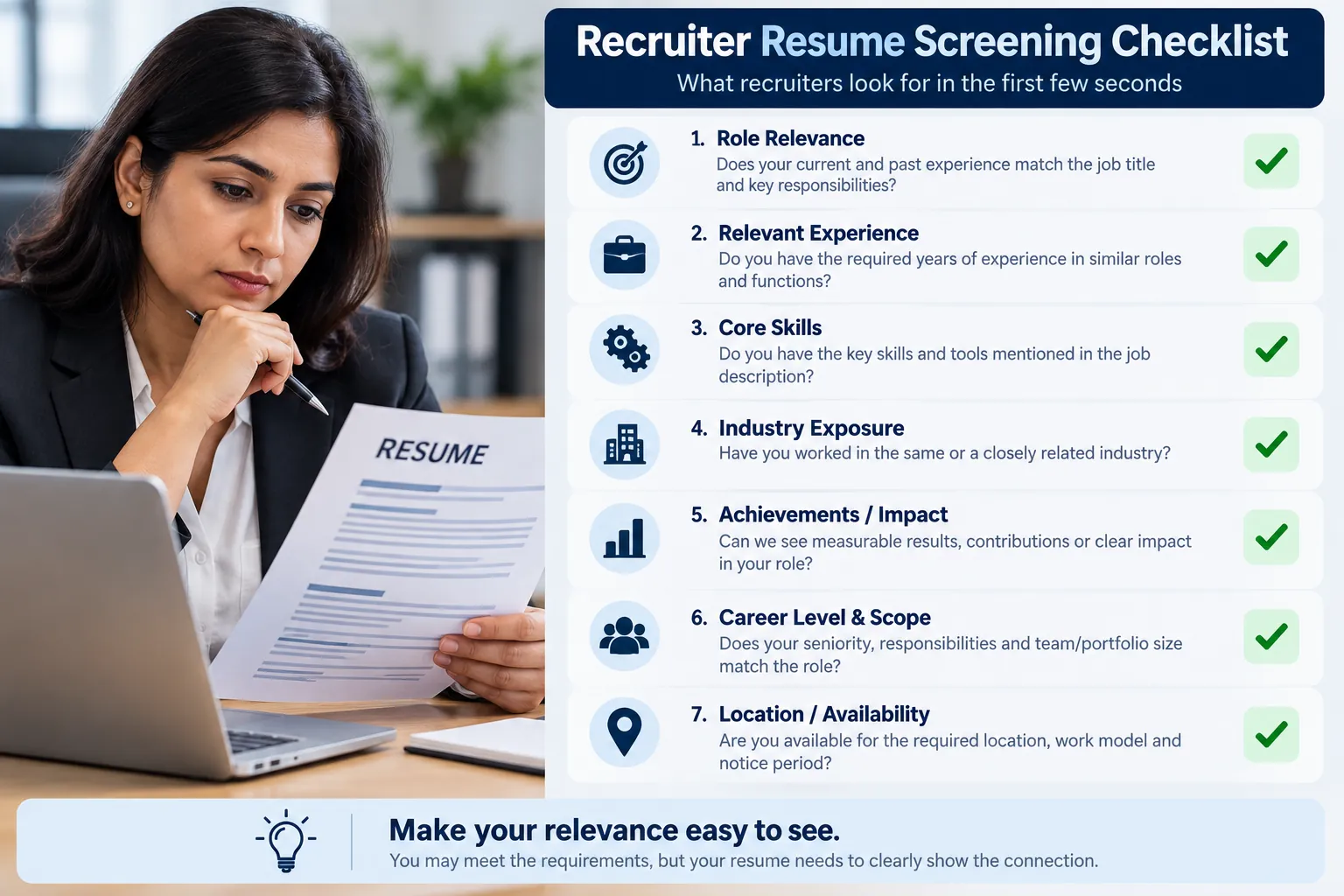
Before submitting your resume, take the job description and answer these seven questions.
1. Is the target role obvious?
Can I immediately tell what position this resume is targeting?
2. Are the most relevant skills visible?
Can I find the important skills without searching through the entire document?
3. Is my recent experience relevant?
Does my recent career demonstrate what this employer needs?
4. Are my achievements clear?
Have I shown outcomes rather than only responsibilities?
5. Does my language match the role?
Where appropriate and truthful, does my resume use terminology that reflects the job description?
6. Is my career level clear?
Can the recruiter understand my seniority and scope?
7. Can a recruiter explain my fit in one sentence?
This is the most important question.
If a recruiter looked at your resume and the job description and couldn't quickly say:
“This candidate appears relevant because…”
your resume may need work.
What You Shouldn't Do
Trying to solve a relevance problem by adding everything to your resume can make it worse.
Don't:
stuff keywords everywhere
copy the job description
claim skills you don't have
exaggerate achievements
change official job titles inaccurately
add irrelevant experience simply to make the resume longer
use complicated graphics to compensate for weak content
create a different career story for every application
Your resume should remain truthful.
The objective is better communication of genuine relevance, not manufacturing a match.
What I See Regularly in Recruitment
In my recruitment work, I have seen candidates who are genuinely capable of doing a role but don't present that capability clearly on paper.
Sometimes the candidate has the right experience but uses a generic resume.
Sometimes the right achievement is buried on page three.
Sometimes the candidate has worked with exactly the type of clients the employer wants but never mentions it in the summary.
Sometimes the person has managed a larger team or business than the vacancy requires, but the resume reads like an individual contributor profile.
And sometimes the candidate is simply using the same resume for every vacancy.
None of these automatically means the candidate is unqualified.
They mean the resume isn't communicating the qualification effectively enough.
Before You Apply: Perform a 10-Minute Relevance Check
Before clicking Apply, don't just ask:
“Do I meet the requirements?”
Ask:
“Can my resume prove that I meet the requirements?”
Take the job description and identify:
3–5 most important requirements
Then look at your resume.
For each requirement, find the evidence.
If you can't find it quickly, either:
the experience isn't there,
the experience isn't relevant enough,
or the resume isn't communicating it clearly.
That distinction is important.
Because the solution is different in each case.
Your Resume Doesn't Need to Say Everything
One of the biggest mistakes experienced professionals make is believing that a stronger resume is a more comprehensive resume.
It isn't.
A strong resume is a relevant resume.
It gives enough information to establish:
Who you are → what you have done → what you are good at → what results you've achieved → why your background is relevant to this role.
The rest can be discussed during the interview.
Your resume's job is not to tell your entire professional life story.
Its job is to make the recruiter want to understand your story further.
Final Takeaway
If your resume is being rejected despite meeting the stated requirements, don't immediately assume that the problem is your experience.
First, examine the communication gap.
You may have the right:
qualifications
experience
skills
industry exposure
achievements
but if those elements aren't presented in the context of the job you're applying for, the recruiter may not see the relevance quickly enough.
Being qualified is one part of the equation. Making your relevance clear is another.
Before your next application, don't ask only:
“Am I qualified for this job?”
Ask:
“Does my resume make it obvious why I am relevant to this job?”
That is a much more useful question.
Frequently Asked Questions
Why does my resume get rejected when I meet all the job requirements?
Meeting the requirements does not guarantee shortlisting. Your resume may not clearly communicate the relevance of your experience, skills, achievements or career level to the specific position.
How can I make my resume more relevant to a job?
Study the job description, identify the most important requirements and make sure your resume clearly demonstrates genuine experience related to those requirements. Tailor your summary, skills and relevant achievements where appropriate.
Does ATS reject qualified candidates?
An ATS can be part of an employer's screening process, but not every employer uses ATS in the same way. A resume can also be reviewed by recruiters or hiring managers. Relevant keywords and clear descriptions can help systems and people understand your background, but keyword stuffing is not a substitute for genuine experience.
Should I use the same resume for every job?
A master resume is useful, but your submitted resume should generally emphasize the experience and skills most relevant to the particular role. Tailoring doesn't necessarily mean rewriting the entire document.
Should I add keywords from the job description to my resume?
Use relevant keywords when they accurately describe your experience and skills. Don't add skills simply because they appear in the job description if you don't actually have them.
How do I know whether my resume communicates relevance?
Take the five most important requirements from the job description and see whether your resume provides clear evidence for each one. If a recruiter has to search extensively to find the connection, your resume may need to be more targeted.