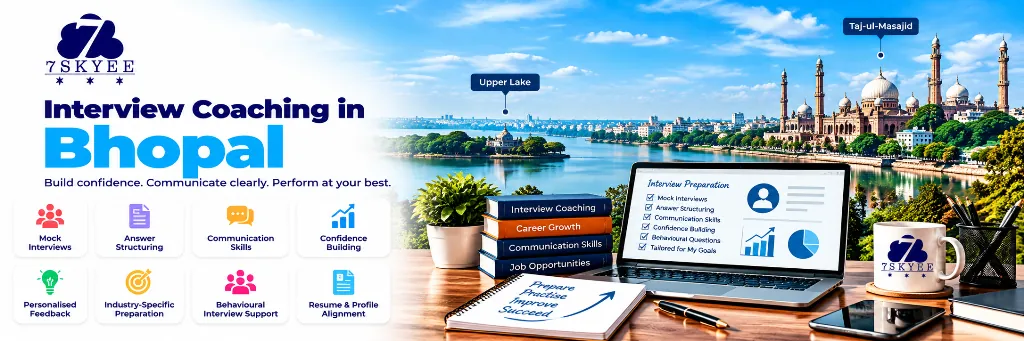
A job interview is your opportunity to explain what you can contribute, demonstrate your professional strengths and show an employer why you are suitable for a position. Even candidates with the right qualifications and experience can find it difficult to communicate their value clearly under interview pressure.
7Skyee provides professional interview coaching in Bhopal for freshers, experienced professionals, managers and senior executives. Our interview preparation approach helps you structure your answers, practise common and role-specific questions, communicate your achievements and prepare for different interview situations.
Whether you are attending your first interview, changing industries, applying for a promotion or preparing for a senior-level opportunity, focused practice can help you approach the process with greater clarity and confidence.
Why Interview Preparation Matters
An interview is more than a test of technical knowledge. Employers may assess your communication, problem-solving, decision-making, motivation, professional behaviour and suitability for the role.
Without preparation, candidates sometimes give answers that are too general, too long or unsupported by examples. Others struggle to explain career changes, employment gaps, achievements or reasons for leaving their current position.
Structured interview preparation can help you:
Understand the requirements of the position.
Organise answers into clear, relevant responses.
Explain your skills and achievements with practical examples.
Prepare for behavioural and competency-based questions.
Communicate more confidently under pressure.
Identify weaknesses in your interview approach.
Ask thoughtful questions about the role and organisation.
Coaching cannot guarantee a job offer. It can, however, help you prepare more systematically and present your experience more effectively.
Interview Coaching for Different Career Stages
Interview Coaching for Freshers
First-time candidates may have limited experience of formal interviews. They may be unsure how to answer questions about their strengths, weaknesses, career goals, academic projects or lack of professional experience.
Preparation can help freshers connect their education, internships, projects, practical training and transferable skills to the job requirements.
Common areas of practice include:
Tell me about yourself.
Why do you want this position?
What are your strengths and areas for development?
Why should we hire you?
Describe a project or challenge you worked on.
Where do you see yourself in the next few years?
The aim is not to memorise scripted answers. It is to develop clear, honest responses that reflect your own experience and the opportunity you are pursuing.
If you are also preparing your application documents, explore our Resume Writing Services.
Interview Coaching for Experienced Professionals
Experienced candidates are often expected to demonstrate more than familiarity with their responsibilities. Employers may want evidence of problem-solving, independent judgement, collaboration, delivery and measurable contribution.
Coaching can help you select relevant examples from your career and explain them in a concise, structured way.
You may practise questions about achievements, difficult situations, stakeholder management, professional disagreements, deadlines, mistakes and lessons learned.
The focus is on showing what you did, why you made particular decisions and what happened as a result.
Interview Coaching for Managers
Managerial interviews may explore leadership, delegation, performance management, conflict resolution, resource planning and decision-making.
Candidates should be prepared to explain how they have led teams, improved processes, managed competing priorities and handled challenging workplace situations.
Useful preparation areas include:
Leading teams through difficult periods.
Addressing underperformance constructively.
Managing disagreement between colleagues.
Meeting targets with limited resources.
Implementing process improvements.
Communicating decisions to senior stakeholders.
Where possible, use real examples and accurate results rather than relying on general statements about leadership.
Interview Coaching for Senior Professionals and Executives
Senior-level interviews may involve business strategy, organisational change, commercial judgement, financial responsibility, team development and long-term planning.
Executives need to explain not only what they have delivered but also the decisions behind those outcomes and the value created for the organisation.
Preparation can help you communicate your leadership philosophy, strategic priorities, major achievements and approach to complex business challenges.
Mock Interview Practice
Mock interviews give you an opportunity to practise in a structured setting before the actual interview.
A useful mock interview should reflect the role you are targeting and the likely areas of assessment. After the practice session, feedback can help identify strengths and areas for improvement.
A mock interview may focus on:
Your introduction and professional summary.
Questions about your work history.
Role-specific or technical questions.
Behavioural and competency-based questions.
Communication, clarity and answer structure.
Follow-up questions and requests for examples.
Questions you may wish to ask the interviewer.
The objective is to improve your ability to respond thoughtfully, not to make every answer sound identical or rehearsed.
How to Structure Strong Interview Answers
One useful approach for behavioural questions is the STAR method.
Situation
Briefly explain the background or challenge you faced.
Task
Describe the responsibility or objective you needed to address.
Action
Explain the specific steps you took and why.
Result
Share the outcome, using accurate figures or evidence where available, and mention what you learned if relevant.
For example, if asked about improving a process, explain the original problem, your responsibility, the changes you introduced and the actual outcome. Avoid taking credit for a team's work without acknowledging the contributions of others.
The STAR method is particularly useful for questions about teamwork, leadership, problem-solving, conflict resolution and achieving targets. It should not be forced into every answer; straightforward questions often need a direct response.
Preparing for Different Interview Formats
HR and Recruiter Interviews
These conversations often explore your background, motivation, salary expectations, availability, career goals and reasons for considering a move.
Prepare a concise career summary and clear explanations for your job search. Be honest about your expectations and avoid criticising previous employers.
Technical Interviews
Technical interviews may test your knowledge, practical judgement and ability to solve problems relevant to the role.
Preparation should include reviewing the job description, revisiting essential concepts and practising explanations of previous projects or technical decisions. The precise preparation depends on the profession.
Behavioural and Competency-Based Interviews
These interviews ask you to describe how you handled real situations.
Prepare a collection of genuine examples that demonstrate problem-solving, teamwork, leadership, communication, adaptability and accountability. Each example should clearly explain your contribution.
Panel Interviews
Panel interviews may involve several interviewers with different responsibilities or perspectives.
Practise addressing the person asking the question while maintaining professional engagement with the wider panel. Keep answers structured and ensure you respond to the question actually asked.
Online Video Interviews
Virtual interviews require preparation beyond the answers themselves.
Check your internet connection, camera, microphone, lighting and background before the meeting. Keep your CV and job description accessible, remove avoidable distractions and join the meeting on time.
Practise speaking naturally to the camera and listening carefully before responding.
Interview Preparation for Bhopal's Employment Market
Bhopal offers opportunities across public administration, education, healthcare, manufacturing, engineering, banking, information technology, retail and professional services. The questions you encounter will depend on your target employer and position.
Government and Public-Sector Roles
Candidates preparing for public-sector recruitment should first review the official selection process and eligibility requirements for the specific vacancy.
Depending on the role, preparation may involve technical knowledge, subject-specific questions, professional experience or a formal interview. Coaching should complement the relevant recruitment requirements rather than replace them.
Engineering and Manufacturing
Engineering and manufacturing interviews may cover technical knowledge, quality, production processes, maintenance, safety, project delivery and problem-solving.
Prepare examples that demonstrate your practical understanding, responsibilities and ability to respond to operational challenges. Supervisory candidates should also be ready to discuss team coordination and performance improvement.
Healthcare and Pharmaceuticals
Healthcare interviews may assess professional qualifications, relevant experience, patient or customer communication, operational judgement and compliance with applicable standards.
Your preparation should reflect your actual professional responsibilities and the specific requirements of the position. Do not claim qualifications or clinical competencies you do not hold.
Education and Training
Candidates applying to educational institutions or training organisations may need to discuss subject expertise, teaching methods, communication, learner engagement and handling difficult situations.
Prepare examples that demonstrate your ability to explain concepts, organise work and respond constructively to challenges.
Banking, Finance and Business Services
Interviews in banking, finance, accounting, sales and professional services may explore analytical ability, accuracy, customer handling, communication, ethical judgement and target management.
Use examples that show how you have solved problems, served customers, managed deadlines or contributed to business objectives.
Information Technology and Digital Roles
Technology interviews may combine technical questions, practical exercises, project discussions and behavioural assessment.
Review the skills listed in the job description and be prepared to explain your own contribution to previous projects. If you do not know an answer, respond honestly and explain how you would approach the problem.
Handling Difficult Interview Questions
Some questions require more thought than a simple description of your experience.
What Is Your Biggest Weakness?
Choose a genuine development area that is appropriate to discuss professionally. Explain the steps you are taking to improve rather than presenting a disguised strength as a weakness.
Why Are You Leaving Your Current Job?
Focus on your professional objectives, the responsibilities you want to develop and the suitability of the new role. Avoid unnecessary criticism of your current employer.
Why Should We Hire You?
Connect your relevant experience, skills and achievements to the employer's stated requirements. Support your answer with evidence rather than broad claims.
Why Is There a Gap in Your Employment History?
Provide a concise and truthful explanation. If you have completed training, managed personal responsibilities or undertaken professional development during the period, mention it where relevant without inventing activities.
What Are Your Salary Expectations?
Research the responsibilities and level of the role, consider your experience and prepare a realistic range if appropriate. Be clear about your expectations while remaining open to understanding the overall role and compensation structure.
Communication and Interview Confidence
Confidence is not the same as speaking continuously or having an immediate answer to every question. Strong interview communication involves listening, organising your thoughts and responding to the question clearly.
During preparation, work on:
Speaking at a measured pace.
Giving direct answers before adding detail.
Avoiding unnecessary jargon and repetition.
Using examples to support important claims.
Asking for clarification when a question is unclear.
Acknowledging when you do not know something.
Maintaining professional and respectful communication.
If nervousness affects your performance, repeated practice and familiarity with the interview format may help you feel better prepared.
Our Interview Coaching Approach
Effective coaching should be connected to your target position and experience rather than limited to generic lists of questions.
Step 1: Understand Your Target Role
Review the job description, seniority, responsibilities and likely interview format.
Step 2: Identify Preparation Priorities
Assess the areas where you need the most support, such as introductions, technical explanations, behavioural questions or leadership examples.
Step 3: Practise Relevant Questions
Work through questions that reflect the role and your career stage. Build responses from your own experience rather than memorising generic scripts.
Step 4: Review Your Answers
Identify where your responses need clearer structure, stronger evidence, greater relevance or more concise communication.
Step 5: Refine and Practise Again
Use feedback to improve your answers and practise the areas that need attention.
Step 6: Prepare for Interview Day
Review your examples, questions for the employer, interview arrangements and any role-specific preparation you need to complete.
Why Choose 7Skyee for Interview Coaching in Bhopal?
7Skyee brings recruitment experience and an understanding of how candidates present their suitability to employers. Our interview coaching focuses on practical preparation, structured answers and clearer communication.
We aim to help you:
Prepare for questions relevant to your target position.
Present your experience and achievements clearly.
Practise behavioural and competency-based answers.
Improve the structure and relevance of your responses.
Identify areas for improvement through practice and feedback.
Approach interviews with a more organised preparation plan.
Your interview performance also depends on your relevant skills, experience, preparation and the employer's selection criteria. Coaching supports your preparation but cannot guarantee selection.
For support with your wider job-search strategy, explore our Career Counselling Services.
Prepare for Your Next Interview
Whether you are a fresher attending your first interview, an experienced professional changing jobs or a manager pursuing a leadership position, thoughtful preparation can help you communicate your value more effectively.
Explore 7Skyee Interview Coaching Services to take the next step towards a more focused interview preparation plan.
Explore More Career Resources
Interview Coaching in Other Cities
Other Career Resources for Bhopal
Resume Writing in Bhopal: Present your experience and achievements in a clear, job-focused resume.
Resume Writing Services: Explore professional resume-writing support.
Career Counselling: Clarify your career direction and next steps.
Personal Recruiter: Explore dedicated support for your job search.
Jobs in Bhopal: Explore job-search resources relevant to Bhopal.
Frequently Asked Questions
1. Who can benefit from interview coaching in Bhopal?
Freshers, experienced professionals, managers and senior executives can benefit from structured interview practice tailored to their target roles and experience.
2. Does interview coaching include mock interviews?
Preparation can include mock interview practice, question development and feedback, depending on the service package selected. Review the service details before booking.
3. Can interview coaching help freshers?
Yes. Freshers can practise introductions, questions about education and projects, strengths, career goals and other common entry-level interview questions.
4. Can you help experienced professionals prepare for job changes?
Yes. Preparation can focus on career achievements, reasons for changing jobs, behavioural questions, role-specific topics and presenting relevant experience.
5. Can interview coaching help with managerial interviews?
Yes. Managerial preparation can cover leadership, decision-making, conflict resolution, team performance, stakeholder management and examples of business impact.
6. Can I prepare for an online interview?
Yes. Preparation can cover answer structure, virtual communication, technical checks, managing distractions and presenting yourself professionally on camera.
7. How many practice sessions will I need?
The number of sessions depends on your experience, target role, interview date and preparation needs. Choose a package based on the service details and the areas you want to improve.
8. Will interview coaching guarantee a job offer?
No. Coaching can help you prepare and communicate more effectively, but hiring decisions depend on your suitability, performance, other candidates and the employer's requirements.
9. How do I get started with 7Skyee?
Visit the Interview Coaching Services page to review the available service and choose the next step.
Build Confidence for Your Next Interview
A successful interview starts with understanding the role, preparing relevant examples and practising how to communicate your experience.
Whether you are entering the job market or preparing for a significant career move, 7Skyee can help you approach interview preparation with a clearer plan.