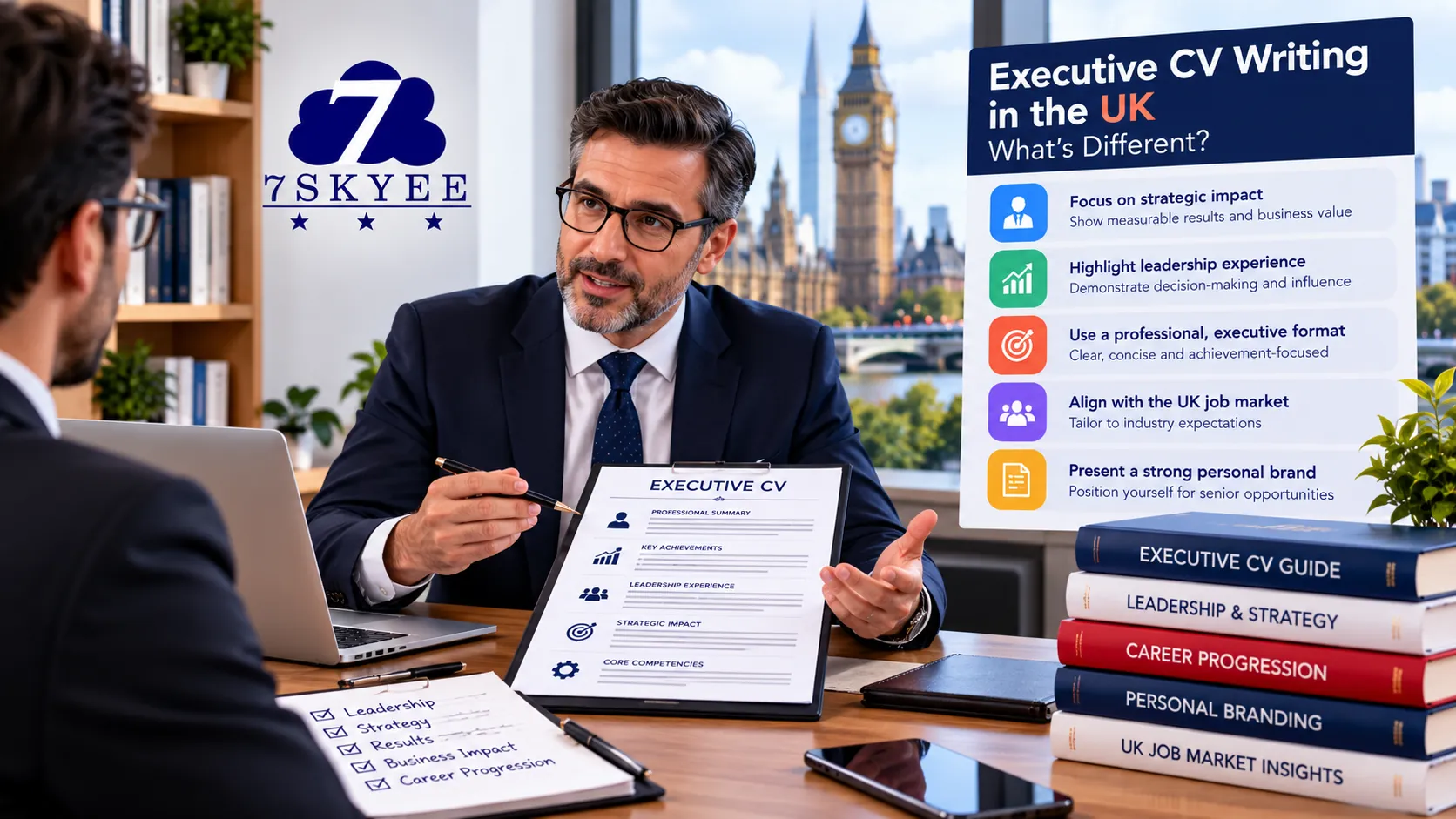
An executive CV needs to do more than summarise a long career. It must communicate the scale of your responsibilities, the decisions you have made, the results you have delivered and the value you could bring to another organisation.
For senior managers, directors and executives, a career history can span multiple industries, leadership roles, business transformations and strategic initiatives. The challenge is deciding which details matter most to the next opportunity and presenting them in a way that is clear, credible and relevant.
An effective executive CV is not simply a longer version of a standard CV. It is a carefully positioned professional document that highlights leadership impact, commercial judgement and relevant achievements.
This guide explains what makes executive CV writing different in the UK, how to present senior-level experience and how to avoid common mistakes when applying for leadership positions.
If you need a broader foundation, read our guide to how to write a UK CV in 2026.
1. What Is an Executive CV?
An executive CV is designed for senior-level opportunities where employers need to understand a candidate's leadership experience, strategic contribution and ability to influence organisational outcomes.
It may be appropriate for roles such as:
Managing Director
Chief Executive Officer
Chief Financial Officer
Chief Operating Officer
Functional Director
Business Unit Head
General Manager
Senior Operations Leader
Vice President or equivalent senior leadership roles
The exact expectations vary by sector, organisation and vacancy. A finance director's CV will need to demonstrate different expertise from that of a technology executive or manufacturing operations leader.
The common requirement is clarity about scope, accountability, achievements and relevance to the position.
2. How an Executive CV Differs from a Standard CV
A standard professional CV often focuses on responsibilities, relevant skills and achievements within a particular role. An executive CV places greater emphasis on leadership, business outcomes and the wider impact of decisions.
Standard professional CV
Executive CV
Focuses on role-specific experience and skills
Emphasises leadership scope and strategic contribution
Describes responsibilities and individual achievements
Demonstrates business impact, decision-making and organisational outcomes
Highlights relevant technical or professional expertise
Balances expertise with leadership, commercial judgement and influence
Covers career progression and recent experience
Builds a coherent narrative of leadership progression
Targets a role or professional level
Positions the candidate for a specific senior leadership opportunity
This does not mean that executive CVs should be full of business jargon or ambitious claims. The evidence must remain specific, accurate and relevant.
3. Start with Your Executive Value Proposition
Your opening profile should make it easy for a recruiter or hiring manager to understand who you are professionally, what you bring and the kind of leadership challenges you are equipped to handle.
Avoid opening with a generic statement such as:
“Experienced and results-driven professional with excellent leadership and communication skills.”
This could describe thousands of candidates and says little about your particular contribution.
Instead, build a profile around your leadership background, sector expertise, scope of responsibility and strongest areas of impact.
For example:
“Senior operations leader with experience managing multi-site teams, improving operational performance and leading cross-functional initiatives in manufacturing environments. Combines workforce leadership and process improvement with a focus on operational efficiency, quality and sustainable business results.”
This is an illustrative example, not a claim about a real candidate. Your profile should reflect your actual experience and target position.
For more guidance on presenting your professional identity, see personal branding for UK professionals.
4. Demonstrate Leadership Impact, Not Just Seniority
Job titles and years of experience provide context, but they do not prove leadership effectiveness.
An executive CV should show what changed because of your decisions, initiatives or leadership.
Depending on your role, useful evidence may include:
Revenue growth or commercial performance.
Cost control or operational efficiency.
Business transformation.
Expansion into new markets.
Development of leadership teams.
Improved service delivery or customer outcomes.
Governance, risk management or compliance improvements.
Successful integration, restructuring or change programmes.
For example, compare these statements.
Responsibility-focused:
“Responsible for operations across multiple sites.”
Impact-focused:
“Led operational improvement initiatives across multiple sites, strengthening performance monitoring and establishing clearer accountability for delivery.”
The second example communicates more about your contribution. Where accurate figures are available, you can strengthen it further by stating the scale of the operation or the measurable outcome.
Do not invent percentages, revenue figures or savings to make a CV appear more impressive. If a result cannot be quantified reliably, explain the change or outcome clearly in words.
5. Explain the Scale of Your Responsibilities
At executive level, context matters. A recruiter needs to understand the scale and complexity of your role, not just the title.
Depending on the position, relevant context may include:
Size of the team or leadership structure.
Geographic coverage.
Number of sites, departments or business units.
Budget or P&L responsibility.
Customer or stakeholder complexity.
Scope of a transformation programme.
Reporting relationships and governance responsibilities.
Include only information that is relevant and appropriate to disclose.
For example, “Led a regional operations team” is useful, but “Led a regional operations team across several sites, with responsibility for service delivery, workforce planning and operational performance” provides greater context.
Use actual numbers where they help the reader understand your scope, while respecting confidentiality obligations.
6. Present Career Progression Clearly
An executive CV should tell a coherent story about how your responsibilities and capabilities have developed.
Your career may show progression from specialist work to team leadership, functional management and broader organisational responsibility. Alternatively, you may have developed deep expertise within one specialist field.
Neither path is inherently better. The important thing is to make the progression understandable.
For each relevant position, show:
Employer and job title.
Employment dates.
A brief description of the organisation or business area where useful.
Scope of responsibility.
The most relevant achievements.
Earlier positions can usually receive less space than recent senior roles, particularly when they are less relevant to your target opportunity.
Avoid giving every job identical treatment if doing so makes your most important leadership experience harder to find.
7. Tailor Your Executive CV to the Target Role
Senior candidates sometimes assume their experience speaks for itself. However, even a strong executive CV needs to reflect the organisation's priorities.
A board may prioritise governance, risk and long-term strategy. A growing business may seek commercial expansion and operational scalability. A manufacturing organisation may place particular importance on productivity, quality, supply-chain performance and workforce leadership.
Before applying:
Review the job description and person specification.
Identify the organisation's main priorities for the role.
Select the achievements that best demonstrate your suitability.
Adjust the executive profile and skills emphasis accordingly.
Remove details that distract from your strongest evidence.
Tailoring does not mean rewriting your career history to match every phrase in a vacancy. It means presenting your genuine experience in the most relevant order.
Our guide to tailoring your CV to a job description in the UK explains the process in more detail.
8. Include the Right Executive Skills
An executive CV should distinguish between technical expertise and leadership capabilities.
Relevant skills depend on the role, but may include:
Strategic planning.
Commercial management.
P&L accountability.
Business transformation.
Operational excellence.
Organisational development.
Change management.
Stakeholder engagement.
Risk and governance.
Talent development.
Market expansion.
Programme leadership.
Do not include every skill you have encountered during your career. Prioritise the capabilities that are essential to the target role and support them through the experience section.
Where possible, demonstrate a skill through an achievement rather than relying on a list of keywords alone.
9. How Long Should an Executive CV Be?
There is no universal page limit that works for every executive. The right length depends on the depth of relevant experience, the complexity of the role and the information needed to establish suitability.
For many senior professionals, a focused two- to three-page CV may provide sufficient space. Some executives with extensive, highly relevant careers may need more.
The objective is not to fit every achievement into a fixed number of pages. It is to make the strongest evidence easy to find.
To keep your CV focused:
Prioritise recent and relevant leadership experience.
Remove repetitive responsibilities.
Summarise older or less relevant positions.
Use concise achievement statements.
Avoid lengthy descriptions of every project.
Keep formatting readable and consistent.
For further guidance, read how long a CV should be in the UK.
10. Executive CV Formatting and ATS Readability
Executive CVs should look professional without becoming difficult to read.
Recruitment processes vary, and some employers use applicant tracking systems (ATS) to collect and process applications. A highly decorative CV may introduce unnecessary readability problems.
Consider these practices:
Use clear section headings.
Choose a readable, professional font.
Keep dates, job titles and employer names consistent.
Use straightforward bullet points.
Avoid relying on complex tables or text boxes to convey essential information.
Include relevant terminology naturally.
Follow the file-format instructions in the application.
A polished design is useful only if it supports the content. Do not sacrifice clarity for visual effects.
Our guide to creating an ATS-friendly CV for UK jobs explains how to improve structure and readability.
11. Should an Executive CV Include a Board or Non-Executive Profile?
If you are applying for a board or non-executive director position, the information required may differ from that of an executive management application.
A board-focused CV may need to emphasise governance, risk oversight, strategic guidance, financial literacy, stakeholder relationships and relevant committee experience.
An executive management CV, by contrast, may need greater detail about operational delivery, organisational leadership and direct responsibility for results.
Some candidates maintain separate versions for different types of opportunities. This can be sensible when the roles require genuinely different positioning.
Do not imply that you have board-level or governance experience you have not acquired. Highlight relevant experience accurately, including committee work, advisory responsibilities or other appropriate contributions where applicable.
12. Common Executive CV Mistakes
Focusing too heavily on job titles: Senior titles alone do not explain your contribution. Provide evidence of responsibility and results.
Using generic leadership language: Replace unsupported claims with specific examples of decisions, initiatives and outcomes.
Listing responsibilities without achievements: Explain what you improved, delivered, developed or changed.
Including too much historical detail: Give appropriate prominence to recent and relevant experience.
Using excessive jargon: Make your achievements understandable to recruiters and decision-makers outside your immediate specialism.
Ignoring the target organisation: Tailor the emphasis to the role rather than sending the same CV for every executive vacancy.
Overdesigning the document: Use professional formatting that remains readable on screen and in recruitment systems.
Disclosing confidential information: Describe the scale and nature of your work without revealing sensitive commercial details.
13. An Executive CV Review Checklist
Before submitting your CV, check that:
The opening profile clearly communicates your executive positioning.
Your recent roles demonstrate relevant leadership experience.
Major achievements show your contribution and outcomes.
The scope of your responsibilities is understandable.
Your CV is tailored to the target role.
Your leadership and technical skills are supported by evidence.
Career dates and job titles are accurate.
The document is readable and professionally formatted.
Claims and metrics are accurate and defensible.
Confidential information has been handled appropriately.
The CV follows the employer's application instructions.
Final Thoughts
Executive CV writing in the UK is about communicating leadership value with clarity and credibility. The strongest CVs do not simply show that a candidate has held senior positions. They explain the scope of their work, the decisions they have made and the outcomes they have helped achieve.
Focus on relevant leadership evidence, a clear career narrative and a professional presentation tailored to the target role. Every section should help the reader understand why your experience matters to the opportunity.
For personalised support, explore 7Skyee's UK CV Writing service