

Choosing your next job is rarely as simple as comparing two salary figures.
A higher-paying role can improve your finances immediately, but it may offer limited learning, weak career progression or little long-term value. On the other hand, a job with better career growth may require you to accept a smaller salary increase today in exchange for stronger skills, greater responsibility and better opportunities later.
So, should you prioritize salary or career growth?
There is no single answer. The right decision depends on your current career stage, financial priorities, experience, skills, industry and where you want your career to be in the next three to five years.
The key is to evaluate the complete career opportunity, rather than making the decision based on salary alone.
Salary vs Career Growth: Why the Decision Isn't Simple
Salary is one of the most important factors when evaluating a job. It affects your financial security, lifestyle, savings and ability to meet personal responsibilities.
But salary is only one part of the overall value of a job.
Consider two opportunities:
Job A
25% higher salary
Same responsibilities
Limited learning
Little promotion potential
Declining industry
Job B
10% higher salary
Significantly larger responsibilities
Strong learning opportunities
Better leadership exposure
Clear progression path
Growing industry
Job A looks better if you compare only the salary.
Job B could potentially create much greater career value over the next few years.
This is why experienced professionals should ask:
"Which opportunity will put me in a stronger position two or three years from now?"
That question often produces a better career decision than simply asking which company is offering more money today.
When Salary Should Be Your Priority
There are situations where taking a higher salary makes complete sense.
1. You are significantly underpaid
If your current compensation is substantially below the market rate for your experience and responsibilities, correcting that gap should be an important consideration.
A job change that brings your compensation closer to market value may be necessary for your financial and professional progress.
2. Your financial responsibilities have increased
Your priorities can change as your career progresses.
A professional who is supporting a family, managing a home loan or planning major financial commitments may reasonably place greater importance on immediate compensation.
Career decisions should reflect your actual circumstances rather than following a generic rule that "growth is always more important than salary."
3. The higher salary comes with better career value too
Sometimes the decision is easy.
If one company offers:
Better salary
Better role
More responsibility
Stronger learning
Better leadership exposure
Better career prospects
then there may be little reason to reject the opportunity simply because salary is higher.
The real question is not salary versus growth.
It is whether the additional salary comes at the expense of your long-term career.
When Career Growth Should Matter More
There are also situations where accepting a smaller immediate salary increase can be a smart decision.
1. The role gives you valuable new skills
Skills compound over time.
A role that allows you to develop capabilities that are highly valued in your industry can increase your future earning potential.
For example, moving from an individual contributor role into a position involving:
Team management
Strategic planning
Client management
P&L responsibility
Technology implementation
Business development
can significantly strengthen your profile.
2. The position gives you greater responsibility
A larger role can make your next career move easier.
If you are currently managing a small team and another opportunity gives you responsibility for a larger function, that experience may become valuable when you pursue your next promotion.
3. There is a clear progression path
Ask what happens after you succeed in the role.
Is there a realistic path toward:
Senior Manager → General Manager → Business Head
or are you likely to remain in the same position for several years?
A clear progression path can be worth more than a modest salary premium today.
4. You are moving into a stronger industry
Industry choice can have a major impact on long-term career opportunities.
A role in a growing sector may provide more opportunities for advancement than a higher-paying position in a shrinking or stagnant industry.
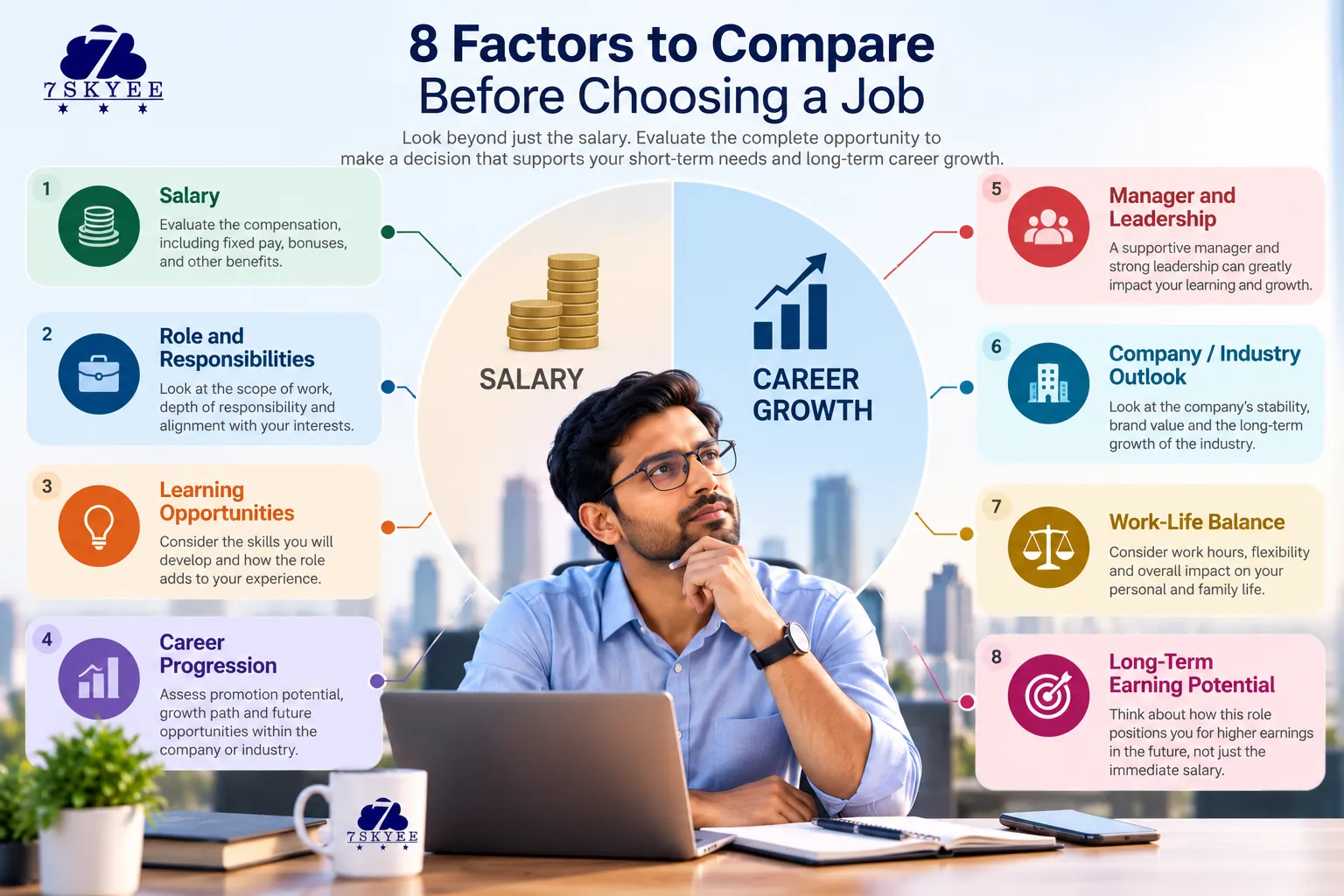
8 Factors to Compare Before Choosing a Job
Salary should be part of your decision — but it shouldn't be the only factor.
When comparing two opportunities, evaluate these eight areas.
1. Salary and Total Compensation
Look beyond fixed salary.
Consider:
Fixed pay
Variable pay
Bonuses
Benefits
Insurance
Retirement benefits
Stock or long-term incentives
Joining or retention bonuses
A job with a higher CTC does not necessarily mean you will receive substantially more take-home pay.
2. Role and Responsibilities
What will you actually be responsible for?
A better title does not automatically mean a better opportunity.
Look at the scope of your work, decision-making authority, team size, business exposure and complexity of the problems you will solve.
A role that expands your professional capabilities can be highly valuable.
3. Learning Opportunities
Ask yourself:
"What will I learn in this role that I don't know today?"
Consider whether you will gain exposure to:
New technologies
New markets
Larger clients
Business strategy
Leadership
Cross-functional projects
New management responsibilities
The right learning opportunity can improve your market value for years.
4. Career Progression
Find out what advancement realistically looks like.
Don't rely only on promises made during the interview.
Ask:
What does the next level look like?
How long do people typically stay at this level?
How are promotions decided?
What responsibilities are required for the next position?
Have people in this role progressed internally?
A career path should be evaluated based on evidence, not just promises.
5. Manager and Leadership
Your manager can have a significant influence on your career.
A supportive manager can give you opportunities, feedback, visibility and challenging assignments.
A poor manager can limit your growth even when the company itself is excellent.
When evaluating an offer, consider the person you will report to and the leadership culture around your role.
6. Company and Industry Outlook
Look beyond the immediate job.
Consider:
Is the company growing?
Is the industry expanding?
Does the organisation have a strong market position?
Is the business investing in new capabilities?
Does the company have a reputation that can strengthen your profile?
A strong employer brand and growing industry can add significant value to your future career.
7. Work-Life Balance
Career growth shouldn't automatically mean sacrificing everything outside work.
Consider:
Working hours
Travel requirements
Remote/hybrid flexibility
Weekend expectations
Relocation
Commute
Impact on family life
A higher salary may not be worth it if the role creates an unsustainable lifestyle.
8. Long-Term Earning Potential
This is often overlooked.
Instead of asking:
"Which job pays more today?"
also ask:
"Which job can increase my earning potential over the next three to five years?"
A role that develops highly valuable skills and gives you greater responsibility may eventually lead to substantially higher compensation.
Should You Take a Lower Salary for Better Career Growth?
Sometimes, yes.
But accepting a lower salary should not be an automatic decision.
Before accepting a lower-paying role, ask yourself:
What am I getting in exchange for the lower salary?
Perhaps you are gaining:
A better designation
A larger team
International exposure
Leadership responsibility
A stronger company brand
New technical skills
Entry into a better industry
A clear promotion path
If the answer is "almost nothing," then accepting the lower salary may not make sense.
A career move should involve a meaningful trade-off, not simply a reduction in compensation justified by the promise of future growth.
How to Compare Two Job Offers
When two opportunities look very different, don't rely on instinct alone.
Create a simple comparison.
FactorJob AJob BSalaryRole & responsibilityLearningCareer progressionManagerCompany outlookWork-life balanceLong-term earning potential
Then ask yourself three questions:
1. Which opportunity is better for me today?
Consider your financial and personal priorities.
2. Which opportunity is better for my career two years from now?
Consider skills, responsibility, industry and progression.
3. Which opportunity gives me more options in the future?
A strong career move should ideally increase the number and quality of opportunities available to you later.
What If You're Already Stuck in a Low-Growth Job?
Sometimes the problem isn't choosing between two offers.
It is deciding whether to remain in your current role at all.
You may notice signs such as:
Your responsibilities have increased but your career has not progressed.
You have stopped learning.
Promotions have repeatedly been delayed.
Your skills are becoming outdated.
Your salary is significantly below market levels.
There is no clear next step.
You are unsure about what direction to take next.
In such situations, simply applying for more jobs may not solve the underlying problem.
You first need to understand what kind of move would actually improve your career.
This is where professional career planning can be useful.
Should You Prioritize Salary Early, Mid or Late in Your Career?
Your priorities can change as you gain experience.
Early Career
Learning, skill development and building a strong professional foundation may deserve greater weight.
A slightly lower salary can sometimes be justified if the role provides exceptional learning and career exposure.
Mid-Career
The decision becomes more balanced.
You may need to consider salary, leadership opportunities, specialization, industry positioning and long-term career direction together.
Senior Career
At senior levels, the quality and scope of the role can become extremely important.
Leadership responsibility, strategic influence, business impact, organisational reputation and long-term earning potential may matter as much as the immediate salary.
There is no universal formula because your personal and professional priorities are different at every stage.
How Career Counselling Can Help You Make the Right Decision
If you're struggling to decide between a higher salary and better career growth, the biggest challenge may not be choosing between two jobs.
It may be understanding what you actually want from your next stage of career.
A professional Career Counselling session can help you evaluate your experience, strengths, career goals and available options before making a major career decision.
Instead of asking only:
"Which job should I take?"
you can evaluate:
"Which career direction is most likely to help me achieve my professional and personal goals?"
This broader perspective can be particularly useful when you're considering a career change, promotion, industry transition or major job move.
If you're based in a particular city, you can also explore Career Counselling in Delhi, Career Counselling in Mumbai, Career Counselling in Bengaluru or Career Counselling in Hyderabad as relevant to your location.
The city pages provide a local entry point, while the main Career Counselling service page provides the complete service details and next step.

Career Growth vs Salary: The Right Answer Depends on Your Goals
There is no rule that says you should always choose career growth over salary — or salary over career growth.
The right choice depends on your circumstances.
If you are significantly underpaid, a meaningful salary correction may be important.
If you are financially comfortable but stuck in a role with limited learning and progression, career growth may deserve greater priority.
And if one opportunity offers both better compensation and stronger career prospects, the decision may be much simpler.
The most important thing is to look beyond the number on the offer letter.
Evaluate what the opportunity can do for your career, your finances and your future.
Your next job should not simply be your next salary.
It should ideally move your career forward.
Ready to make a more informed career decision?
If you're unsure whether your next move should focus on higher salary, career growth, a new industry or a completely different career direction, professional guidance can help you evaluate the options objectively.
Explore 7Skyee Career Counselling →
For the city links, I would use the exact live city-page URLs already on 7Skyee rather than inventing slugs, and keep them secondary to the main Career Counselling conversion link.


