
How to Answer "Tell Me About Yourself" in an Interview
Almost every interview begins with one simple question:
"Tell me about yourself."
It sounds straightforward, yet it is one of the most challenging questions for job seekers. Many candidates either speak for too long, provide irrelevant personal details, or struggle to organize their thoughts.
Ironically, this isn't a trick question at all.
It's an opportunity.
The first few minutes of an interview often determine its direction. A confident, structured introduction immediately creates a positive impression and gives the interviewer confidence in your communication skills, professionalism, and suitability for the role.
On the other hand, an unstructured or confusing answer can make even a highly qualified candidate appear unprepared.
The good news is that answering this question isn't about memorizing a script. It's about understanding what interviewers expect and presenting your professional story in a clear, relevant, and engaging way.
In this guide, you'll learn why recruiters ask this question, what they are really evaluating, the most common mistakes candidates make, and the proven framework that helps professionals answer with confidence.
Why Recruiters Ask "Tell Me About Yourself"
Many candidates assume interviewers ask this question simply to break the ice.
In reality, it serves a much bigger purpose.
Your answer helps recruiters quickly determine whether you are someone they should continue investing time in during the interview.
Within the first few minutes, interviewers are already forming opinions about your communication style, confidence, professionalism, and ability to organize information logically.
This opening question acts as a preview of everything that follows.
Instead of asking dozens of small questions immediately, recruiters allow candidates to introduce themselves naturally. This helps them understand how you present your experience and whether your background aligns with the position.
A strong introduction also makes the rest of the interview more conversational because it provides interviewers with topics they can explore further.
What Recruiters Really Want to Hear
One of the biggest misconceptions is that interviewers want to know your life story.
They don't.
They already have your resume.
They are not asking for information they can read on paper.
Instead, they want to understand:
Who are you professionally?
What experience makes you suitable for this role?
What achievements are you most proud of?
What skills set you apart?
Why are you interested in this opportunity?
How do you communicate under pressure?
Think of your answer as the headline of your career—not the entire biography.
A great introduction gives recruiters enough information to become interested without overwhelming them with unnecessary details.
This Is Your Personal Elevator Pitch
Imagine you have just one minute to convince someone that you're worth interviewing.
What would you say?
That is essentially what this question measures.
Your answer should communicate:
Your current professional identity
Your relevant experience
Your biggest strengths
One or two notable achievements
Your career direction
Everything else can be discussed later during the interview.
Remember, recruiters don't expect perfection.
They expect clarity.
What Interviewers Are Actually Evaluating
While you're introducing yourself, interviewers are evaluating far more than the words you speak.
They observe how you think, how you communicate, and how you present yourself professionally.
Here are some of the key areas they assess.
1. Communication Skills
Can you explain your background clearly?
Do you organize your thoughts logically?
Can you communicate confidently without sounding rehearsed?
Strong communication skills are valuable in almost every profession.
2. Confidence
Confidence doesn't mean speaking loudly or using difficult vocabulary.
It means speaking naturally, maintaining composure, and believing in your own experience.
Candidates who appear comfortable discussing their careers often leave stronger impressions.
3. Professional Focus
Interviewers notice whether your answer remains relevant to the role.
Candidates who spend several minutes discussing childhood memories, hobbies, or unrelated personal information often lose the interviewer's attention.
Professional relevance matters.
4. Self-Awareness
Do you understand your strengths?
Can you explain your professional journey?
Can you identify what motivates your career decisions?
Candidates who demonstrate self-awareness usually perform better throughout the interview.
5. Career Direction
Recruiters also evaluate whether your career path makes sense.
Your introduction should show progression rather than randomness.
Even if you've changed industries or roles, your answer should explain why those decisions helped shape your professional growth.
6. Enthusiasm
Interviewers look for candidates who genuinely enjoy what they do.
Energy, positivity, and genuine interest often influence hiring decisions more than candidates realize.
Common Mistakes Candidates Make
Despite preparing extensively for interviews, many candidates struggle with this opening question because they misunderstand its purpose.
Let's look at the most common mistakes.
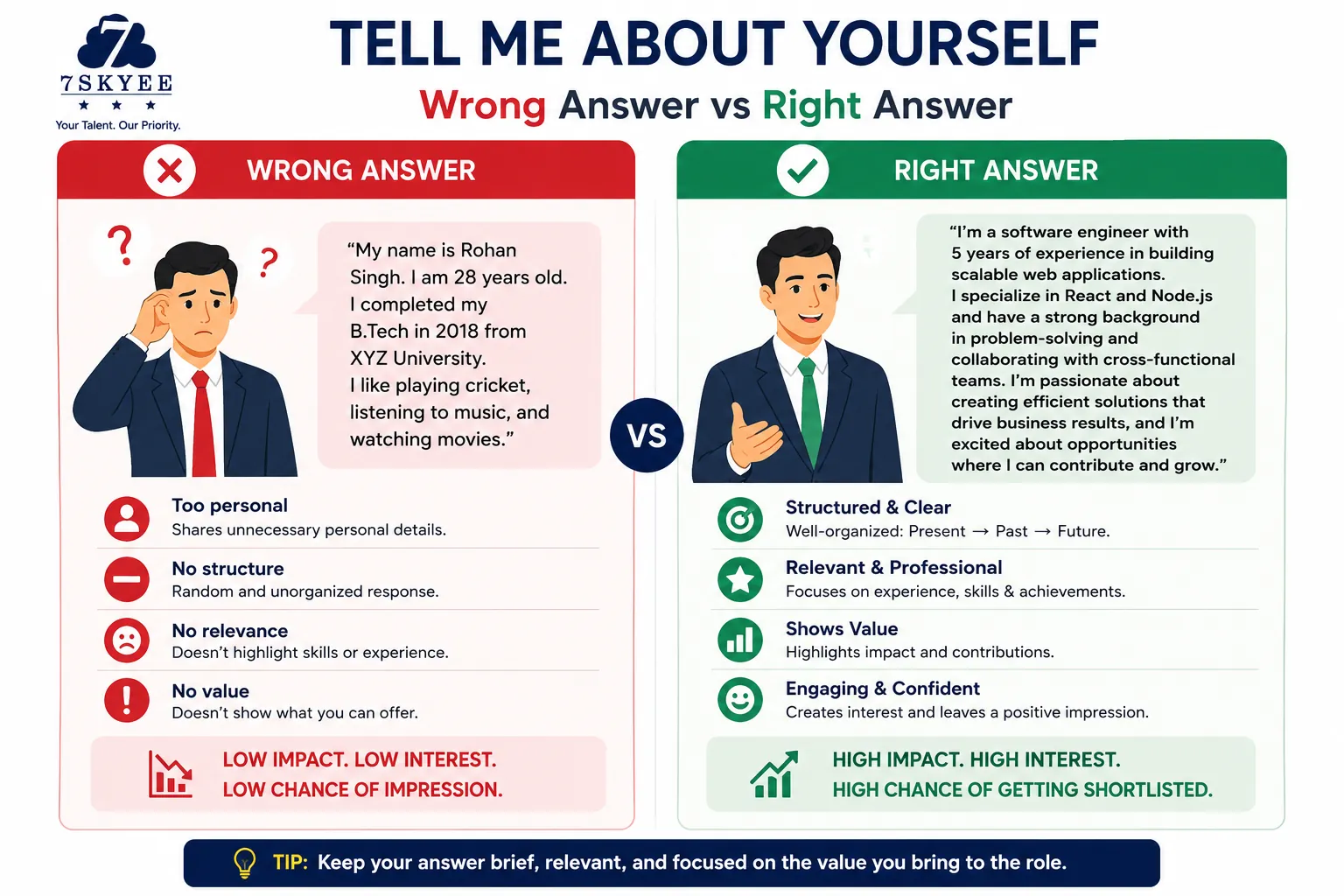
Mistake 1: Telling Your Entire Life Story
Many candidates begin with:
"I was born in..."
Recruiters are interviewing you for a job—not writing your autobiography.
Your answer should focus on your professional journey rather than your personal history.
Mistake 2: Repeating Your Resume Word for Word
Interviewers have already reviewed your resume.
Reading it back to them adds little value.
Instead of repeating dates and job titles, explain the story behind your career and highlight your most relevant achievements.
Mistake 3: Speaking Without Structure
Some candidates jump randomly between different jobs, experiences, and achievements.
This creates confusion.
A structured answer is much easier to understand and remember.
Later in this guide, you'll learn the Present → Past → Future framework, one of the most effective ways to organize your response.
Mistake 4: Talking for Too Long
Your answer shouldn't become a ten-minute presentation.
Most effective introductions last 60 to 90 seconds.
This gives interviewers enough information while leaving room for follow-up questions.
Mistake 5: Being Too Modest
Some candidates avoid discussing achievements because they don't want to appear arrogant.
However, interviews are designed for you to demonstrate your value.
Mention measurable accomplishments confidently, while giving appropriate credit to your team where relevant.
Mistake 6: Including Irrelevant Personal Information
Your hobbies, family background, favourite sports, or travel experiences are generally unnecessary unless they directly support the role.
Keep your introduction focused on your professional identity.
Mistake 7: Sounding Memorized
Candidates who memorize every sentence often sound robotic.
Interviewers can usually tell when an answer has been rehearsed word for word.
Instead of memorizing sentences, understand the structure and speak naturally.
The Psychology Behind a Great First Impression
Research consistently shows that first impressions form quickly—and interviews are no exception.
Within the first few moments of meeting you, interviewers begin forming opinions based on what they observe.
Your introduction plays a major role in shaping these perceptions.
A confident smile, good posture, appropriate eye contact, and a calm speaking pace all contribute to credibility.
The words you choose matter, but how you deliver them matters just as much.
Candidates who speak with clarity and purpose create an impression of professionalism and preparedness.
Another important psychological factor is recency and primacy. People tend to remember what they hear first and what they hear last.
That's why your opening introduction and closing statement often leave the strongest impression.
Rather than trying to impress with complicated language, focus on authenticity.
Be genuine.
Be relevant.
Be concise.
A simple, confident introduction is far more memorable than a lengthy speech filled with unnecessary details.
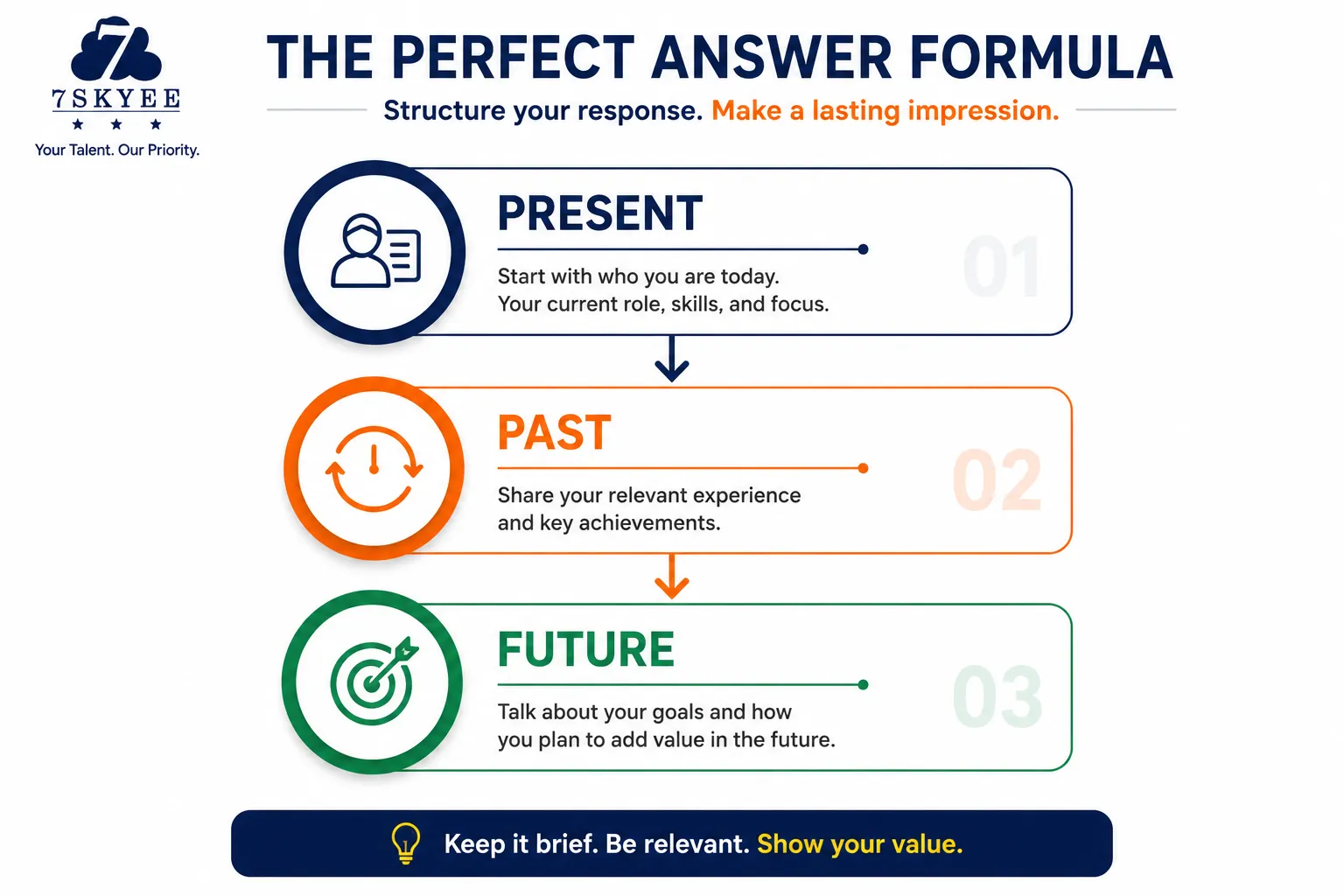
The Present → Past → Future Formula
One of the biggest challenges candidates face is organizing their thoughts. They know what they've done, but they struggle to present it in a way that's engaging, logical, and relevant.
A simple yet highly effective approach is the Present → Past → Future framework.
Recruiters appreciate this structure because it tells your professional story in a natural flow. It helps you stay focused while giving interviewers exactly the information they need.
Step 1: Present – Who Are You Today?
Start with your current professional identity.
Tell the interviewer:
Your current designation or qualification
Your years of experience (if applicable)
Your core expertise
Your strongest professional skills
This immediately gives the interviewer context.
Example
"I'm currently working as a Senior Sales Executive with over five years of experience in B2B sales and key account management. My expertise lies in building client relationships, identifying business opportunities, and consistently achieving revenue targets."
Keep this section concise—around 20–30 seconds.
Step 2: Past – What Has Prepared You?
Next, briefly explain the journey that brought you to your current position.
Instead of listing every job you've had, focus on experiences that are relevant to the role.
Highlight:
Major responsibilities
Career progression
Key achievements
Skills you've developed
Recruiters are more interested in your impact than your duties.
Instead of saying:
"I managed customer accounts."
Say:
"I managed a portfolio of over 80 enterprise clients and helped increase annual customer retention by 18%."
Achievements make your introduction memorable.
Step 3: Future – Why Are You Here?
Finish by explaining why you're excited about this opportunity.
This is where many candidates lose valuable points.
Avoid saying:
"I'm looking for a better salary."
Instead, connect your career goals with the company's opportunity.
For example:
"I'm now looking for an opportunity where I can take on greater responsibilities, continue learning, and contribute to an organization known for innovation and long-term growth."
This ending shows ambition, maturity, and genuine interest.
Sample Answers
Example 1 – Fresher
"I'm a recent graduate in Mechanical Engineering with a strong interest in manufacturing and production processes. During my academic journey, I completed projects focused on quality improvement and participated in technical workshops that strengthened my analytical and problem-solving skills. I also completed an internship where I gained practical exposure to production planning and team collaboration. I'm now looking forward to starting my professional career with an organization where I can apply my knowledge, learn from experienced professionals, and build a successful long-term career."
Example 2 – Experienced Professional
"I'm currently working as an HR Executive with over four years of experience in recruitment, employee engagement, and HR operations. Throughout my career, I've successfully managed end-to-end recruitment, coordinated onboarding, and supported employee development initiatives. One of my key achievements was reducing average hiring time by improving the recruitment workflow. I'm now looking for an opportunity where I can take on broader HR responsibilities, contribute strategically, and continue growing professionally."
Example 3 – Sales Professional
"I'm currently working as an Area Sales Manager with seven years of experience in FMCG sales and distributor management. Over the years, I've developed expertise in market expansion, business development, and team leadership. In my current role, I consistently exceeded sales targets while expanding our dealer network across multiple territories. I'm excited about this opportunity because it allows me to leverage my experience while contributing to a larger organization with ambitious growth plans."
Example 4 – Senior Manager
"I'm currently leading operations for a manufacturing business with over twelve years of experience in production planning, supply chain coordination, and continuous improvement initiatives. Throughout my career, I've focused on improving operational efficiency, reducing costs, and developing high-performing teams. I've successfully led multiple cross-functional projects that improved productivity and customer satisfaction. I'm now looking to contribute my leadership experience within an organization that values operational excellence and long-term business growth."
Example 5 – Career Changer
"I began my career in customer support, where I developed strong communication and problem-solving skills. Over time, I discovered a passion for data analytics and completed professional training in Excel, SQL, and Power BI. I've worked on several practical projects to strengthen my technical abilities, and I'm now seeking an opportunity to transition into a business analytics role where I can combine my customer understanding with data-driven decision-making."
Adjust Your Answer Based on Experience
Freshers
Focus on:
Education
Projects
Internships
Certifications
Technical skills
Enthusiasm
Experienced Professionals
Focus on:
Experience
Achievements
Industry expertise
Career growth
Leadership
Business impact
Senior Executives
Focus on:
Leadership
Business transformation
Strategy
Team development
Revenue growth
Organizational impact
Body Language Matters
A great answer can lose its impact if your body language sends the wrong message.
Interviewers pay close attention to your non-verbal communication.
Maintain Good Posture
Sit upright with relaxed shoulders. Good posture conveys confidence and professionalism.
Make Natural Eye Contact
Maintain eye contact without staring. This helps build trust and demonstrates confidence.
Smile Naturally
A genuine smile creates a positive atmosphere and makes you appear approachable.
Use Controlled Hand Gestures
Natural gestures can emphasize important points, but avoid excessive movement or fidgeting.
Avoid Distracting Habits
Don't tap the table, shake your leg, or play with a pen. These habits may suggest nervousness.
Communication Tips
How you speak is just as important as what you say.
Speak Clearly
Use a moderate pace. Speaking too quickly can make you seem anxious, while speaking too slowly may reduce engagement.
Pause Naturally
Short pauses give you time to think and make your answer easier to follow.
Avoid Filler Words
Minimize words like:
Um...
Actually...
Basically...
You know...
Like...
These can weaken an otherwise strong answer.
Be Authentic
Interviewers appreciate genuine responses. Rather than memorizing a script, understand the structure and express your story naturally.
Keep Your Answer Within 60–90 Seconds
One of the biggest mistakes candidates make is talking for too long.
Aim for an introduction that lasts 60–90 seconds.
This is enough time to cover your professional background while leaving room for the interviewer to ask follow-up questions.
Remember:
Your goal isn't to answer every possible question.
Your goal is to encourage the interviewer to ask the next one.
Industry-Specific Sample Answers
Every profession has different expectations. While the Present → Past → Future structure remains the same, the content should be tailored to the role you're applying for.
Manufacturing Professional
"I'm currently working as a Production Engineer with over six years of experience in manufacturing operations and process improvement. My expertise includes production planning, quality control, and Lean Manufacturing practices. Throughout my career, I've successfully improved production efficiency while reducing machine downtime and material wastage. I'm now looking forward to joining an organization where I can contribute to operational excellence and continue developing my leadership capabilities."
IT Professional
"I'm a Software Developer with five years of experience building web applications using Java, Spring Boot, and React. I've worked on scalable enterprise applications, collaborated with cross-functional teams, and delivered solutions that improved system performance and user experience. I'm excited about this opportunity because it aligns perfectly with my passion for developing innovative software solutions while continuing to grow technically."
Human Resources Professional
"I'm an HR professional with over five years of experience in talent acquisition, employee engagement, and HR operations. I've managed end-to-end recruitment, improved onboarding processes, and worked closely with hiring managers to attract quality talent. I'm now looking for an opportunity where I can contribute strategically to workforce development while continuing to grow as an HR leader."
Sales & Marketing Professional
"I'm currently working as a Business Development Manager with eight years of experience in sales, client relationship management, and market expansion. Throughout my career, I've consistently exceeded revenue targets, developed new business opportunities, and built long-term client relationships. I'm looking forward to contributing my business development expertise to an organization focused on innovation and sustainable growth."
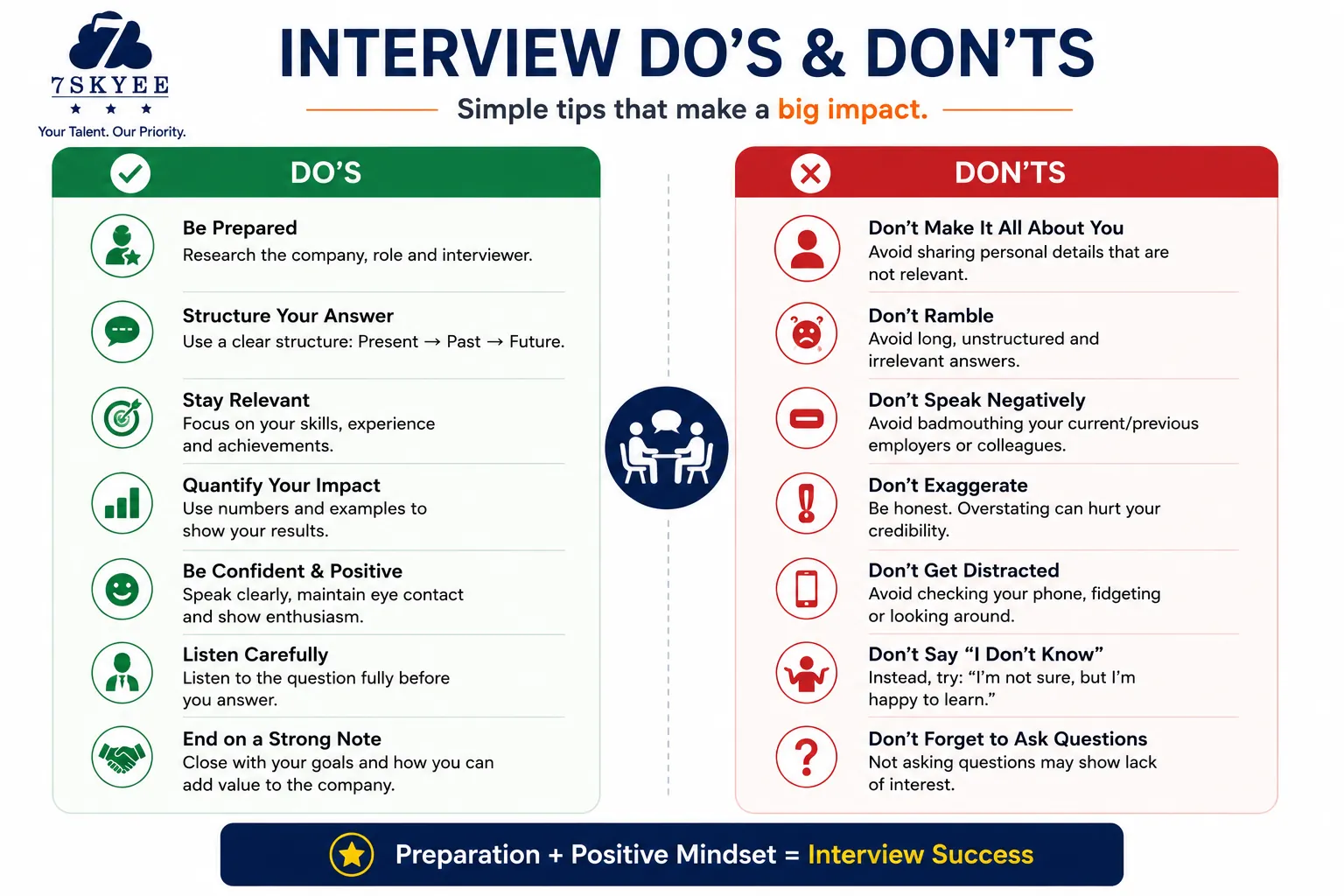
Interview Do's
A successful introduction is about more than just content. How you present yourself has a significant impact on the interviewer's perception.
✓ Prepare Before the Interview
Research the company, understand the job description, and identify the skills most relevant to the role.
✓ Keep Your Answer Professional
Focus on your career journey, achievements, and goals rather than unnecessary personal information.
✓ Follow a Clear Structure
Use the Present → Past → Future framework to keep your answer organized and easy to follow.✓ Quantify Your Achievements
Whenever possible, support your accomplishments with numbers.
Examples:
Increased sales by 25%
Managed a team of 18 employees
Reduced recruitment time by 30%
Numbers make your achievements more credible.
✓ Speak with Confidence
Maintain eye contact, smile naturally, and communicate at a comfortable pace.
Confidence comes from preparation—not memorization.
✓ End Positively
Finish by expressing enthusiasm for the opportunity and explaining why you're excited about the role.
Interview Don'ts
Avoid these common mistakes that can weaken your introduction.
✗ Don't Tell Your Life Story
Recruiters are interested in your professional journey—not your childhood or personal history.
✗ Don't Memorize Every Word
A rehearsed answer often sounds robotic.
Understand the structure instead of memorizing sentences.
✗ Don't Criticize Previous Employers
Speaking negatively about former organizations or managers creates a poor impression.
Remain professional, even when discussing challenging experiences.
✗ Don't Exaggerate
Be honest about your experience and achievements.
Interviewers often verify claims through follow-up questions.
✗ Don't Speak Too Long
Aim to finish within 60–90 seconds.
Leave enough room for the interviewer to ask additional questions.
✗ Don't Forget to Smile
A positive attitude makes you more approachable and leaves a lasting impression.
Final Interview Checklist
Before every interview, ask yourself:
✔ Have I researched the company?
✔ Do I understand the job description?
✔ Have I prepared a structured introduction?
✔ Can I explain my achievements with confidence?
✔ Have I practiced speaking naturally?
✔ Do I know why I want this role?
✔ Am I prepared with thoughtful questions for the interviewer?
If you answered "Yes" to each of these, you're already ahead of many candidates.
Expert Tips from 7Skyee Recruiters
After interviewing thousands of professionals across industries, we've noticed one consistent pattern:
The strongest candidates aren't necessarily the most experienced—they're the ones who communicate their value clearly.
When answering "Tell Me About Yourself," remember these five principles:
Be relevant.
Be concise.
Be confident.
Be authentic.
Focus on value, not just responsibilities.
Your introduction should create curiosity and encourage the interviewer to learn more about you.
Think of it as opening the conversation—not finishing it.
Your introduction should sound natural rather than rehearsed. Practising it aloud and adapting it to your target role can help you communicate your experience more clearly. Explore our Interview Coaching Packages for personalised preparation and practical interview feedback.
Final Thoughts
The question "Tell Me About Yourself" is much more than a routine interview opener. It is your first opportunity to establish credibility, demonstrate confidence, and create a positive first impression.
A well-structured introduction allows interviewers to quickly understand your professional background, recognize your strengths, and see how your experience aligns with their requirements.
The key isn't having the most impressive career history. It's presenting your journey in a way that's relevant, engaging, and memorable.
By using the Present → Past → Future framework, avoiding common mistakes, and practicing your delivery, you'll be able to answer this question with confidence in almost any interview.
Remember, interviews don't begin when the technical questions start—they begin the moment you introduce yourself.
Make those first 90 seconds count.
Frequently Asked Questions
How long should my answer be?
Ideally, between 60 and 90 seconds. This provides enough detail while keeping the interviewer engaged.
Should I mention my family or hobbies?
Only if they're directly relevant to the role or help illustrate a valuable skill. Otherwise, keep the focus on your professional background.
Can I memorize my answer?
You should understand the structure rather than memorize every sentence. Speaking naturally creates a stronger impression.
What if I'm a fresher?
Focus on your education, projects, internships, certifications, technical skills, and enthusiasm to learn.
What if I'm changing careers?
Explain the transferable skills you've developed and why you're making the transition. Show how your previous experience adds value to your new career path.


