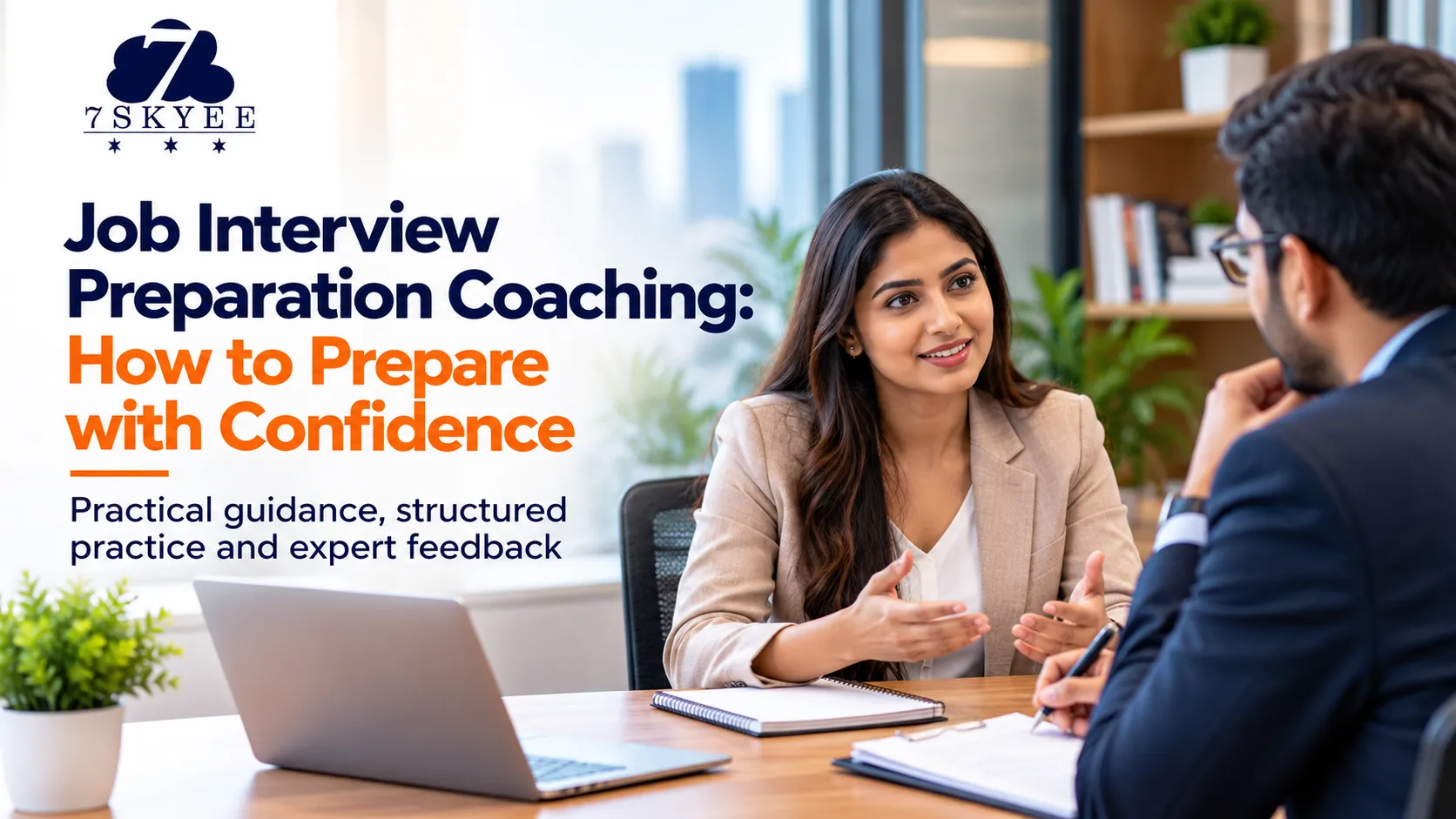
Preparing for a job interview involves much more than reading common interview questions and memorising answers. Employers want to understand how you think, communicate, solve problems and apply your experience to the position they need to fill.
Even experienced professionals can struggle to explain their achievements clearly, handle challenging questions or demonstrate why they are the right person for a role. Freshers and career changers may face different challenges, such as limited interview experience or difficulty connecting their backgrounds to a new opportunity.
This is where job interview preparation coaching can help. Structured preparation gives you an opportunity to organise your thoughts, practise realistic questions, identify weaknesses in your answers and develop a more confident interview approach.
At 7Skyee, our Interview Coaching service helps candidates prepare strategically for important career opportunities.
What Is Job Interview Preparation Coaching?
Job interview preparation coaching is a structured process that helps candidates prepare for interviews based on their experience, target role and career objectives.
Rather than relying only on generic interview tips, candidates work on the specific areas that may influence their performance, including:
Presenting their professional background clearly.
Explaining achievements with relevant examples.
Answering behavioural and competency-based questions.
Communicating their strengths and professional value.
Handling difficult or unexpected questions.
Improving verbal communication and answer structure.
Preparing thoughtful questions for the interviewer.
The objective is not to memorise a perfect script. It is to learn how to communicate relevant information clearly, confidently and authentically.
Why Interview Preparation Matters
Your qualifications and professional experience may help you secure an interview, but your ability to explain your suitability can influence the employer's decision.
Consider a candidate who has managed a team, improved a business process or delivered an important project. Simply mentioning these responsibilities may not demonstrate the full value of their contribution.
A stronger answer explains the situation, the candidate's actions and the outcome.
Interview preparation helps you identify these examples before the interview rather than trying to remember them under pressure.
It can be particularly useful when:
You have attended interviews but struggle to convert them into offers.
You find it difficult to explain your achievements.
You are applying for a promotion or leadership position.
You are returning to work after a career break.
You are changing industries or job functions.
You have an important interview approaching and limited preparation time.
You feel nervous when answering questions in front of a panel.
If you want to understand how recruiters assess candidates, read our related guide on the signals hiring managers actually care about.
How to Prepare for a Job Interview: A Step-by-Step Approach
1. Understand the Role Before Preparing Your Answers
Start by studying the job description carefully.
Identify the responsibilities, skills, qualifications and business outcomes the employer expects from the successful candidate. Look for repeated requirements and distinguish essential capabilities from desirable ones.
For example, a sales manager's interview may focus on revenue growth, team performance, customer acquisition and forecasting. An operations manager may be assessed on productivity, process improvement, cost control and people management.
Your preparation should reflect the role rather than rely on a generic list of interview questions.
Create a simple preparation table:
Job requirementRelevant experienceExample to discussLeadershipManaged a teamImproved team productivityProblem-solvingResolved an operational issueReduced recurring errorsCommunicationWorked with multiple stakeholdersCoordinated a complex projectResults orientationDelivered a business targetImproved a measurable performance indicator
Use genuine examples and accurate figures wherever possible.
2. Prepare a Strong Introduction
One of the most common interview questions is, "Tell me about yourself."
Your answer sets the tone for the conversation. A lengthy account of your personal history or a repetition of your CV may not help the interviewer understand your suitability.
Instead, organise your introduction around three elements:
Professional background: Explain your relevant experience or qualifications.
Key strengths: Highlight capabilities connected to the position.
Career relevance: Explain why your background makes you a suitable candidate for this opportunity.
Keep your introduction concise enough to invite further discussion.
For a practical framework and examples, read our guide on how to answer "Tell me about yourself" in an interview.
3. Build a Bank of Professional Examples
Employers often ask candidates to describe a situation in which they solved a problem, handled a conflict, demonstrated leadership or achieved a difficult objective.
Prepare several examples from your professional or academic experience.
Choose examples that demonstrate different capabilities, such as:
Solving a difficult problem.
Managing competing priorities.
Handling disagreement.
Taking ownership of a mistake.
Improving a process.
Working towards a challenging target.
Leading a team or influencing stakeholders.
For each example, explain the context, your responsibility, the actions you personally took and the result.
The STAR method is a useful structure for behavioural interview questions:
Situation: What was happening?
Task: What responsibility or challenge did you face?
Action: What did you do?
Result: What happened as a result of your actions?
You can learn how to apply this framework in our guide to the STAR method for behavioural interview questions.
4. Practise Common Interview Questions
Preparing for common questions helps you organise your thoughts before the actual interview.
However, avoid memorising every answer word for word. Rehearsed responses can sound unnatural and may become difficult to adapt when the interviewer asks a follow-up question.
Use the following questions as a starting point.
Interview questionWhat your answer should demonstrateTell me about yourself.A clear and relevant professional introductionWhy should we hire you?Your suitability and value for the roleWhat is your greatest strength?A relevant capability supported by evidenceWhat is your biggest weakness?Self-awareness and genuine improvementWhy do you want to leave your current job?A professional and forward-looking explanationDescribe a challenging situation.Problem-solving and decision-makingTell me about a time you handled conflict.Communication and professional judgementWhere do you see yourself in five years?Realistic career direction and alignmentWhat are your salary expectations?Preparation and a reasoned understanding of your expectations
Prepare the central points for each answer, then practise expressing them naturally.
5. Practise Through a Mock Interview
Reading answers silently is not the same as speaking them in an interview.
A mock interview recreates important elements of the actual experience. You answer questions aloud while another person evaluates your clarity, relevance, structure and communication.
A useful mock interview should include:
Questions relevant to your target position.
Follow-up questions that test the depth of your answers.
Practice explaining achievements and professional decisions.
Feedback on answer structure and communication.
An opportunity to repeat weaker answers.
Clear priorities for further improvement.
You can practise with a colleague, mentor or professional coach. The important point is to receive honest feedback and use it to improve.
For a structured practice routine, read our guide to preparing for a mock interview.
6. Improve the Way You Communicate
Strong answers can lose their impact when they are too long, unclear or difficult to follow.
During practice, pay attention to how you communicate, not just what you say.
Clarity: Explain your main point before adding supporting details.
Relevance: Connect your answer to the question and the requirements of the role.
Structure: Organise your response so the interviewer can follow your reasoning.
Evidence: Support important claims with genuine examples.
Pace: Speak at a measured speed and allow the interviewer to follow your explanation.
Listening: Make sure you understand the question before answering. If necessary, ask the interviewer to clarify it.
Professional presence: Maintain appropriate eye contact, attentive body language and a composed manner.
These are skills that improve through deliberate practice rather than memorisation alone.
7. Prepare Questions for the Interviewer
An interview is also an opportunity for you to understand the position and the organisation.
Prepare a few relevant questions, such as:
What would success in this position look like during the first six months?
What are the most important challenges facing the team?
How will performance be evaluated?
What are the key priorities for the person joining this role?
What are the next steps in the recruitment process?
Choose questions that reflect the level of the position and what you genuinely need to understand.
Avoid asking questions that have already been answered clearly during the conversation.
When Should You Consider Professional Interview Coaching?
Self-preparation is useful, but it can be difficult to identify weaknesses in your own answers. You may believe an answer is clear while the interviewer hears an unfocused explanation or struggles to understand your individual contribution.
Professional interview preparation coaching can provide an external perspective and a more structured approach.
It may be particularly valuable if you:
Have attended several interviews without receiving an offer.
Are preparing for a senior management or leadership interview.
Need to communicate complex experience more effectively.
Are moving into a different industry or job function.
Have difficulty answering questions under pressure.
Want realistic practice and specific feedback before an important interview.
A good coaching session should be tailored to your circumstances. It should help you understand what needs improvement, practise the relevant skills and develop a clear plan for your next interview.
Explore the 7Skyee Interview Coaching service to see how structured preparation can support your interview goals.
Interview Preparation for Freshers and Experienced Professionals
The preparation process should reflect your career stage.
For Freshers
Freshers may have limited professional experience, but they can still demonstrate relevant abilities through academic projects, internships, volunteering, presentations and other genuine experiences.
Focus on explaining what you contributed, how you approached challenges and what you learned.
Avoid claiming experience or results you cannot substantiate.
For Mid-Career Professionals
Candidates with several years of experience should focus on measurable contributions, problem-solving, stakeholder management and the skills required for their next role.
Rather than describing every responsibility in their current position, they should select examples that demonstrate the value they can bring to the prospective employer.
For Senior and Leadership Professionals
Senior candidates are often expected to demonstrate strategic thinking, decision-making, leadership, business impact and the ability to manage complex situations.
Prepare examples that show how your decisions affected business performance, teams, customers or organisational priorities.
Be ready to explain not only what you achieved but also why you chose a particular approach and what you learned from the outcome.
How to Evaluate Your Interview Performance
After each practice session, assess your performance honestly.
AreaQuestions to ask yourselfRelevanceDid I answer the question directly?StructureWas my answer easy to follow?EvidenceDid I support my claims with real examples?ClarityDid I communicate my point clearly?ConcisenessDid I avoid unnecessary detail?ConfidenceDid I remain composed when challenged?Role fitDid I connect my experience to the employer's needs?ListeningDid I understand the question before responding?
Choose the two or three areas that need the most improvement and work on those first.
For example, if your answers are too long, practise delivering the main point and supporting evidence in a more focused way. If you struggle with behavioural questions, prepare additional examples and rehearse using the STAR framework.
Progress comes from identifying specific problems and practising better responses.
A Practical 24-Hour Interview Preparation Plan
If your interview is tomorrow, focus on the activities that will make the biggest difference.
First 30 minutes: Review the role
Read the job description and identify the most important requirements.
Next 30 minutes: Select your examples
Prepare relevant examples that demonstrate your skills, achievements and judgement.
Next 30 minutes: Practise key questions
Rehearse your introduction, reasons for applying, strengths and relevant behavioural examples.
Next 30 minutes: Conduct a mock interview
Answer questions aloud and ask a practice partner to challenge you with follow-up questions.
Next 15 minutes: Review and refine
Identify your weakest answers and improve their structure.
Final preparation: Confirm the practical details
Check the interview time, location or video link, travel arrangements and any documents you need.
Avoid spending the entire evening memorising answers. Get adequate rest so you can think clearly during the interview.
Frequently Asked Questions
What is job interview preparation coaching?
Job interview preparation coaching helps candidates prepare for interviews through role-specific questions, answer development, practice and feedback. It aims to improve how candidates communicate their experience and suitability for a position.
Is interview coaching useful for experienced professionals?
Yes. Experienced professionals may benefit from coaching when preparing for promotions, leadership roles, career changes or interviews that require them to communicate complex achievements clearly.
Can mock interviews improve interview performance?
Mock interviews provide an opportunity to practise answers aloud, identify weaknesses and receive feedback before the actual interview. Their value depends on the relevance of the questions and how effectively the candidate applies the feedback.
How many interview coaching sessions do I need?
The number of sessions depends on your experience, target position, current preparation level and interview timeline. Some candidates need focused practice for a specific interview, while others may benefit from more extensive preparation.
Can I prepare for an interview without a professional coach?
Yes. You can review the job description, prepare examples, practise common questions and conduct mock interviews independently. Professional coaching offers an additional perspective, tailored feedback and a more structured preparation process.
How do I choose an interview coaching service?
Look for a service that considers your target role, professional background and preparation needs. Understand what the sessions include, how feedback is provided and what the package costs before making a decision.
You can review the available options in the 7Skyee Interview Coaching packages and pricing section.
Prepare Strategically for Your Next Interview
A successful interview is not about delivering perfect answers to every question. It is about demonstrating that you understand the role, can communicate your experience and have the judgement and capabilities the employer needs.
Start by understanding the job, preparing relevant examples and practising your answers aloud. Use feedback to identify weaknesses, then focus on improving the areas that matter most.
If you want structured support with your preparation, explore 7Skyee Interview Coaching.
Review the available coaching packages and pricing to find an option that suits your preparation needs.
Prepare with purpose. Practise with confidence. Present your experience more effectively.