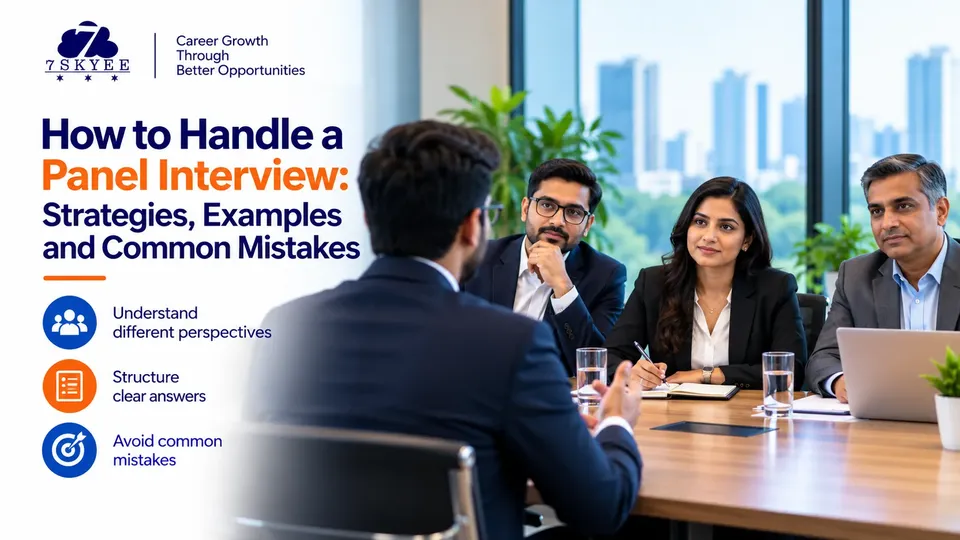
A panel interview can feel more demanding than a one-to-one conversation. Instead of responding to a single interviewer, you may be speaking with a hiring manager, a functional expert, an HR representative and a senior leader in the same room.
Each person may assess something different. One may focus on your technical knowledge, another on how you work with people, and another on whether you can deliver the results the business needs.
The challenge is not to impress everyone with a different answer. It is to communicate your experience clearly, respond thoughtfully and show how your skills fit the role.
From a recruiter’s perspective, a strong panel interview is a conversation with several stakeholders—not a competition to win everyone’s attention at once.
1. Understand what the panel is trying to assess
Panel interviews are often used when a position involves several departments, significant responsibility or decisions that require agreement from multiple stakeholders.
For example, a manufacturing company recruiting a Production Manager may involve the plant head, HR manager and quality head. The plant head may assess production planning, HR may examine leadership and retention, while the quality head may want to understand how the candidate handles defects, audits and compliance.
The same candidate can receive different questions because each interviewer has a different concern.
Before the interview, study the job description and identify the likely priorities of each stakeholder.
Likely interviewer
What they may assess
Hiring manager
Role fit, performance and delivery
HR representative
Communication, motivation and behavioural fit
Functional expert
Technical knowledge and practical judgement
Senior leader
Business impact, ownership and decision-making
These are common patterns rather than fixed rules. The actual panel depends on the organisation and role.
Your preparation should reflect this variety. If you are already preparing answers to standard interview questions, our guide on how to answer “Why should we hire you?” can help you connect your experience to the employer’s needs.
2. Research the role from more than one perspective
Reading the job description once is rarely enough. Break it down into the outcomes the employer expects, the skills needed to deliver them and the people who may be affected by your decisions.
Suppose you are interviewing for a Sales Manager position. The panel may ask about revenue growth, team performance, customer relationships, forecasting and coordination with operations.
Prepare examples that demonstrate these capabilities rather than memorising a separate answer for every possible question.
A useful preparation sheet has four columns:
Requirement: What does the job demand?
Evidence: Which achievement from your career proves you can do it?
Stakeholder: Who is likely to care about this example?
Outcome: What measurable result did you deliver?
For instance, an example about improving sales conversion could demonstrate commercial judgement to the business head, team coaching to HR and forecasting discipline to the finance representative.
This makes your experience more versatile and reduces the risk of sounding unprepared when the panel approaches the same subject from different angles.
3. How to answer when several interviewers are watching
One of the most common mistakes in a panel interview is directing every answer exclusively towards the most senior person in the room.
It is natural to pay attention to the person who appears to have the greatest authority. However, other panel members may be evaluating your response just as carefully.
Use a simple approach:
Begin your answer by making eye contact with the person who asked the question.
Maintain your attention on that person while establishing your main point.
Include the other panel members naturally as you explain your reasoning.
Finish your answer clearly instead of letting your attention drift around the room.
If the interview is online, look towards the camera when making your key point, while still acknowledging each interviewer as they speak.
You do not need to make equal eye contact with everyone at every moment. Natural, composed communication is more effective than consciously trying to distribute your attention.
4. Use a structured example instead of a long explanation
Panel interviews can move quickly. A response that takes five minutes to reach its main point may lose the attention of some interviewers, even when the underlying experience is impressive.
For behavioural questions, the STAR method is a useful framework:
Situation: Briefly explain the context.
Task: Describe your responsibility.
Action: Explain what you personally did.
Result: Share the outcome and what it demonstrated.
Our detailed guide to the STAR method for behavioural interview questions explains how to structure these examples effectively.
Consider a candidate interviewing for an operations role.
Weak answer:
“I have handled production issues many times. I am good at solving problems and coordinating with the team. We always try to achieve the targets.”
This answer makes claims but offers little evidence. The panel cannot see how the candidate actually thinks or acts.
Stronger answer:
“In my previous role, production output was falling short because recurring equipment stoppages were disrupting the shift plan. I reviewed the downtime records with maintenance, identified the recurring causes and introduced a daily review of the main stoppages. We also clarified escalation responsibilities between production and maintenance. This helped reduce avoidable interruptions and made the production plan more reliable.”
The stronger answer explains the problem, the candidate’s contribution and the operational significance. If the candidate has reliable figures, they should add them—for example, the percentage reduction in downtime or the improvement in output.
The principle: provide enough detail to prove your capability, but keep the answer focused on the question.
5. What if two interviewers ask conflicting questions?
Different panel members may have competing priorities. A business head might ask how quickly you can deliver results, while HR may ask how you would maintain team morale during a demanding period.
You should not treat these questions as opposing sides that require you to choose one.
Instead, explain how you balance the priorities.
For example:
“I would first establish the business outcome and the deadline. Then I would assess the team's capacity, identify the critical tasks and agree on priorities with the relevant stakeholders. If the deadline created a genuine resource constraint, I would communicate the risk early and propose options rather than make a commitment the team could not realistically deliver.”
This response demonstrates commercial awareness without ignoring people management.
If you disagree with an interviewer’s premise, remain respectful. Clarify your understanding, explain the evidence behind your view and acknowledge any legitimate trade-off.
A panel interview is also an opportunity to demonstrate how you handle disagreement—something employers may expect you to do in the role itself.
6. How to handle difficult follow-up questions
Panel members may challenge an example to understand your actual contribution.
Questions could include:
“What exactly did you do personally?”
“Why did you choose that approach?”
“What would you do differently now?”
“How do you know the result was caused by your actions?”
“What happened when the team disagreed with you?”
These questions are not automatically signs that the panel doubts you. Interviewers may simply be testing the depth of your experience.
Avoid becoming defensive or repeating your original answer word for word.
Instead, respond directly, explain your reasoning and acknowledge limitations where appropriate. If you made a mistake, describe what you learnt and how you changed your approach.
For example:
“Looking back, I would involve the quality team earlier. We resolved the immediate issue, but earlier coordination would have helped us identify the downstream impact sooner.”
A thoughtful reflection can demonstrate maturity more convincingly than an attempt to present every past decision as perfect.
7. Common panel interview mistakes to avoid
Speaking only to the most senior interviewer
Recognise the questioner, but include the wider panel in the conversation. Other stakeholders may have significant influence over the hiring decision.
Giving long, unfocused answers
Lead with the main point, support it with a relevant example and finish with the outcome. Let the panel ask for more detail where needed.
Using the same example for every question
Prepare several examples covering problem-solving, teamwork, leadership, conflict and measurable results. Reuse an example only when it genuinely answers the question.
Becoming defensive when challenged
Listen to the complete question before responding. Explain your reasoning calmly and correct any misunderstanding without arguing.
Memorising scripted answers
Prepare the evidence and structure behind your answers, not a speech to recite. A natural response is easier to adapt to unexpected follow-up questions.
8. What should you ask at the end of a panel interview?
Your questions should show that you are thinking about the role and its outcomes—not simply trying to make a final impression.
Choose one or two questions that have not already been answered during the discussion.
Examples include:
“What would success in this position look like in the first six months?”
“Which business or team challenges would you want the person joining this role to address first?”
“How does this role work with the other functions represented here?”
“What would distinguish someone who performs well in this position from someone who performs exceptionally well?”
These questions help you understand the expectations behind the job title. They also allow different panel members to explain their priorities.
If you have a specific concern about reporting lines, travel, targets or decision-making authority, ask it professionally rather than making assumptions.
9. A practical preparation plan for the day before
The best preparation is targeted rather than endless. Use this checklist to identify gaps before the interview.
Panel interview readiness checklist
0 of 7
Review the job description and identify the five most important requirements.
Research the company, its business model and recent relevant developments.
Prepare four to six examples covering achievements, problem-solving, conflict and leadership.
Practise your introduction and your reasons for wanting the role.
Prepare for technical, functional and behavioural follow-up questions.
Prepare two thoughtful questions for the panel.
Check the interview time, location or video link, and keep copies of your CV ready.
Reset checklist
If you are preparing for a particularly important interview, practise aloud rather than only reading your notes. A mock interview can reveal whether your answers are too long, whether your examples demonstrate enough evidence and whether you handle follow-up questions comfortably.
10. How to make a strong final impression
A panel interview does not require a perfect answer to every question. It requires credible evidence that you understand the role, can explain your decisions and are likely to work effectively with the people who will depend on you.
Focus on three things:
Clarity: Answer the question asked before adding extra detail.
Evidence: Support important claims with real examples and outcomes.
Judgement: Explain how you approach decisions, trade-offs and difficult situations.
Your answers should also remain consistent with your experience and CV. If a panel asks about a career transition or employment gap, prepare a clear and honest explanation rather than improvising under pressure. Our guide on how to explain a career gap in an interview covers this situation in more detail.
For candidates looking for local support, 7Skyee also provides Interview Coaching in Hyderabad, alongside its main Interview Coaching service. The service focuses on role-specific preparation, mock interviews, answer refinement and practical feedback.
Final takeaway
The most effective way to handle a panel interview is to prepare for the different perspectives in the room without losing sight of the job itself.
Understand the role, build a bank of strong examples, answer with structure and remain composed when interviewers probe your decisions. Above all, demonstrate how you think and what you can contribute—not just how well you can deliver a rehearsed answer.
A panel interview is not simply a test of confidence. It is an opportunity to show that your experience, judgement and communication are suited to the responsibility you are seeking.