

Behavioral interview questions are designed to understand how you have handled real situations—not simply what you know.
Questions such as “Tell me about a time when you handled a difficult situation,” “Describe a conflict you resolved,” or “Give me an example of when you demonstrated leadership” can be difficult because there is no single correct answer.
The interviewer wants to hear a relevant example from your experience and understand what happened, what you were responsible for, what you actually did and what happened as a result.
The STAR method provides a simple structure for answering these questions clearly.
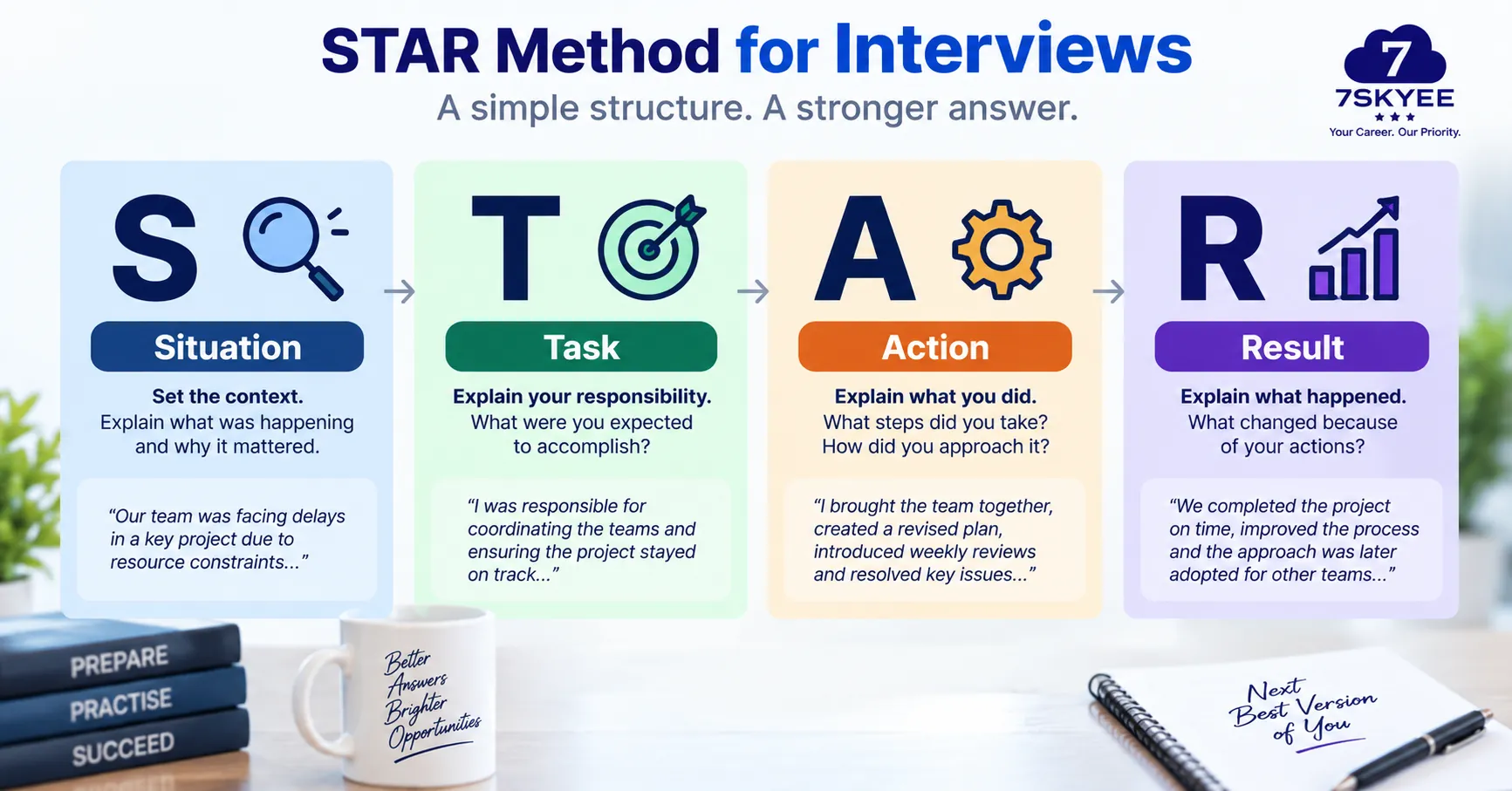
STAR stands for:
S — Situation
T — Task
A — Action
R — Result
Used properly, the method can help you avoid long, unfocused answers and make your experience easier for an interviewer to evaluate.
What Is the STAR Method?
The STAR method is a structured approach for answering behavioural and competency-based interview questions using a real example from your experience.
Instead of giving a general statement such as:
“I am good at handling pressure.”
you provide evidence.
You explain:
The situation you faced
The responsibility or challenge you had
The actions you personally took
The result of those actions
For example, instead of saying:
“I am good at resolving conflicts.”
you might explain a specific disagreement between two team members, describe your role in resolving it, explain what you did and then demonstrate what changed as a result.
The fundamental principle
Don't just tell the interviewer what you are capable of. Show them through a relevant example.
What Does STAR Stand For?
S — Situation
Set the context.
Explain what was happening, where you were working and why the situation mattered.
Keep this part concise.
Example
“In my previous role, our team was preparing for the launch of a new service, but we were facing delays because three departments were working with different priorities.”
This gives the interviewer enough context without spending two minutes describing the entire company.
T — Task
Explain your responsibility.
What were you expected to accomplish?
What problem were you responsible for solving?
Example
“I was responsible for coordinating the teams and ensuring that the launch remained on schedule.”
The Task should make your personal responsibility clear.
A — Action
This is usually the most important part of your answer.
Explain what you did.
Don't spend most of your answer describing what your team, manager or company did.
Explain:
What did you decide?
What did you change?
Who did you involve?
How did you approach the problem?
What alternatives did you consider?
How did you communicate?
What did you personally contribute?
Example
“I brought the three department leads together, mapped the outstanding dependencies and created a shared delivery plan. I then introduced short weekly progress reviews and assigned clear owners to each critical activity. When one dependency remained delayed, I worked directly with the relevant team to identify an alternative solution rather than waiting for the original timeline.”
Now the interviewer can see your behaviour and decision-making, rather than simply hearing that the team succeeded.

R — Result
Explain what happened because of your actions.
Whenever possible, use measurable results.
Example
“We completed the remaining activities within the revised timeline and launched the service without delaying the planned customer rollout. The coordination process was subsequently adopted for other cross-functional projects.”
A strong result can include:
Revenue impact
Cost reduction
Time saved
Customer improvement
Productivity
Team performance
Successful delivery
Process improvement
Business expansion
Promotion or recognition
But don't invent numbers simply to make an answer sound impressive.
A credible result is better than an impressive-looking number you cannot defend.
Why Do Recruiters Ask Behavioural Questions?
A resume tells an interviewer about your career history.
A behavioural interview can provide evidence of how you operate in real situations.
Depending on the question, the interviewer may be trying to understand:
Problem-solving
Leadership
Communication
Teamwork
Decision-making
Ownership
Adaptability
Conflict management
Prioritisation
Customer focus
Resilience
Commercial judgement
For example, asking:
“Tell me about a time you disagreed with your manager.”
may not simply be about disagreement.
The interviewer may be assessing:
Can you challenge an idea professionally?
Can you explain your position without becoming defensive?
Can you accept a different decision?
Can you maintain a productive relationship afterwards?
That is why memorising generic answers isn't enough.
You need to understand what the question is actually trying to evaluate.
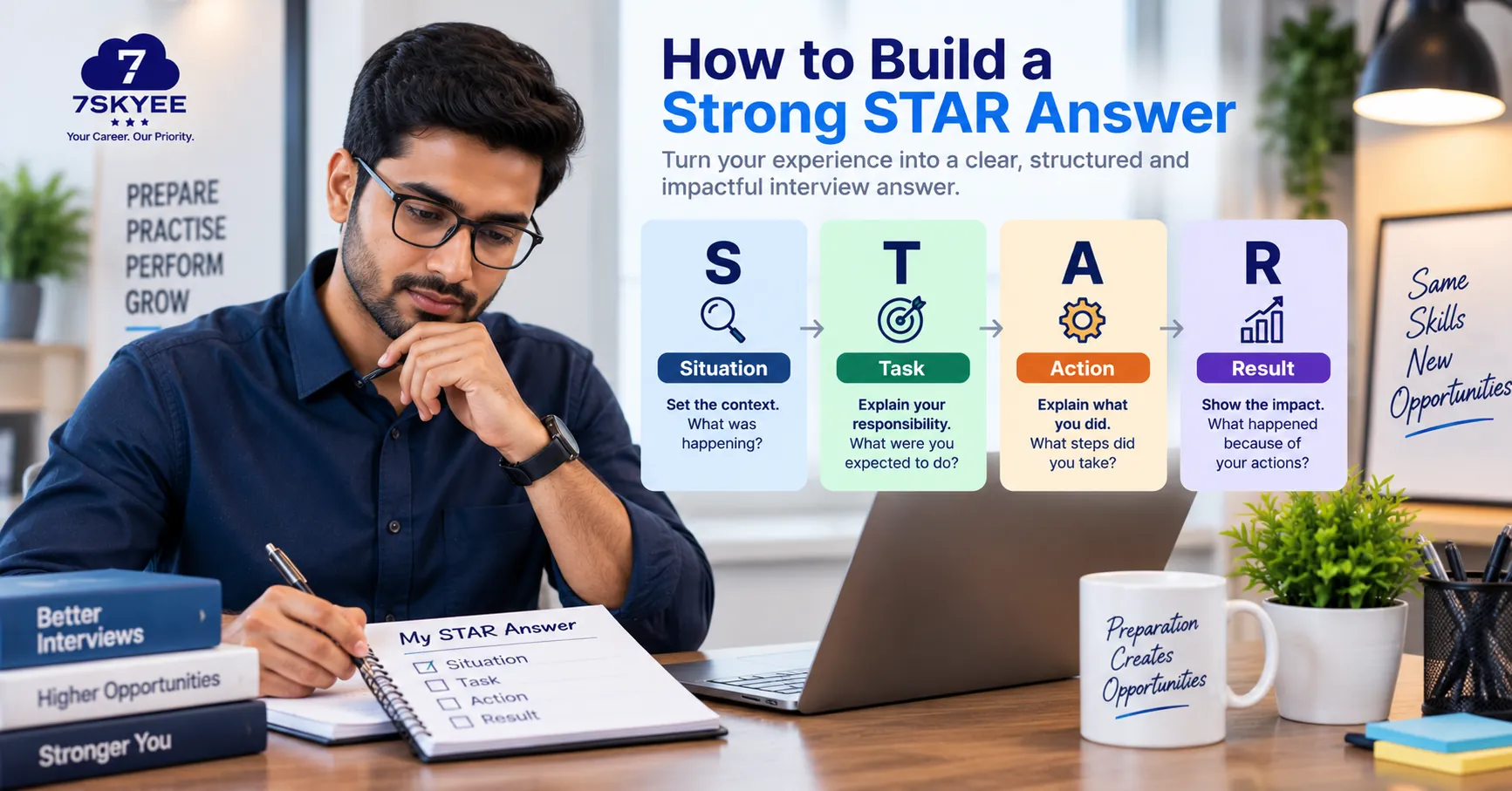
How to Build a Strong STAR Answer
A useful STAR answer follows this sequence:
Situation
What was happening?
↓
Task
What were you responsible for?
↓
Action
What did you personally do?
↓
Result
What changed because of your actions?
A simple preparation template is:
Situation: At [company/team], we faced [specific situation].
Task: I was responsible for [specific responsibility].
Action: I [specific actions you personally took].
Result: As a result, [measurable or meaningful outcome].
You shouldn't necessarily speak these labels aloud during the interview.
They are primarily a thinking framework that helps you organise your response.

STAR Example: Leadership
Question
“Tell me about a time when you had to lead a team through a difficult situation.”
Situation
“In my previous organisation, we were going through a period of rapid growth and our team had to handle a significantly higher workload without an immediate increase in headcount.”
Task
“As the team lead, I needed to maintain delivery quality while helping the team manage the increased workload.”
Action
“I reviewed the workload across the team, identified activities that could be prioritised or automated and redistributed responsibilities according to individual strengths. I also introduced short weekly check-ins so that potential issues could be identified earlier. For the most critical activities, I personally supported the team members who were facing the greatest pressure.”
Result
“The team maintained delivery during the growth period, critical deadlines were met and we subsequently retained the revised workload-planning process.”
Notice that the answer doesn't simply say:
“I am a good leader.”
It provides evidence of leadership.
STAR Example: Handling a Difficult Situation
Question
“Tell me about a difficult situation you handled at work.”
A good answer doesn't need to involve a dramatic crisis.
A difficult situation could involve:
A demanding client
A missed deadline
A team conflict
A resource shortage
A project problem
A change in business priorities
A difficult stakeholder
Example
“A key client was unhappy because a project milestone had been delayed. I was responsible for managing the relationship and getting the project back on track. I first spoke with the internal team to understand the actual cause of the delay rather than immediately making commitments to the client. I then created a revised delivery plan, discussed the options openly with the client and established more frequent progress updates. We completed the delayed milestone under the revised plan and restored the client's confidence in the project.”
The answer demonstrates:
Ownership → investigation → communication → action → outcome.
STAR Example: Meeting a Tight Deadline
Question
“Tell me about a time when you had to deliver something under significant time pressure.”
A useful answer might look like:
“We had to complete an important client deliverable within a significantly shorter timeframe than originally planned. I reviewed the deliverables and separated the essential activities from those that could be completed later. I reassigned tasks based on team capability, established daily checkpoints and personally handled the highest-risk dependencies. We completed the critical deliverables within the required timeframe and avoided delaying the client's wider project.”
The important point is that the candidate explains how they prioritised and acted, rather than simply saying:
“I worked hard and completed it.”
STAR Example: Failure or Mistake
This is one of the more difficult behavioural questions.
Question
“Tell me about a time when you made a mistake.”
Don't try to pretend you've never made one.
Instead, choose an example that demonstrates:
Awareness → Ownership → Correction → Learning
For example:
“Early in my previous role, I underestimated the time required for a cross-functional project because I relied too heavily on the initial estimates. Once I recognised the issue, I discussed it with the stakeholders, revised the delivery plan and introduced dependency tracking for similar projects. The immediate project was completed with a revised timeline, and the planning process helped us identify risks earlier in subsequent projects.”
The objective isn't to demonstrate that you are perfect.
It is to demonstrate that you can recognise problems, take responsibility and improve.

STAR Example: Conflict With a Colleague
Question
“Tell me about a time when you had a disagreement with a colleague.”
Avoid blaming the other person.
Instead, focus on:
The source of the disagreement
Your approach
Communication
Resolution
What you learned
For example:
“A colleague and I had different views about how a project should be prioritised. Rather than continuing the discussion informally, I suggested that we compare both approaches against the project's objectives, timeline and available resources. We reviewed the options together and agreed on a hybrid approach. The project moved forward without the disagreement affecting the wider team.”
This demonstrates maturity.
How to Answer “Tell Me About a Time When…”
When you hear:
“Tell me about a time when…”
don't immediately start speaking.
Take a few seconds to identify the best example.
Ask yourself:
What competency is the interviewer testing?
Is it:
Leadership?
Teamwork?
Problem-solving?
Conflict management?
Decision-making?
Adaptability?
Communication?
Then select the example that provides the strongest evidence.
Don't choose the most dramatic story.
Choose the story that best demonstrates the competency.
A relatively ordinary workplace situation can produce a stronger answer than an exaggerated story if it clearly demonstrates your judgement and actions.
How Long Should a STAR Answer Be?
There is no perfect number of seconds for every behavioural question.
As a practical guide, many STAR answers can be delivered in approximately 1–2 minutes, depending on the complexity of the example.
The Action section should generally receive the most attention.
A useful mental balance is:
Situation: Short
Task: Short
Action: Detailed
Result: Clear
If your answer takes five minutes, you may be giving too much background.
If it takes 20 seconds, you may not be providing enough evidence.
Remember:
The interviewer wants the story, not the entire history of the situation.
STAR Method for Senior & Executive Professionals
Senior professionals need to be particularly careful with behavioural answers.
At senior levels, simply explaining what you personally did may not be enough.
Interviewers may also want to understand:
Strategic judgement
Business impact
Leadership philosophy
Stakeholder management
Commercial thinking
Decision-making under uncertainty
Organisational influence
Change leadership
Risk management
For example, instead of saying:
“I managed the team through a difficult period.”
an executive-level answer could explain:
“The business was entering a new market and we had limited internal capability. I assessed the capability gap, prioritised the functions that needed to be built first and worked with the leadership team to determine whether we should build, hire or outsource each capability.”
Then explain the actions and resulting business impact.
At senior levels, think beyond activity.
Ask:
What business decision did I influence?
What problem did I solve?
What changed because of my leadership?
That is often much more valuable than simply describing your daily responsibilities.
Common STAR Method Mistakes
1. Giving a hypothetical answer
If asked:
“Tell me about a time…”
don't respond:
“If that happened, I would…”
The interviewer asked for evidence from your experience.
2. Spending too long on the Situation
Candidates sometimes spend most of the answer explaining company history, organisational structure and background.
Keep the context relevant.
3. Talking about "we" too much
Teamwork matters, but the interviewer needs to understand your contribution.
Instead of:
“We analysed the problem and we implemented a new process.”
say:
“I analysed the problem and worked with the team to implement a new process.”
That makes your role clearer.
4. Forgetting the Result
Don't finish with:
“And then we implemented the solution.”
Explain what happened afterwards.
5. Using the same example repeatedly
Prepare several examples.
Ideally have stories covering:
Leadership
Conflict
Failure
Problem-solving
Teamwork
Tight deadline
Difficult stakeholder
Change
Achievement
One experience may demonstrate multiple competencies, but having several examples gives you greater flexibility.
6. Memorising answers word-for-word
Preparation is good.
Memorisation can make an answer sound rehearsed.
Prepare the story and key points, not a script.
A 5-Step STAR Preparation Exercise
Before an important interview, create a simple preparation sheet.
Step 1: Identify the competencies
Look at the job description and identify capabilities the employer appears to value.
Step 2: List your examples
Write down real situations from your career.
Step 3: Map each example to a competency
For example:
Leadership → Team restructuring
Problem-solving → Process improvement
Conflict → Stakeholder disagreement
Failure → Missed project estimate
Step 4: Convert each example into STAR
Write four short sections:
Situation
Task
Action
Result
Step 5: Practise aloud
Speaking is different from writing.
Practise explaining the example naturally without reading it word-for-word.
10 Behavioural Interview Questions to Practise
Before your next interview, prepare STAR examples for questions such as:
Tell me about a time you demonstrated leadership.
Tell me about a difficult problem you solved.
Describe a time you disagreed with a colleague or manager.
Tell me about a time you failed or made a mistake.
Describe a time you worked under significant pressure.
Tell me about a time you had to meet a challenging deadline.
Describe a time you dealt with a difficult stakeholder or customer.
Tell me about a time you introduced an improvement.
Describe a situation where you had to adapt to change.
Tell me about an achievement you are particularly proud of.
Don't prepare ten completely separate speeches.
Build a library of strong career stories that can be adapted to different questions.
Your Final STAR Interview Checklist
Before the interview, ask yourself:
Situation
☐ Can I explain the context quickly?
Task
☐ Is my responsibility clear?
Action
☐ Have I explained what I did?
☐ Have I explained my decision-making?
Result
☐ Have I clearly explained the outcome?
☐ Can I quantify the result where appropriate?
Relevance
☐ Does the example demonstrate the competency being tested?
Delivery
☐ Can I explain the story naturally without memorising a script?
If you can answer these questions, your behavioural interview responses are likely to become much clearer and more structured.
The STAR Method Is a Structure—Not a Script
The biggest mistake candidates make with the STAR method is treating it like a formula that must produce a perfect answer.
It isn't.
The purpose of STAR is to help you organise your experience so the interviewer can understand it.
A strong behavioural answer should still sound like you.
Use real examples. Be specific about your contribution. Explain your decisions. Be honest about challenges. And always finish by explaining what happened.
Most importantly, don't wait until the interview to discover which examples you want to use.
The strongest STAR answers usually come from candidates who have already reflected on their career experiences and know which stories demonstrate their capabilities.
Writing a structured answer is a useful start, but practising it aloud can reveal where your example needs more detail or a clearer result. Explore our Interview Coaching Packages for mock interview practice and personalised feedback on your interview responses.
Frequently Asked Questions
What is the STAR method in an interview?
The STAR method is a framework for answering behavioural interview questions. It stands for Situation, Task, Action and Result and helps candidates explain real workplace examples in a structured way.
What does STAR stand for?
STAR stands for Situation, Task, Action and Result. Situation explains the context, Task explains your responsibility, Action explains what you did and Result explains the outcome.
Is the STAR method suitable for experienced professionals?
Yes. It can be particularly useful for experienced and senior professionals because it provides a structured way to demonstrate leadership, decision-making, stakeholder management and business impact.
How long should a STAR answer be?
There is no fixed duration, but many behavioural answers can be effectively delivered in around one to two minutes. Keep the situation and task concise and spend more time explaining your actions and results.
Should I use STAR for every interview question?
No. STAR is primarily useful for behavioural and competency-based questions, particularly questions asking you to describe a specific past experience.
What should I do if I don't have a measurable result?
Use the most meaningful outcome you can accurately explain. Results can include successful delivery, improved processes, stronger relationships, reduced risk, customer outcomes or lessons that changed how you worked.
Should I memorise STAR answers?
It is better to prepare your examples and key points rather than memorise complete answers. Memorised responses can sound unnatural and may make it harder to adapt when the interviewer asks a follow-up question.
Can I use the same STAR example for different questions?
Yes, if the example genuinely demonstrates the competency being tested. However, prepare several examples so you can choose the most relevant story for each question.

