

You update your resume.
You create a LinkedIn profile.
You register on job portals.
Then you start applying.
One application becomes ten.
Ten become fifty.
Fifty become another version of the same message:
“Application submitted.”
And then you wait.
For many professionals, this is what a job search has become.
The problem isn't necessarily a lack of vacancies.
The problem is that you are doing the entire search yourself.
Finding opportunities.
Deciding which ones fit.
Applying.
Following up.
Preparing for interviews.
Trying to understand employer expectations.
Negotiating an offer.
And often doing all of this while working full-time.
This is where the idea of a Personal Recruiter becomes interesting.
A Personal Recruiter is not simply someone who forwards you job vacancies.
The concept is much closer to having a dedicated recruitment professional working alongside you during your job search.
Instead of asking:
“Where are the jobs?”
the process becomes:
“Which opportunities make sense for this particular professional—and how do we pursue them effectively?”
That difference matters.
First, What Does a Personal Recruiter Actually Do?
A Personal Recruiter provides dedicated support around an individual's job search.
Depending on the service and agreed scope, that support can include:
Understanding your career objective
Defining target roles
Identifying suitable employers
Searching for relevant opportunities
Mapping the target market
Reviewing your professional positioning
Supporting your resume and LinkedIn positioning
Helping prepare for interviews
Coordinating parts of the recruitment process
Providing feedback during the search
Helping evaluate offers
Maintaining a structured search process
The exact services can vary between providers.
That is important.
“Personal Recruiter” is not a universally standardised job title or regulated service.
Different companies may use the term differently.
So before paying for such a service, understand exactly what is included.

A Personal Recruiter Is Not the Same as a Job Portal
This is where many people misunderstand the concept.
A job portal gives you access to opportunities.
You search.
You filter.
You apply.
A Personal Recruiter is intended to provide human support around the search.
Think about the difference.
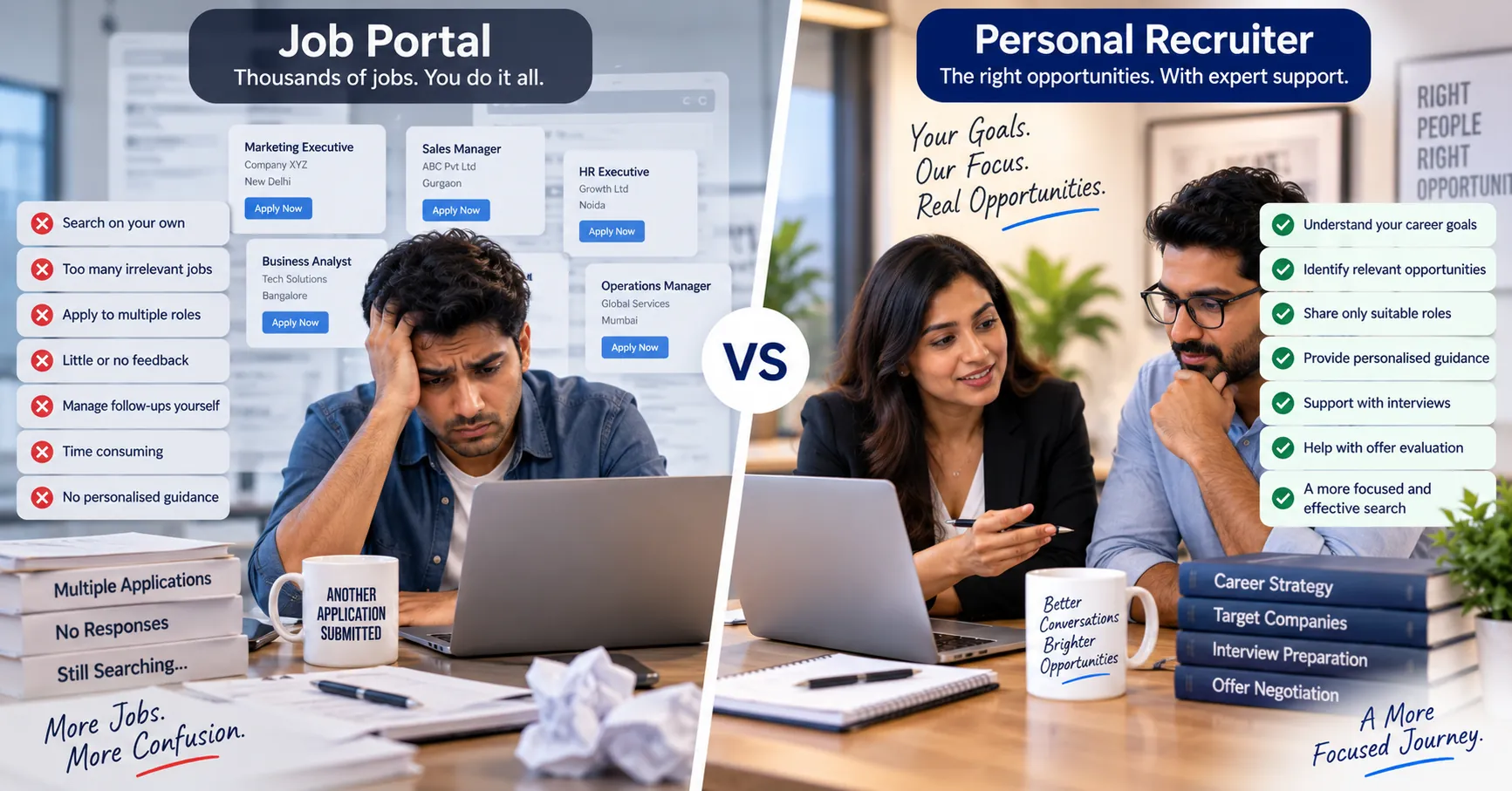
Job Portal
Opportunity → You find it → You apply
Personal Recruiter
Your career goal → Target opportunities → Recruiter-led search → Relevant introductions/applications → Interview support → Offer evaluation
The second approach is more involved.
It is also why a Personal Recruiter service should not be judged simply by the number of vacancies shown to you.
The value is in relevance, strategy, human involvement and execution.
What If You Already Have a Good Resume?
You might be thinking:
“I already have a strong resume. Why would I need a Personal Recruiter?”
That's a fair question.
A resume solves one part of the job search.
It doesn't solve everything.
Imagine a senior finance professional targeting a move into a larger organisation.
Their resume may be perfectly written.
But they still need to determine:
Which companies should they target?
Which roles actually fit their experience?
Is their salary expectation realistic?
Which employers are currently hiring?
How should they position themselves?
Which opportunities are worth pursuing?
How should they handle interviews?
How should they compare offers?
A strong resume can help you present yourself.
A Personal Recruiter is intended to help with the search around that profile.
Those are different functions.
The Biggest Difference: Someone Is Focused on Your Search
When you apply for jobs yourself, you are usually managing multiple priorities.
Your current job.
Your family.
Your daily responsibilities.
Your inbox.
Your interviews.
Your applications.
Your follow-ups.
Your recruiter conversations.
It is easy for the job search to become inconsistent.
One week you apply aggressively.
The next week you don't have time.
Then you see a vacancy three days after it was posted.
A dedicated recruiter can bring greater structure to the process.
Instead of:
“I should probably apply for some jobs this weekend.”
the search becomes:
Target → Search → Evaluate → Approach → Interview → Review → Adjust
That is a fundamentally different experience.

But Does a Personal Recruiter Guarantee a Job?
This is one of the most important questions to ask.
No legitimate recruitment service should imply that employment can be guaranteed regardless of market conditions, candidate fit or employer decisions.
A Personal Recruiter can influence the quality and structure of your search.
They cannot control:
Whether an employer has an opening
How many candidates apply
Employer selection decisions
Interview outcomes
Internal hiring freezes
Changes in company requirements
Salary budgets
Market conditions
So the better promise is not:
“We will get you a job.”
It is:
“We will give your job search focused professional support and pursue relevant opportunities within the agreed scope.”
That distinction makes the service more credible.
Who Can Benefit From a Personal Recruiter?
A Personal Recruiter isn't necessarily for everyone.
If you're happy searching independently, have plenty of time and receive strong responses from employers, you may not need one.
But dedicated recruiter support can be particularly interesting for professionals who fall into one of these situations.

You're Already Working but Don't Have Time to Search
This is one of the most obvious use cases.
You may want to move but don't have several hours every week to search, research companies and follow up.
You're Looking for a Specific Type of Opportunity
Perhaps you're targeting:
A particular industry
A particular city
A particular state
A specific country
Senior management positions
Specialist roles
International opportunities
A targeted search can make more sense than applying broadly.
You're Not Sure Which Opportunities Are Worth Pursuing
More vacancies aren't necessarily better.
You may need help filtering them.
You're Senior or Experienced
At senior levels, the search can become less about applying to hundreds of vacancies and more about positioning, target companies, relationships and relevant opportunities.
You're Planning an International Move
Searching across another country's employment market introduces additional considerations.
You may need to understand:
Market expectations
Role terminology
Employer landscape
Compensation
Location
Professional positioning
Eligibility or work-authorisation considerations
A recruiter familiar with the relevant market can potentially make the process more structured.
The Real Question Isn't “Can Someone Find Me a Job?”
It is:
“Can someone make my job search more focused than what I am doing alone?”
That's the better way to evaluate a Personal Recruiter.
Imagine two professionals with similar experience.
Professional A
Applies to 150 jobs.
Some are relevant.
Many aren't.
Their resume is slightly different for every application.
They track everything in spreadsheets.
They follow up inconsistently.
Professional B
Defines a target.
Builds a list of relevant employers.
Prioritises suitable roles.
Positions their profile around those roles.
Tracks the search.
Prepares deliberately for interviews.
Reviews what is working and adjusts.
The second professional isn't guaranteed a better outcome.
But their process is more deliberate.
That's the fundamental idea behind personal recruitment support.
What Should You Expect From a Good Personal Recruiter?
If you're considering paying for this type of service, don't just ask:
“How many jobs will you send me?”
Ask better questions.
1. Will someone actually work on my search?
You should understand whether you're receiving genuine human involvement or simply automated vacancy alerts.
2. Will my search be targeted?
Ask how roles and employers will be selected.
3. What geographic area is covered?
This is particularly important for international services.
"Global" can mean very different things between providers.
4. What roles can you target?
Understand whether there are restrictions around role, seniority or industry.
5. How long does the service last?
You should know the exact service validity period before purchasing.
6. What happens after I receive an interview?
Find out whether interview preparation or recruiter feedback is included.
7. Is offer evaluation included?
For senior professionals, this can be particularly useful.
8. What isn't included?
A professional service should clearly explain its boundaries.
Personal Recruiter vs Applying Alone
Here's a simple comparison.
Job Search AlonePersonal RecruiterYou define your searchSearch can be structured with a recruiterYou find opportunitiesRecruiter helps identify relevant opportunitiesYou decide what to apply forOpportunities can be filtered against your targetYou manage applicationsSearch can be organised systematicallyYou prepare independentlyInterview support may be includedYou evaluate offers aloneOffer evaluation may be availableYou manage the entire processDedicated support throughout the agreed scope
The Personal Recruiter model isn't necessarily about doing everything for you.
It's about giving you professional support around a process that is normally difficult to manage alone.
Is a Personal Recruiter the Same as a Traditional Recruitment Agency?
No.
A traditional recruitment agency generally works on behalf of employers.
The employer has a vacancy.
The recruiter searches for candidates.
The employer is the client.
A Personal Recruiter service, by contrast, is designed around the job seeker's search.
The professional becomes the person receiving the dedicated service.
This changes the starting point.
Instead of:
Employer → Vacancy → Candidate
the process begins with:
Professional → Career Goal → Target Market → Relevant Opportunities
That is why the two models shouldn't be confused.
What About Recruiters Who Contact You on LinkedIn?
That's another common question.
If a recruiter contacts you about a vacancy, that doesn't necessarily mean they are your Personal Recruiter.
They may be recruiting for a specific employer.
Their responsibility is generally connected to filling that employer's position.
A Personal Recruiter is different because the search is built around your career objectives and agreed service scope, rather than one employer's vacancy.
How a Personal Recruiter Search Can Work
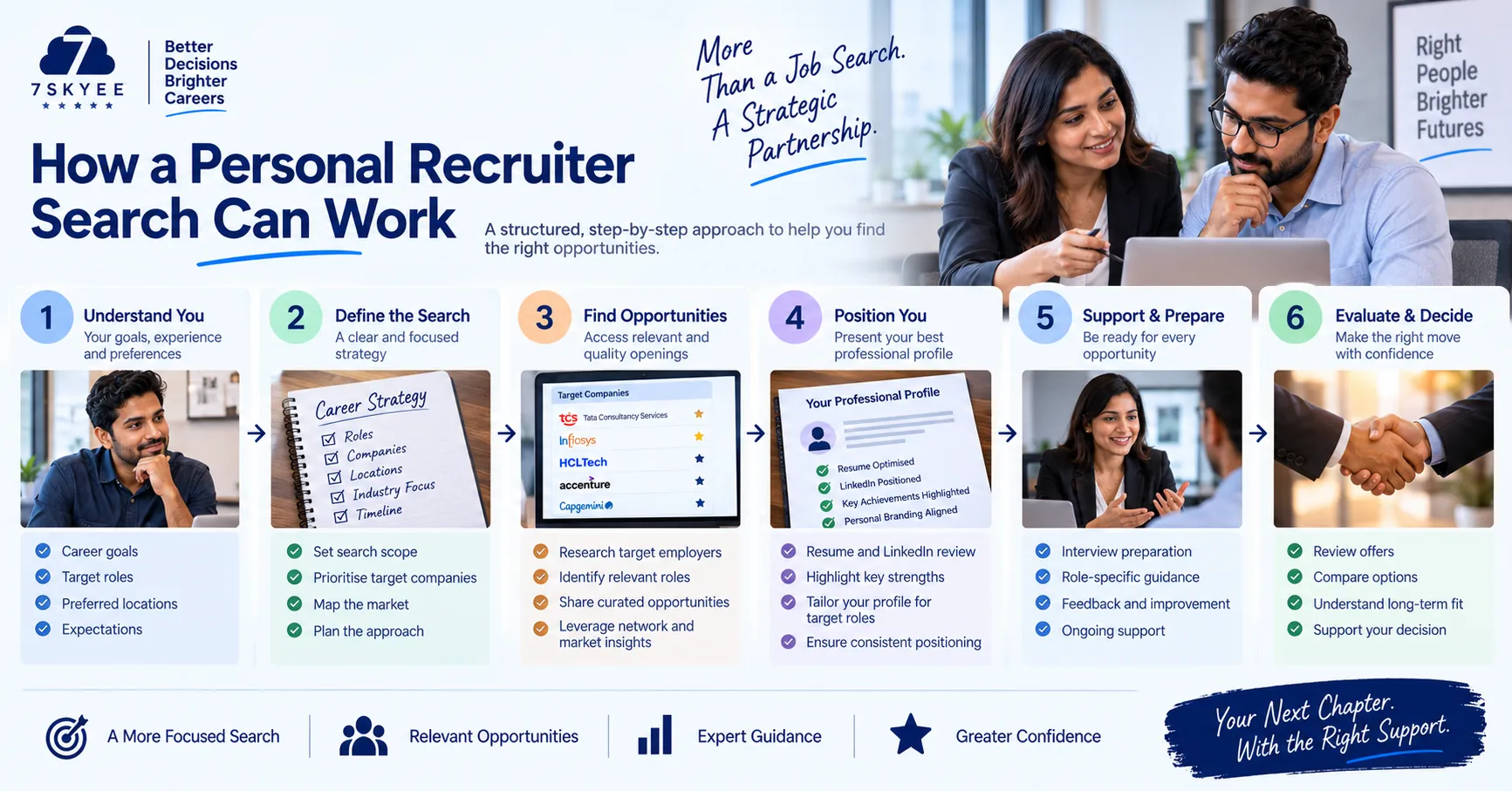
A good process might look something like this:
First: Understand You
Your experience, goals, target roles, preferred locations and expectations.
Then: Define the Search
Which employers, industries, locations and roles should be targeted?
Then: Build the Market
Identify relevant companies and opportunities.
Then: Position You
Make sure your professional profile communicates the value you bring to the target market.
Then: Pursue Opportunities
Focus the search on relevant openings and employer opportunities within the agreed scope.
Then: Prepare
When interviews arise, help you prepare for the specific opportunity.
Finally: Evaluate
Consider feedback, compensation and the overall opportunity before making decisions.
The process should remain structured but flexible.
If the market isn't responding, the strategy may need to change.
What a Personal Recruiter Should Not Do
A professional service should also have boundaries.
A Personal Recruiter shouldn't encourage you to:
Apply indiscriminately
Misrepresent your experience
Fabricate qualifications
Hide important employment information
Accept an unsuitable role simply to close the search
Pay unexplained fees
Assume an employer's decision can be controlled
Your career remains your decision.
The recruiter's job is to support the search—not take ownership of your professional choices.
Is It Worth Paying for a Personal Recruiter?
That depends on your circumstances.
Consider three things:
Your Time
How much time are you currently spending on your job search?
Your Search Complexity
Are you looking for a general job or a highly specific opportunity?
Your Opportunity Cost
What could a more focused search mean for your career, time and professional positioning?
For someone casually exploring opportunities, a Personal Recruiter may not be necessary.
For someone who is employed, experienced, time-poor and targeting a specific market, the value proposition may be considerably stronger.
The important thing is to evaluate the service you are actually buying, rather than the label.
A Personal Recruiter Should Work With You, Not Just For You
There is another misconception worth addressing.
Hiring a Personal Recruiter doesn't mean you stop participating in your own job search.
You still need to:
Provide accurate information
Communicate your goals
Attend interviews
Respond to opportunities
Make career decisions
Negotiate when appropriate
Provide feedback
The strongest relationship is collaborative.
You bring the career.
The recruiter brings recruitment expertise, market focus and structured search support.
Together, the process can become more effective.
So, Is a Personal Recruiter Right for You?
Ask yourself:
Do I know exactly what I want next?
If yes, that's a good starting point.
Do I have limited time to search?
If yes, dedicated support may be useful.
Am I applying repeatedly without getting enough relevant opportunities?
You may benefit from a more targeted strategy.
Am I targeting a specific city, country, industry or seniority level?
A defined search scope can be particularly valuable.
Do I want someone with recruitment experience to help navigate the process?
That's precisely where a Personal Recruiter can add value.
But if you're still unsure about what career you actually want, a Personal Recruiter may not be the first service you need.
You may need Career Counselling first.
And that's an important distinction.
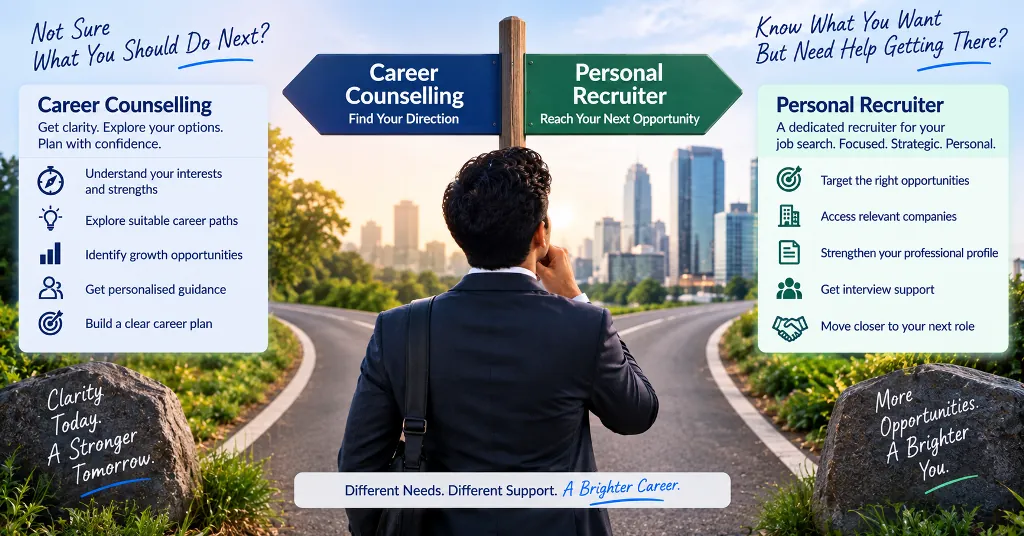
Personal Recruiter or Career Counselling?
Think about the difference this way:
“I don't know what I should do next.”
Career Counselling.
“I know what I want, but I need help getting there.”
Personal Recruiter.
“I know what I want, but my resume isn't positioning me properly.”
ATS Resume Writing.
“I'm getting interviews but struggling to convert them.”
Interview Coaching.
Sometimes you need one service.
Sometimes your career journey requires more than one.
The Bottom Line
A Personal Recruiter isn't a magic shortcut to employment.
It is a different way of approaching the job search.
Instead of managing every part of the process yourself, you have a dedicated recruitment professional helping you focus the search around your goals, experience and target opportunities.
The best service should be transparent about its scope, pricing, duration and responsibilities.
And you should know exactly what you're buying before you start.
At 7Skyee, our Personal Recruiter service is designed around that principle: a structured, recruiter-led job search built around the professional—not a generic stream of job alerts.
Because your next career move deserves more than simply clicking Apply.
It deserves a strategy.

Frequently Asked Questions
What is a Personal Recruiter?
A Personal Recruiter is a dedicated recruitment professional who provides job-search support to an individual based on their career goals, target roles and agreed search scope.
How is a Personal Recruiter different from a recruitment agency?
Traditional recruitment agencies generally work for employers to fill vacancies. A Personal Recruiter service is designed around supporting the job seeker's search for relevant opportunities.
Can a Personal Recruiter guarantee me a job?
No legitimate recruiter can control an employer's hiring decision. A Personal Recruiter can provide structured search support and pursue relevant opportunities, but employment depends on factors including candidate fit and employer decisions.
Is a Personal Recruiter useful for experienced professionals?
It can be particularly useful for professionals who have limited time, are targeting specific roles or markets, or want a more structured approach to their job search.
Can a Personal Recruiter help with international jobs?
Some Personal Recruiter services include international searches. The geographic coverage, countries, markets and services should always be clearly defined before purchasing.
Do I still need a resume if I use a Personal Recruiter?
Yes. Your resume remains an important part of your professional positioning. Depending on the service, resume review or positioning support may also be included.
Is a Personal Recruiter the same as a LinkedIn recruiter?
No. Recruiters using LinkedIn may be sourcing candidates for particular employers and vacancies. A Personal Recruiter service is designed around the individual's job search.
How much does a Personal Recruiter cost?
Pricing varies considerably depending on the service provider, geographic search scope, duration, level of recruiter involvement and target market. Always compare the actual scope and deliverables rather than price alone.


