

An employment gap does not automatically make your resume weak.
People take career breaks for many reasons. You may have taken time away to care for family, pursue education, manage personal responsibilities, recover from a difficult period, start a business, or simply reassess your career direction.
The important question is not always “Why was there a gap?”
It is:
“How clearly and confidently can you explain it?”
A well-presented resume can show that your career break is simply one part of your professional story—not the definition of your career.
Should You Explain an Employment Gap on Your Resume?
Not every short gap needs an explanation.
A few months between jobs is relatively common, particularly when someone is actively searching for the right opportunity.
However, a longer gap may attract questions from recruiters, especially if the dates on your resume make the gap obvious.
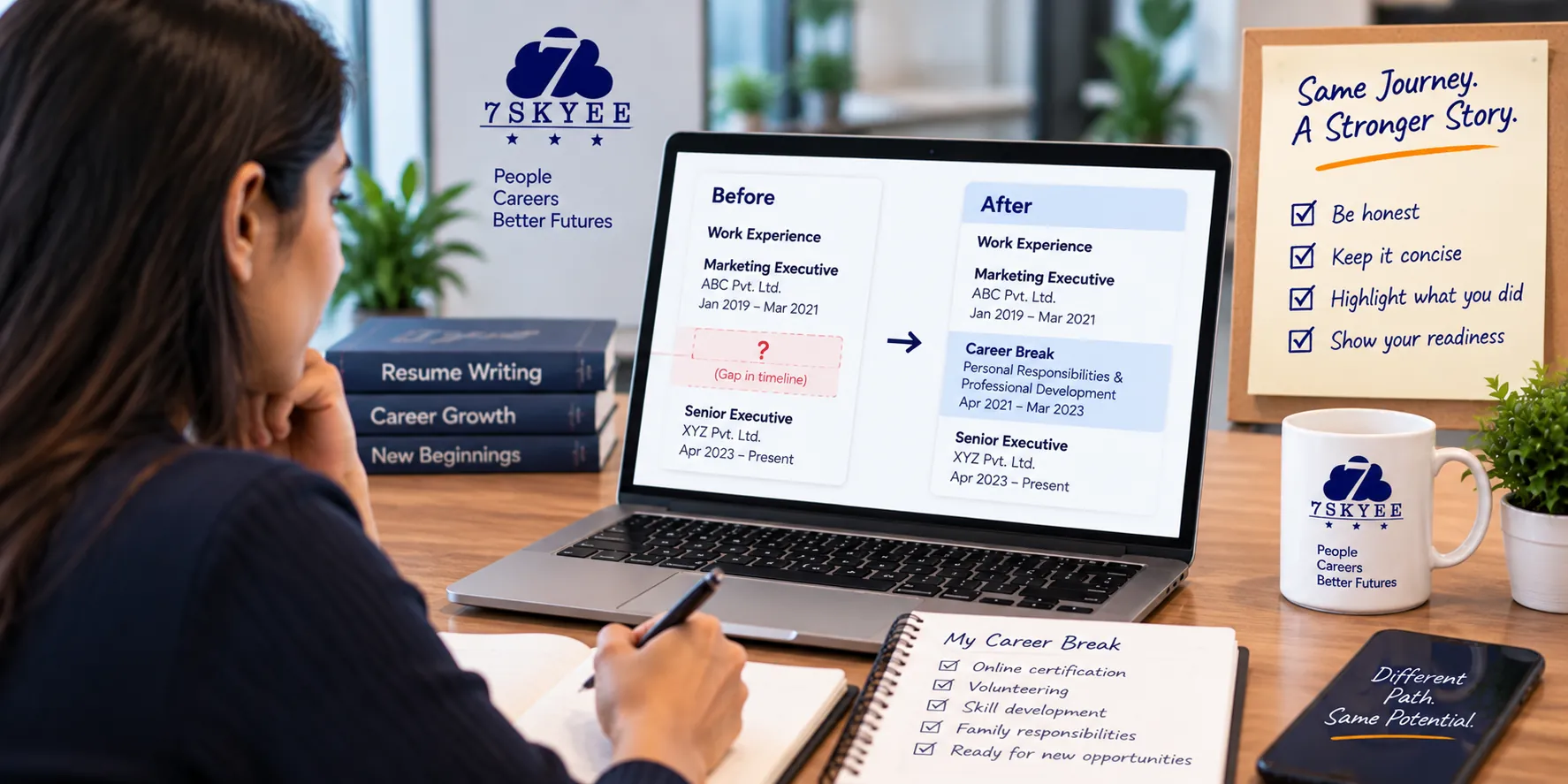
Rather than trying to hide it, present the period honestly and focus on what is relevant.
For example:
Career Break | January 2024 – September 2025
Family responsibilities; completed professional courses and maintained industry knowledge.
This is clearer than leaving a large unexplained space between two jobs.
First, Understand What the Gap Means
Before writing your resume, identify the actual reason for your career break.
Common reasons include:
Family or caregiving responsibilities
Further education
Health or personal circumstances
Relocation
Career transition
Starting or running a business
Freelancing or consulting
Professional development
Competitive exams
Travel or personal priorities
Redundancy followed by an extended job search
You don't need to provide private details.
Your objective is to give enough context to make the timeline understandable.
How to Show an Employment Gap on Your Resume
There is no need to create an elaborate explanation.
A simple entry can be enough.
Example 1: Family Responsibilities
Career Break | 2023 – 2025
Took time away from full-time employment to manage family responsibilities while maintaining professional skills through online learning.
Example 2: Further Education
Career Break | 2024 – 2025
Completed a professional certification in digital marketing and developed practical skills through independent projects.
Example 3: Career Transition
Career Transition | 2023 – 2024
Focused on transitioning from sales into business development, completing relevant training and building industry knowledge.
Example 4: Freelance Work
Don't automatically describe this period as an employment gap if you were actually working independently.
Independent Consultant | 2023 – 2025
Provided marketing support to small businesses, including content planning, campaign coordination and customer research.
Your freelance or consulting experience may actually strengthen your resume.
Should You Put the Reason for the Gap on Your Resume?
Usually, keep it brief.
Your resume is not the place for a detailed personal explanation.
For example:
Career Break | 2023 – 2025
Took a planned career break for family responsibilities and continued professional development during this period.
That's enough.
You can provide more context during the interview if the recruiter asks.
Turn the Gap Into Relevant Experience
One of the best ways to handle a career break is to show what you did during it.
Ask yourself:
Did you learn something?
Mention relevant courses, certifications or training.
Did you work independently?
Include freelance, consulting or project work.
Did you develop new skills?
Highlight skills that are relevant to the position you're targeting.
Did you manage significant responsibilities?
You don't need to turn personal responsibilities into exaggerated professional achievements, but you can explain relevant transferable skills where appropriate.
Did you work on projects?
Include meaningful projects that demonstrate current capability.
The goal is not to manufacture experience.
It is to show that your professional development did not necessarily stop when your full-time employment did.
What Recruiters Look For After an Employment Gap
A recruiter usually wants to know three things:
1. What happened?
Was the gap understandable?
2. Are you ready to return?
Does your resume demonstrate current skills and relevant knowledge?
3. Can you perform the role?
Your recent experience, skills, achievements and interview performance will ultimately matter far more than simply having a gap in your timeline.
That's why your resume should move quickly from the explanation of the gap to evidence of your current value.
What Not to Do
Don't hide the gap with misleading dates
Changing employment dates to make a gap disappear can create a much bigger problem if the information is later checked.
Be accurate.
Don't write a long personal explanation
Your resume should remain professional and focused.
You don't need several paragraphs explaining your circumstances.
Don't apologise for the gap
Avoid language such as:
“Unfortunately, I was unemployed for two years…”
You don't need to frame your career history as something you should apologise for.
Don't invent activities
Never add fake freelance projects, consulting work or employment simply to fill a gap.
Recruiters may ask detailed questions about anything listed on your resume.
Don't let the gap dominate the resume
The career break is one part of your timeline.
Your skills, achievements and suitability for the role should remain the focus.

How to Explain an Employment Gap During an Interview
Your resume may introduce the gap, but the interviewer may ask you about it directly.
Keep your answer:
Honest + Brief + Positive + Forward-looking
For example:
“I took a career break between 2023 and 2025 to focus on family responsibilities. During that period, I also kept my skills current through professional learning. I'm now ready to return to full-time work and am particularly interested in this role because it matches my previous experience in operations.”
Notice what the answer does:
Explains the gap.
Doesn't overshare.
Shows continued development.
Brings the conversation back to the job.
You don't need to spend five minutes defending the gap.
What If Your Gap Was Because You Couldn't Find a Job?
This is also common.
You don't need to pretend that you were doing something else.
You can say:
“After my previous role ended, I spent time looking for the right opportunity rather than making a rushed move. During that period, I also worked on developing my skills in X and Y. I'm now focused on finding a role where I can contribute in a long-term capacity.”
The important thing is to demonstrate purpose and readiness.
How to Make Your Resume Stronger After a Career Break
If you've recently returned to the job market, don't rely only on your older experience.
Strengthen the current section of your resume with:
Recent certifications
Relevant courses
Freelance projects
Consulting work
Portfolio projects
Industry events
Professional associations
Relevant achievements
Updated technical skills
You don't need to fill every month of the gap.
Instead, demonstrate that your skills are relevant today.
Where Should the Career Gap Appear?
Use a chronological structure that makes your timeline easy to understand.
For example:
Senior Sales Manager
ABC Company | 2020–2023
Career Break
2023–2025
Family responsibilities; completed professional development courses.
Sales Director
XYZ Company | 2025–Present
This is far better than trying to manipulate the dates so the gap is difficult to see.
Employment Gap vs Career Gap
These terms are sometimes used interchangeably, but there can be a useful distinction.
An employment gap usually refers to a period when you were not employed by an organisation.
A career gap can be broader and may include a period away from your normal professional path.
For example, someone may leave a corporate role to:
Run a family business
Study
Freelance
Raise children
Travel
Change industries
Build a startup
So don't automatically assume that “not employed” means “not productive.”
Your resume should reflect the reality of what you did.
A Simple Formula for Explaining Any Employment Gap
When you're unsure what to write, use this structure:
Reason → Relevant Activity → Readiness
Reason: Briefly explain why you took the break.
Relevant Activity: Mention meaningful learning, work or development during the period.
Readiness: Show that you're now prepared for your target role.
For example:
“I took a planned career break to manage family responsibilities. During that time, I completed a certification in project management and kept up with industry developments. I'm now ready to return to a full-time project management role.”
Simple. Honest. Professional.
Recruiter Tip: Don't Try to Hide Your Story
A career gap becomes harder to discuss when a candidate appears uncomfortable about it.
Instead of trying to make the gap disappear, make the timeline understandable.
Recruiters don't expect every career to follow a perfectly straight line.
What matters is whether your experience makes sense, whether your skills are current and whether you're a credible fit for the role.
Final Takeaway
An employment gap doesn't have to define your resume.
Be honest about the timeline, keep your explanation concise and use the rest of your resume to demonstrate what you can contribute today.
If you learned new skills, worked independently, completed projects or managed important responsibilities during the break, include the relevant parts.
And when you're asked about the gap in an interview, answer confidently and bring the conversation back to your experience, skills and readiness for the role.
Your career doesn't have to be perfectly linear to be valuable.
Frequently Asked Questions
How do I explain an employment gap on my resume?
Be honest and concise. Add a simple “Career Break” entry with the dates and, where relevant, mention professional development, freelance work, education or other meaningful activities.
Should I mention a two-year career gap on my resume?
Yes, particularly if it creates an obvious gap in your employment timeline. A brief, professional explanation is generally better than leaving the period unexplained.
Should I explain why I left work for family responsibilities?
You can, but you don't need to provide private or detailed personal information. A simple statement such as “Took a career break for family responsibilities” can be sufficient.
Can a career gap hurt my chances of getting a job?
A gap can lead to questions, but it does not automatically prevent you from getting hired. Your relevant experience, current skills, qualifications and ability to explain the gap professionally all matter.
Should I lie about an employment gap?
No. Don't change employment dates or invent jobs, projects or consulting work to hide a gap. Accuracy is important throughout the hiring process.
How do I explain an employment gap in an interview?
Keep your answer brief and honest. Explain the reason, mention any relevant activity during the break and finish by showing that you're ready for the role you're pursuing.


