
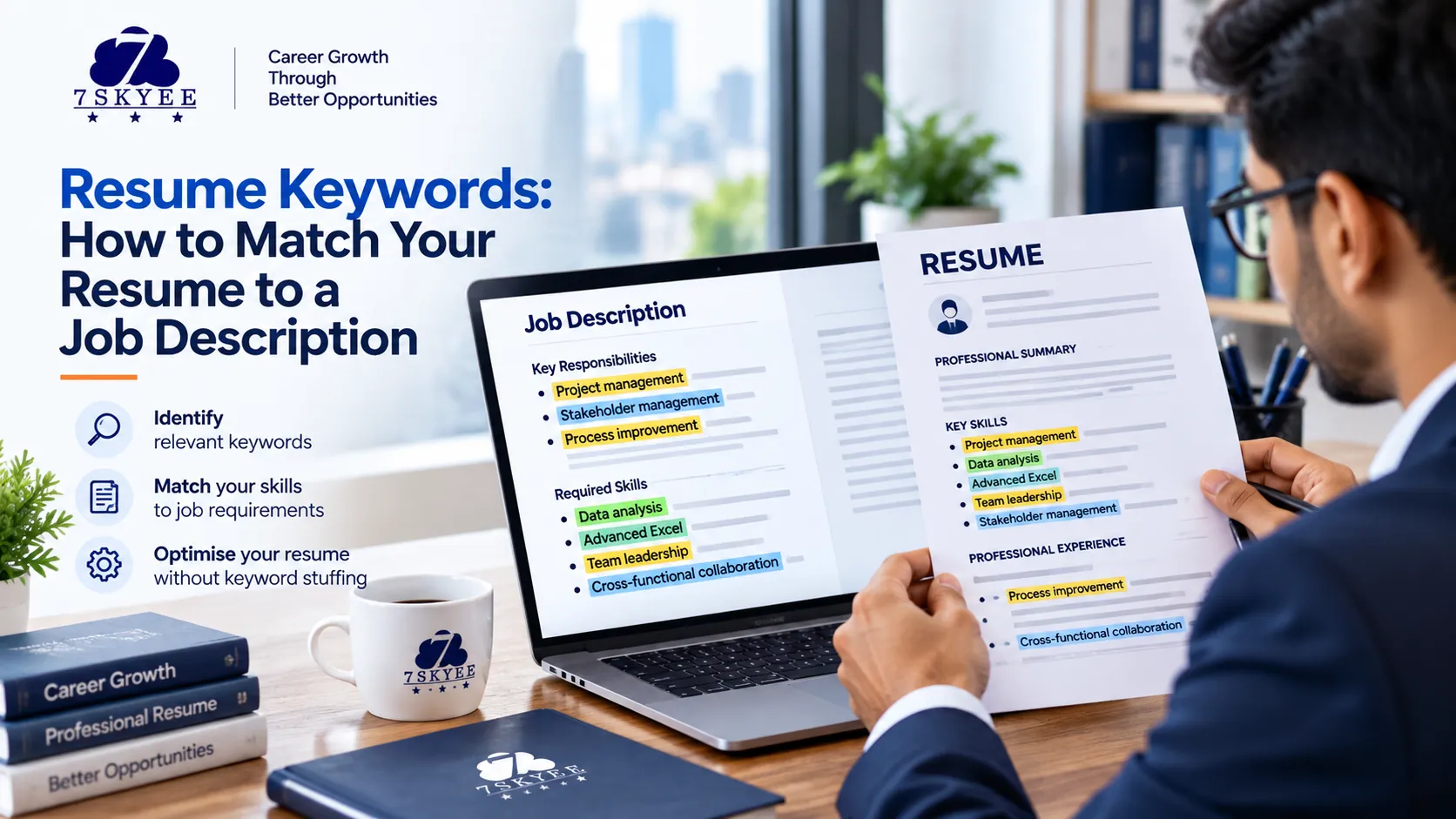
You may have the right qualifications, relevant experience and the skills an employer needs. Yet your resume may still fail to communicate why you are a suitable candidate.
One reason is that your resume and the job description may use different language to describe the same skills or responsibilities.
For example, a job description might ask for “stakeholder management”, while your resume says you “worked with internal teams and external clients”. Your experience may be relevant, but the connection is not immediately obvious.
This is where resume keywords matter.
Resume keywords are the skills, qualifications, tools, job-related terminology and areas of experience that help communicate your suitability for a particular role.
Using the right keywords can make your resume more relevant to a vacancy and easier for recruiters to evaluate. However, simply inserting more keywords will not guarantee that your application passes an Applicant Tracking System (ATS) or results in an interview.
The objective is to communicate your genuine experience in language that reflects the employer's requirements.
In this guide, we explain how to identify resume keywords, prioritise the most important ones and use them naturally without keyword stuffing.
What Are Resume Keywords?
Resume keywords are words and phrases associated with the requirements of a particular job.
They may describe your professional skills, technical knowledge, qualifications, responsibilities, industry experience or achievements.
For example, a Sales Manager vacancy might include keywords such as:
Business development
Key account management
Revenue growth
Sales forecasting
Team leadership
Customer relationship management
Negotiation
Market expansion
A Human Resources Manager vacancy might emphasise:
Talent acquisition
Workforce planning
Employee engagement
Performance management
HR operations
Labour law compliance
Learning and development
HR analytics
The keywords that matter depend on the role, employer, seniority and industry.
There is no universal list of resume keywords that works for every job. The most useful keywords are those that accurately represent your experience and align with the position you are pursuing.
Why Are Keywords Important in an ATS-Friendly Resume?
Many employers use Applicant Tracking Systems and other recruitment technologies to manage applications. Depending on the system and employer's workflow, these tools may help organise applications, parse resume information and support candidate searches or screening.
Relevant keywords can help communicate the connection between your background and the vacancy.
However, keywords are only one part of the hiring process. Employers may also consider qualifications, relevant experience, achievements, job titles, location, seniority and other selection criteria.
A resume can contain many matching keywords and still be unsuitable for a role if it lacks the required experience.
Similarly, a qualified candidate can weaken an application by failing to explain relevant skills and achievements clearly.
The goal is not to write a resume for software alone. It is to create a document that is readable, relevant and accurate for both recruitment technology and human reviewers.
For more on resume structure and screening, read our guide to writing a resume for experienced professionals in India.
How to Identify Keywords in a Job Description
Before editing your resume, examine the vacancy carefully. Start with the actual requirements rather than adding keywords based on guesswork.
1. Identify the essential skills
Look for phrases that describe the skills required to perform the job.
These may appear under headings such as:
Required skills
Essential qualifications
Key responsibilities
What you will do
Candidate requirements
Preferred experience
Separate essential requirements from desirable ones wherever the description makes that distinction.
For example, if a vacancy requires experience in B2B sales, enterprise account management and sales forecasting, those terms deserve attention if they accurately describe your background.
Do not treat every phrase in the job description as equally important.
2. Look for repeated terms
Repeated terminology can indicate that an employer considers a particular skill or responsibility important.
If “team management”, “sales targets” and “business development” appear throughout a Sales Manager vacancy, examine whether your resume clearly demonstrates those capabilities.
Repetition is a useful clue, not a definitive ranking of what an employer will prioritise.
3. Identify technical skills and tools
Technical requirements can be particularly important in specialist roles.
Depending on your profession, these might include:
SAP
Advanced Excel
SQL
Power BI
Salesforce
AutoCAD
Financial modelling
Applicant Tracking Systems
Specific manufacturing or engineering processes
Only include tools, systems and technical skills that you genuinely know or have used.
If a vacancy requires advanced Excel and you have used pivot tables, lookup functions and reporting dashboards, describe those capabilities accurately rather than simply copying the word “Excel”.
4. Identify qualifications and industry terminology
Some positions require particular qualifications, certifications, regulatory knowledge or industry-specific experience.
Examples include:
Chartered Accountancy
Project Management Professional certification
GMP compliance
Supply chain management
Quality assurance
Financial reporting
Labour law compliance
Include relevant qualifications and terminology where applicable. Never claim a certification, licence or qualification you do not hold.
5. Understand the job's level of seniority
The same skill can mean different things at different career levels.
For an entry-level position, “data analysis” might refer to preparing reports and interpreting basic trends.
For a senior leadership position, the employer might expect “business intelligence”, “strategic planning”, “performance management” or “data-driven decision-making”.
Your resume should reflect the level at which you have actually worked.
The Four Types of Resume Keywords You Should Look For
A practical way to organise your research is to divide keywords into four categories.
1. Job title and functional keywords
These describe the role or professional function.
Examples:
Regional Sales Manager
Talent Acquisition
Financial Planning
Operations Management
Supply Chain
Business Development
Use an accurate job title and relevant functional terminology. Do not change your official employment history to create a misleading impression.
2. Skills and competency keywords
These describe what you can do.
Examples include stakeholder management, negotiation, project management, team leadership, problem-solving and process improvement.
Prioritise the skills that are both relevant to the role and supported by your experience.
3. Technical and industry keywords
These identify tools, systems, methods, regulations and specialist knowledge.
For example, a manufacturing role might require Lean Manufacturing, Six Sigma, preventive maintenance or quality control.
A finance position may emphasise financial reporting, budgeting, forecasting or statutory compliance.
4. Achievement and outcome keywords
These help communicate the business impact of your work.
Examples include revenue growth, cost reduction, productivity improvement, process optimisation and customer retention.
Where possible, support these terms with evidence.
Instead of writing:
“Responsible for process improvement.”
You could write:
“Redesigned the reporting process, reducing monthly reporting time by 25%.”
Use figures only when they are accurate and can be reasonably substantiated.
How to Match Your Resume to a Job Description: A Step-by-Step Method
Once you have identified the important keywords, use the following process to tailor your resume.
Step 1: Choose the right vacancy
Start with a role that genuinely matches your experience, qualifications and career objectives.
Keyword optimisation cannot compensate for a fundamental mismatch between your background and the job requirements.
Step 2: Create a keyword checklist
Read the job description and note the most relevant requirements.
For example, consider a vacancy for a Regional Sales Manager.
Job requirement Keyword or phrase Manage major customers Key account, management, Expand business, Business development, Monitor performance, Sales forecasting, Lead a sales team, Team leadership, Improve revenue, Revenue growth, Expand into new territories, Market expansion
This checklist gives you a clear picture of what the employer is seeking.
Step 3: Compare the checklist with your resume
For each requirement, ask yourself:
Do I have this skill or experience?
Is it already visible in my resume?
Have I explained it clearly?
Can I provide a genuine example?
Is the evidence relevant to this particular role?
You may discover that some keywords are already present but buried in an old job description or an unhelpful skills list.
Others may be missing because you have described the work differently.
Step 4: Improve the wording where appropriate
Suppose the job description requests stakeholder management.
Your existing resume says:
“Coordinated with different departments to complete projects.”
If accurate, you might revise it to:
“Coordinated cross-functional stakeholders across sales, operations and finance to deliver projects within agreed timelines.”
The revised statement communicates the relevant capability more clearly without inventing experience.
Step 5: Prioritise the most relevant information
Place important, role-relevant skills and achievements where recruiters can find them easily.
Depending on your experience, this may mean improving:
Your professional summary
Your key skills section
Recent employment descriptions
Achievement statements
Relevant project details
Do not simply add a large keyword list at the top of the document.
The surrounding evidence should explain how you used those skills.
Step 6: Review the finished resume
Before applying, check that:
The target role is clear.
Essential skills are visible.
Relevant achievements are easy to find.
The resume uses readable formatting.
Keywords appear naturally.
All claims are accurate.
The document remains easy for a person to understand.
This final review is important because a resume should demonstrate professional value, not just repeat vacancy terminology.
Example: Before and After Resume Keyword Optimisation
Imagine that a company is hiring a Sales Manager and its vacancy emphasises business development, key account management, revenue growth and sales forecasting.
Before optimisation
“Responsible for sales activities, managing customers and achieving targets.”
This statement is broad. It does not explain the scale of the responsibility or demonstrate the candidate's impact.
After optimisation
“Managed key accounts, developed new business opportunities and monitored sales forecasts to support revenue growth across the assigned territory.”
This version uses relevant terminology while communicating the nature of the work more clearly.
If the candidate has verified results, the statement could be strengthened further:
“Expanded key accounts and developed new business opportunities, contributing to 18% revenue growth across the assigned territory.”
The percentage should be used only if it accurately reflects the candidate's contribution and can be substantiated.
Notice the difference: effective keyword optimisation does not mean copying a job description. It means explaining genuine experience in a way that is relevant to the opportunity.
Where Should You Place Keywords in Your Resume?
Keywords should appear in the sections where they make the most sense.
Professional summary
Use this section to communicate your role, relevant expertise and strongest professional value.
For example:
“Sales professional with experience in B2B business development, key account management, sales forecasting and regional revenue growth.”
Only include areas supported by your actual experience.
Skills section
Use a concise list of relevant technical, functional and professional skills.
Avoid adding every skill mentioned in the vacancy if you cannot demonstrate it.
Work experience
This is often the best place to demonstrate keywords through actual responsibilities and achievements.
Instead of merely listing “team leadership”, explain the team you led, the scope of your responsibility and the results you achieved.
Projects and qualifications
For technical, project-based or specialist roles, relevant projects, certifications and qualifications may help demonstrate specific requirements.
Include them where they strengthen your application.
Common Resume Keyword Mistakes to Avoid
1. Keyword stuffing
Repeating the same phrase excessively does not make your resume stronger.
It can make the document difficult to read and may undermine your credibility.
Use keywords naturally and provide context.
2. Copying the entire job description
A resume that reproduces vacancy language without demonstrating relevant experience offers little evidence of suitability.
Translate requirements into accurate examples from your career.
3. Claiming skills you do not possess
Never add a tool, certification, qualification or technical skill merely because it appears in the vacancy.
Misrepresentation can damage your credibility and create problems during interviews or employment verification.
4. Ignoring the human reader
An ATS-friendly resume should still be readable, logically structured and professionally presented.
Avoid sacrificing clarity to accommodate a long list of keywords.
5. Using one resume for every application
You may not need to rewrite your entire resume for every vacancy, but different roles can require different emphasis.
A Sales Manager position and a Business Development Head position may value overlapping skills while requiring different evidence of seniority, strategy and business impact.
Tailor the relevant sections without changing the facts of your career.
For more on this issue, read Why Your Resume Gets Rejected Even When You Meet the Job Requirements.
How Often Should You Update Your Resume Keywords?
Review your resume whenever you apply for a substantially different role, target a new industry or move into a different level of responsibility.
For similar vacancies, you may only need to adjust the professional summary, relevant skills and selected achievement statements.
For a significant career transition, you may need to reconsider the overall positioning of the document.
The important thing is to keep your resume consistent with your actual experience while making the most relevant evidence visible for each opportunity.
When Professional Resume Writing Support Can Help
Some professionals can tailor their resumes independently using a structured checklist.
Others may benefit from an experienced review, particularly when they are:
Moving into a more senior role
Changing industries or functions
Applying for specialist positions
Returning to work after a career break
Struggling to explain achievements
Applying repeatedly without receiving relevant interview calls
Unsure how to position broad or complex experience
A professional review can help identify gaps in positioning, improve the presentation of achievements and align the resume more closely with the roles you want to pursue.
If your resume needs more than a few keyword changes, explore 7Skyee's professional Resume Writing service. The service focuses on career positioning, ATS optimisation, achievement-led content and role alignment.
Frequently Asked Questions
What are the best keywords for a resume?
The best keywords depend on the specific role, industry and employer requirements. Focus on relevant skills, qualifications, tools, responsibilities and achievements that accurately reflect your experience.
How do I find keywords in a job description?
Identify essential requirements, repeated skills, technical tools, qualifications and responsibilities. Create a checklist and compare it with your existing resume before making changes.
How many keywords should a resume contain?
There is no universal ideal number. Include enough relevant terminology to communicate your suitability, but prioritise accuracy, readability and meaningful evidence over a numerical target.
Do keywords guarantee that my resume will pass an ATS?
No. ATS platforms and employer workflows vary. Keywords may help communicate relevance, but screening can also depend on qualifications, experience, application questions and other criteria.
Should I use the exact words from a job description?
Use the same terminology when it accurately describes your skills or experience. Where your wording differs, you can clarify the connection without copying entire sentences or making misleading claims.
Should I change my job title to match the vacancy?
No. Do not misrepresent your official job title. You can clarify your function or responsibilities where appropriate, provided the description remains accurate.
Can I use the same resume for multiple jobs?
You can use a strong master resume as your starting point. For each important application, review the role's requirements and adjust relevant content where appropriate.
Can professional resume writing services help with keywords?
A professional resume writer can help identify relevant terminology, improve role alignment and present your genuine skills and achievements more clearly. No resume-writing service can guarantee selection or an interview.
Final Takeaway
The purpose of resume keyword optimisation is not to include as many keywords as possible.
It is to make the connection between your experience and the employer's requirements easier to understand.
Identify the important requirements, compare them with your actual skills, improve the wording where appropriate and support key claims with evidence.
A strong resume does more than contain the right words. It demonstrates why those words accurately describe you.
Ready to Strengthen Your Resume?
If you have relevant experience but are unsure whether your resume communicates it effectively, 7Skyee can help you review your career positioning and create an ATS-friendly, recruiter-ready resume tailored to your target roles.
Explore Professional Resume Writing at 7Skyee:
https://7skyee.net/services/resume-writing