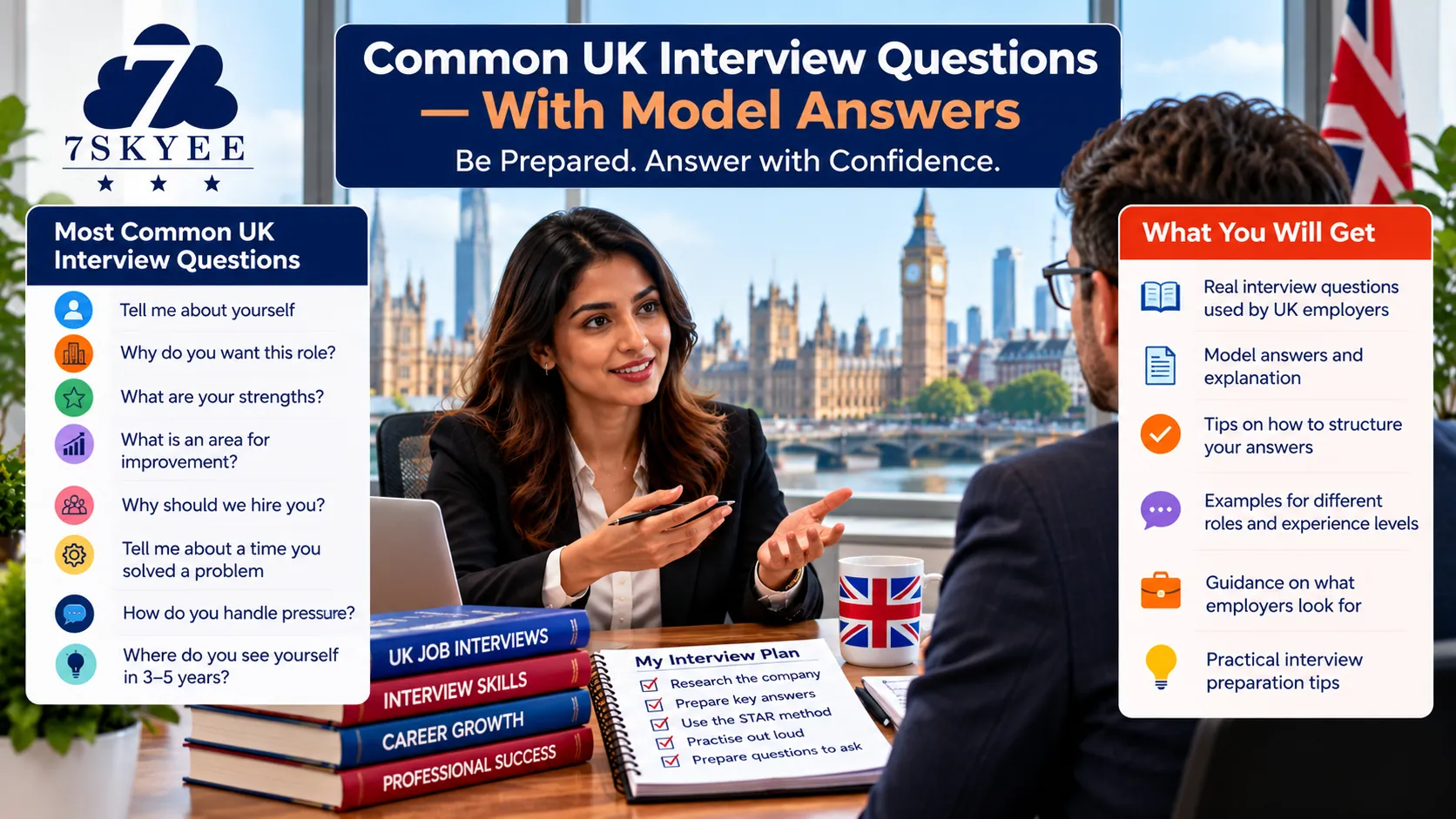
Common UK Interview Questions — With Model Answers
Preparing for a job interview involves more than memorising answers. You need to understand what an employer is assessing, identify relevant examples from your experience and explain your suitability for the role clearly.
UK employers may use a combination of general, competency-based, technical and role-specific questions. The format depends on the organisation, the position and the seniority of the candidate.
Some questions explore your motivation. Others assess how you solve problems, work with colleagues, handle pressure or make decisions.
This guide covers common UK job interview questions, example answers and practical advice on adapting your responses to your own experience.
1. Tell Me About Yourself
This is a common opening question. The interviewer usually wants a concise introduction to your professional background, relevant strengths and interest in the position.
Avoid giving a detailed account of your personal life or repeating every line of your CV. Focus on the information that makes you relevant to the vacancy.
Example answer:
"I am an operations professional with experience coordinating teams, improving processes and managing day-to-day delivery. In my current role, I have developed strong skills in planning, problem-solving and working with different departments. I am now looking for an opportunity where I can take on broader responsibilities and contribute to improving operational performance."
How to personalise your answer:
Start with your professional background or current role.
Mention two or three relevant strengths.
Include a genuine achievement or area of expertise.
Explain briefly why the opportunity interests you.
Keep your introduction focused. You can expand on individual achievements when the interviewer asks follow-up questions.
2. Why Do You Want This Job?
Employers want to understand whether you have researched the position and can explain why it suits your interests and experience.
Avoid answers based entirely on salary, convenience or the fact that you need a job.
Example answer:
"I am interested in this position because it combines project coordination with opportunities to improve processes and work across different teams. My previous experience has helped me develop the planning and communication skills needed for this type of role. I am also interested in the organisation's work in this area and believe the position would allow me to contribute while continuing to develop professionally."
How to personalise your answer:
Research the organisation, read the job description and identify the responsibilities that genuinely appeal to you. Explain how they connect with your experience and career direction.
Avoid generic statements that could apply to any employer.
3. What Do You Know About Our Organisation?
This question assesses your preparation and interest in the employer.
Before the interview, review the organisation's website, services or products, recent announcements, business priorities and the job description.
Example answer:
"From my research, I understand that your organisation works with customers across several sectors and places emphasis on service quality. I was particularly interested in the focus on improving customer experience. My experience in coordinating teams and resolving operational issues is relevant to that priority, and I would welcome the opportunity to contribute."
Only include details you have verified. Avoid reciting the entire company website; choose two or three relevant points and explain why they matter to you.
4. What Are Your Strengths?
Choose strengths that are relevant to the role and support them with evidence.
Simply saying that you are hardworking, reliable or organised does not demonstrate how those qualities help you perform.
Example answer:
"One of my strengths is organising complex workloads. In my current role, I regularly manage competing deadlines and coordinate with colleagues to keep tasks moving. I prioritise work according to urgency and impact, communicate potential delays early and review progress regularly. This approach helps me maintain control of deadlines without overlooking important details."
Preparation tip: Identify three strengths from the job description. Prepare a genuine example for each, so you can demonstrate them rather than simply listing them.
5. What Is Your Biggest Weakness?
This question is an opportunity to demonstrate self-awareness and a willingness to improve.
Choose a genuine development area that you can discuss professionally. Explain what you are doing to address it.
Example answer:
"Earlier in my career, I sometimes spent too much time refining work before sharing it. I realised that this could delay useful feedback. I now agree on priorities and deadlines at the start of a task, share progress earlier and use feedback to decide where further refinement is necessary."
This answer explains the development area, the steps taken and the improvement in approach.
Avoid presenting a disguised strength such as "I work too hard" unless you can explain a real limitation and how you manage it. Do not claim that you have no weaknesses.
6. Why Should We Hire You?
Use this question to connect your relevant skills, experience and approach to the employer's needs.
Example answer:
"My experience in coordinating projects, solving operational problems and working with different teams aligns well with the responsibilities described in the job advert. I bring a structured approach to planning and communication, and I am comfortable taking responsibility for resolving issues. I would aim to use those strengths to help the team deliver its objectives while learning the organisation's specific processes."
How to personalise your answer:
Identify the three most important requirements in the job description. For each, consider what evidence from your experience demonstrates that you can meet it.
Avoid claiming to be the perfect candidate. Make a clear, evidence-based case for your suitability.
7. Tell Me About a Time You Solved a Problem
This is a competency-based question. The interviewer wants evidence of how you approach a challenge.
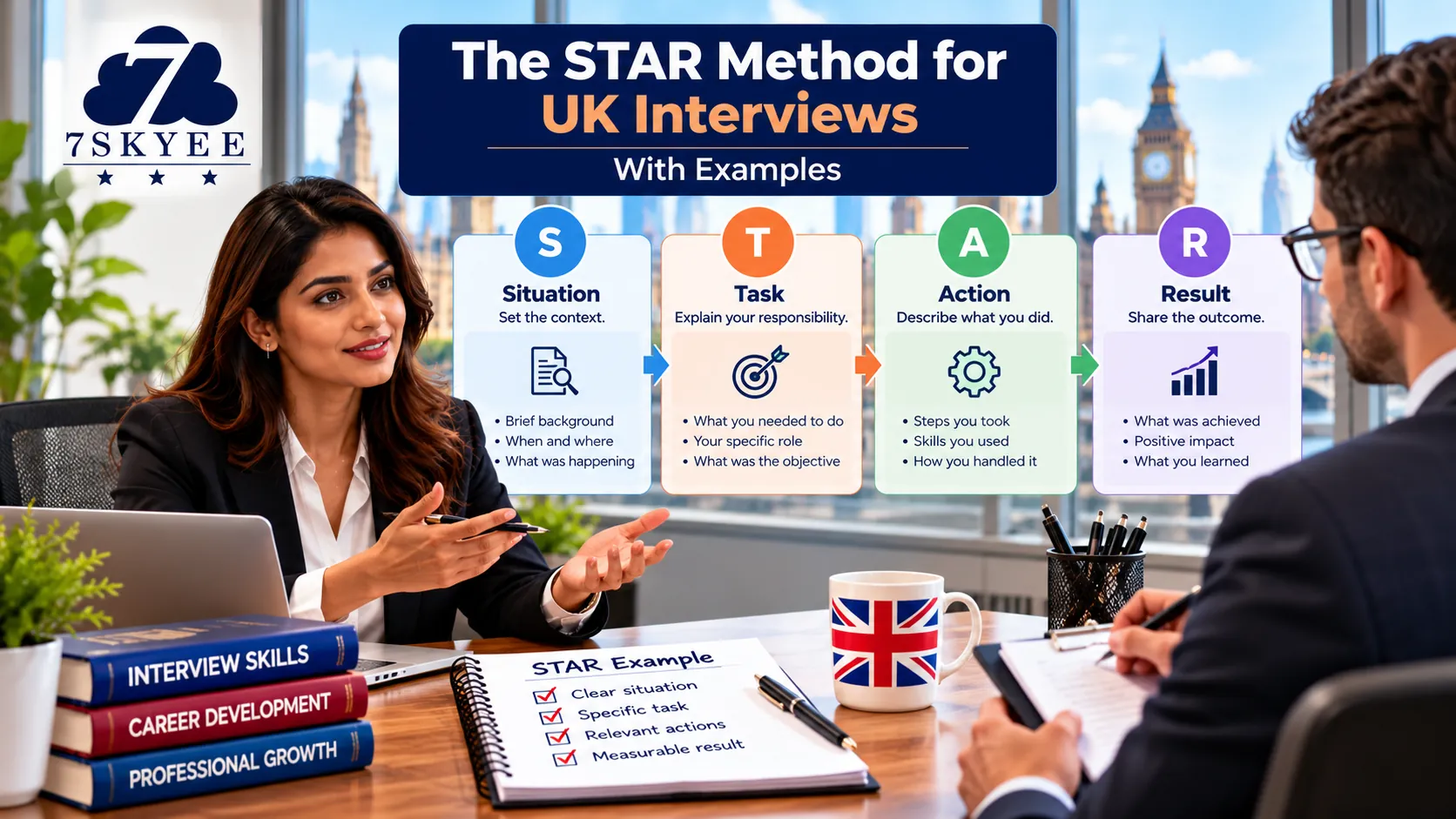
The STAR method can help you structure your answer around Situation, Task, Action and Result.
Example answer:
"In my previous role, our team was experiencing repeated delays because information was arriving from different departments at inconsistent times. I was asked to help identify the causes and improve coordination. I reviewed the workflow, spoke with the departments involved and introduced a shared tracker with clearer responsibilities and deadlines. This gave the team better visibility of outstanding tasks and helped us identify potential delays earlier."
Adapt the example to your real experience and include measurable outcomes when you can substantiate them.
For a fuller explanation of how to structure competency-based answers, read The STAR Method for UK Interviews — With Examples.
8. Tell Me About a Time You Worked Under Pressure
Employers may ask this question to understand how you prioritise, communicate and make decisions when time or resources are limited.
Example answer:
"During a busy period, my team had to complete an important report while continuing to manage its normal workload. I reviewed the outstanding tasks, identified which information was essential and agreed priorities with the colleagues involved. I monitored progress and checked information as it arrived rather than leaving all the verification until the end. We submitted the report within the required timeframe and maintained a clear record of the outstanding actions."
Choose a situation that shows your actual approach to pressure. Explain how you prioritised work and communicated with others instead of simply saying that you remain calm.
9. Describe a Time You Had a Disagreement With a Colleague
Interviewers may use this question to assess communication, judgement and your ability to handle professional differences.
Example answer:
"A colleague and I disagreed about how to prioritise tasks for a project. I arranged a discussion to understand their concerns and explained the reasons behind my own recommendation. We reviewed the deadlines, business impact and available resources together. This helped us agree on a revised priority order and clarify responsibilities. The experience reinforced the importance of discussing evidence and objectives rather than treating a difference of opinion as a personal conflict."
Focus on the steps you took to resolve the disagreement. Avoid criticising the other person or suggesting that every conflict is someone else's fault.
10. Tell Me About a Mistake You Made
Employers may want to understand whether you take responsibility, learn from experience and make improvements.
Example answer:
"On one project, I underestimated the time needed to obtain information from another department. When I realised the risk to the deadline, I informed the project lead, confirmed when the information would be available and reorganised the remaining tasks so other work could continue. Afterward, I changed my planning process to request external input earlier and allow more time for dependencies. I learned to consider risks outside my immediate control when setting deadlines."
Choose a genuine example that you can explain clearly. Be honest about your responsibility and describe what you changed as a result.
11. Where Do You See Yourself in Five Years?
The interviewer may be exploring your ambitions, professional interests and whether the role fits your longer-term direction.
You do not need to predict your exact job title or career path.
Example answer:
"Over the next few years, I would like to deepen my expertise in this area, take ownership of more complex responsibilities and contribute to wider team objectives. I am interested in developing both my technical knowledge and my ability to coordinate work across teams. This position appeals to me because it would provide an opportunity to build on my existing experience while continuing to learn."
Keep your answer realistic and relevant to the position. Avoid making promises about staying for a particular period if you cannot genuinely make that commitment.
12. Why Are You Leaving Your Current Job?
Answer professionally, even if you have experienced difficulties in your current workplace.
You might be looking for career development, a different type of responsibility, a new industry or an opportunity to use your skills in a different setting.
Example answer:
"I have gained valuable experience in my current position, particularly in managing day-to-day responsibilities and working with different teams. I am now looking for a role that offers greater scope to develop my skills in process improvement and take responsibility for more complex work. The responsibilities of this position appear closely aligned with that next step."
Avoid criticising your manager, colleagues or employer. If you have been made redundant or your role is ending, explain the circumstances honestly and briefly.
13. What Are Your Salary Expectations?
Salary discussions can vary according to the employer, sector, location, role and level of experience.
Research the likely salary range before the interview. Consider the responsibilities of the role, your relevant experience and the overall package.
Example answer:
"Based on my understanding of the responsibilities and the market for similar roles, I would be looking for a competitive package in line with the position's scope and expectations. I am open to discussing the full package and would also be interested to understand the salary range budgeted for the role."
If you have a researched range, you can state it directly. Make sure it reflects your expectations and is based on credible information rather than guesswork.
14. What Questions Do You Have for Us?
Prepare a few thoughtful questions before the interview. This helps you understand the position and demonstrates that you are considering how you could contribute.
Depending on the role, you might ask:
What would success look like in the first three to six months?
What are the team's main priorities at the moment?
How does this role work with other departments?
What are the main challenges someone in this position would need to address?
How is performance normally evaluated?
What are the next stages of the recruitment process?
Choose questions that have not already been answered during the interview. Avoid asking questions simply for the sake of asking them.
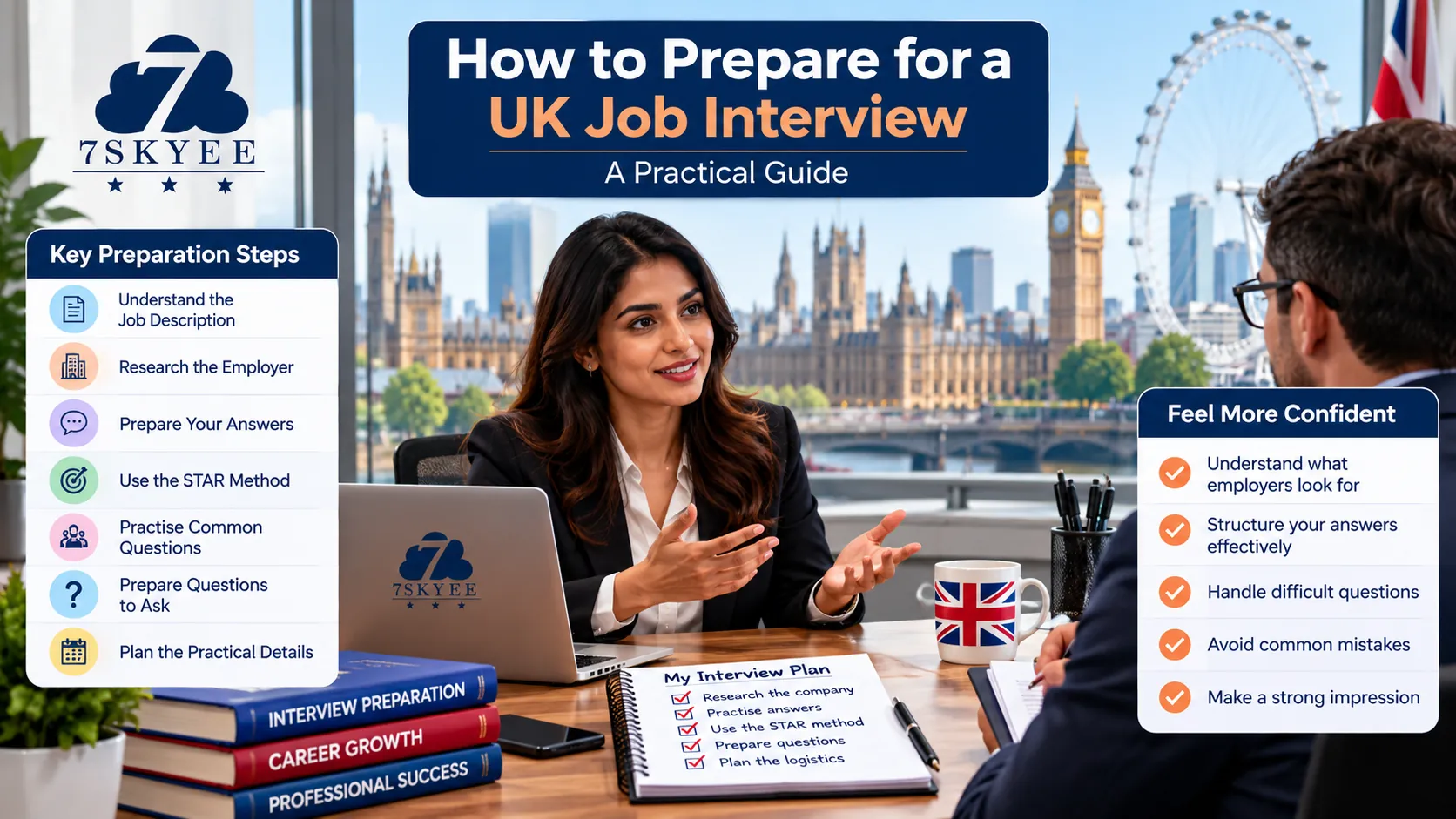
How to Prepare for UK Job Interview Questions
Preparing effective answers does not mean memorising a script for every possible question. A better approach is to build a flexible set of examples and practise adapting them.
Study the job description
Identify the main responsibilities, skills and experience requirements. Consider which questions the interviewer may ask to assess each requirement.
Research the employer
Understand what the organisation does, who its customers are and what is relevant to the role. Use reliable, up-to-date information.
Prepare examples from your experience
Write down situations where you solved a problem, worked with others, managed pressure, improved a process or achieved an important objective.
Practise concise answers
For questions about past experiences, use the STAR method when appropriate. Keep your answers focused and give enough detail for the interviewer to understand your contribution.
Prepare for follow-up questions
Interviewers may ask why you chose a particular approach, what you would do differently or how you measured success. Be ready to explain your reasoning.
Practise aloud
Speaking your answers aloud can help you identify unclear explanations, unnecessary detail and examples that need stronger evidence.
For a broader preparation checklist covering research, planning and interview practice, read How to Prepare for a UK Job Interview.
Common Interview Answer Mistakes to Avoid
Even a well-prepared candidate can weaken an answer by:
Giving a long introduction without answering the question.
Repeating claims without supporting examples.
Speaking negatively about former colleagues or employers.
Taking credit for work completed entirely by a team.
Exaggerating responsibilities or inventing results.
Memorising answers so rigidly that they sound unnatural.
Giving the same example regardless of the question.
Failing to explain what they learned from a difficult experience.
Providing an answer that does not address the employer's actual requirement.
The goal is not to sound perfect. It is to provide clear, relevant and credible evidence of your suitability.
Final Thoughts
Preparing for common UK interview questions helps you communicate your experience more clearly and approach interviews with a plan.
Start by understanding the role, researching the employer and preparing genuine examples that demonstrate your skills. Practise explaining those examples in your own words, and adapt each response to the question being asked.
Remember that model answers are starting points, not scripts to copy. Your strongest answers will reflect your own experience, decisions and achievements.
If you would like personalised help with structuring answers, practising competency-based questions or preparing for a specific role, explore 7Skyee's UK Interview Coaching service.