Preparing for a job interview involves more than reading through your CV and deciding what to wear. You need to understand the employer, identify what the role requires, prepare relevant examples and communicate your experience clearly.
Whether you are applying for your first job in the UK, changing careers or pursuing a senior position, effective preparation can help you approach the interview with greater confidence.
UK employers may use competency-based questions, technical assessments, strengths-based questions, scenario discussions or a combination of formats. The right preparation depends on the role, the organisation and the interview stage.
This guide explains how to prepare for a UK job interview, practise your answers, handle challenging questions and avoid common mistakes.
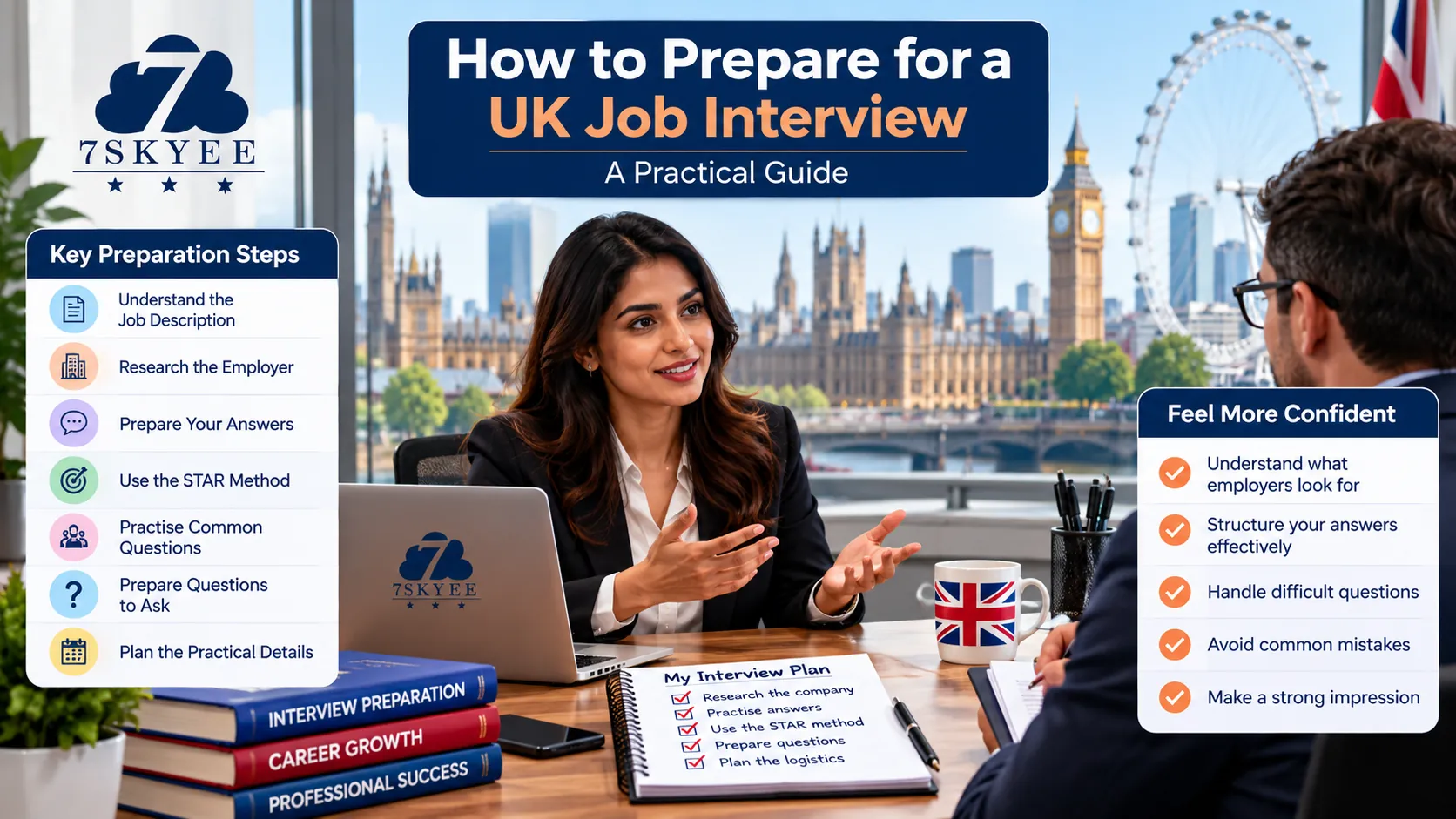
1. Understand the Job Description
Start by reading the job description carefully. It provides important clues about the employer's priorities, the skills required and the responsibilities you may be expected to handle.
Look beyond the job title and identify the specific requirements.
Pay attention to:
Essential qualifications and experience.
Technical or professional skills.
Communication and teamwork requirements.
Leadership or management responsibilities.
Industry knowledge and relevant systems.
Expected results and performance objectives.
Separate essential requirements from desirable ones. Then identify examples from your experience that demonstrate how you meet the most important criteria.
For example, if a job description emphasises stakeholder management, prepare an example of how you coordinated different teams, resolved conflicting priorities or communicated a difficult decision.
Your goal is to show how your experience relates to the position rather than simply repeating the wording of the job advert.
If you are also updating your application documents, our guide to writing a CV for jobs in the UK explains how to present your experience in a way that is relevant to the roles you want.
2. Research the Employer
Interviewers may want to understand why you applied to their organisation and what you know about its work.
Spend time researching the employer before the interview.
Review:
The company's official website.
Its products, services or customers.
Recent company announcements and developments.
The organisation's values and stated priorities.
The department or team you may join.
The main challenges facing the organisation or industry.
Use reliable, current information rather than relying entirely on old reviews or social media discussions.
Think about why the position interests you and how your background could contribute to the organisation.
Prepare a clear answer to the question, "Why do you want to work for us?"
A strong answer connects three things: your understanding of the organisation, your interest in the role and the experience or skills you could bring.
Avoid generic statements such as "Your company is very successful." Explain what specifically interests you and why the opportunity makes sense for your career.
3. Prepare Your Answer to "Tell Me About Yourself"
This is a common opening question, and it gives you an opportunity to establish a clear professional narrative.
You do not need to describe your entire career history. Instead, provide a concise introduction that connects your background to the position.
A useful structure is:
Present: Briefly describe your current role or professional background.
Experience: Highlight relevant skills, responsibilities or achievements.
Future: Explain why this opportunity is a logical next step.
For example:
"I have several years of experience in operations, with a focus on improving processes, coordinating teams and maintaining service standards. In my current role, I have worked on initiatives to improve efficiency and strengthen communication across departments. I am now looking for an opportunity where I can use that experience to contribute to a larger operation and take on broader responsibility."
Adapt the example to your own circumstances. Do not claim achievements or experience you cannot substantiate.
Practise your introduction until it sounds natural, but avoid memorising every word. The aim is to communicate your professional story clearly and confidently.
4. Use the STAR Method for Competency-Based Questions
Many interviews include questions about how you handled situations in the past.
Examples include:
Tell me about a time you solved a difficult problem.
Describe a situation where you worked under pressure.
Give an example of when you handled a disagreement.
Tell me about a time you took initiative.
Describe an achievement you are particularly proud of.
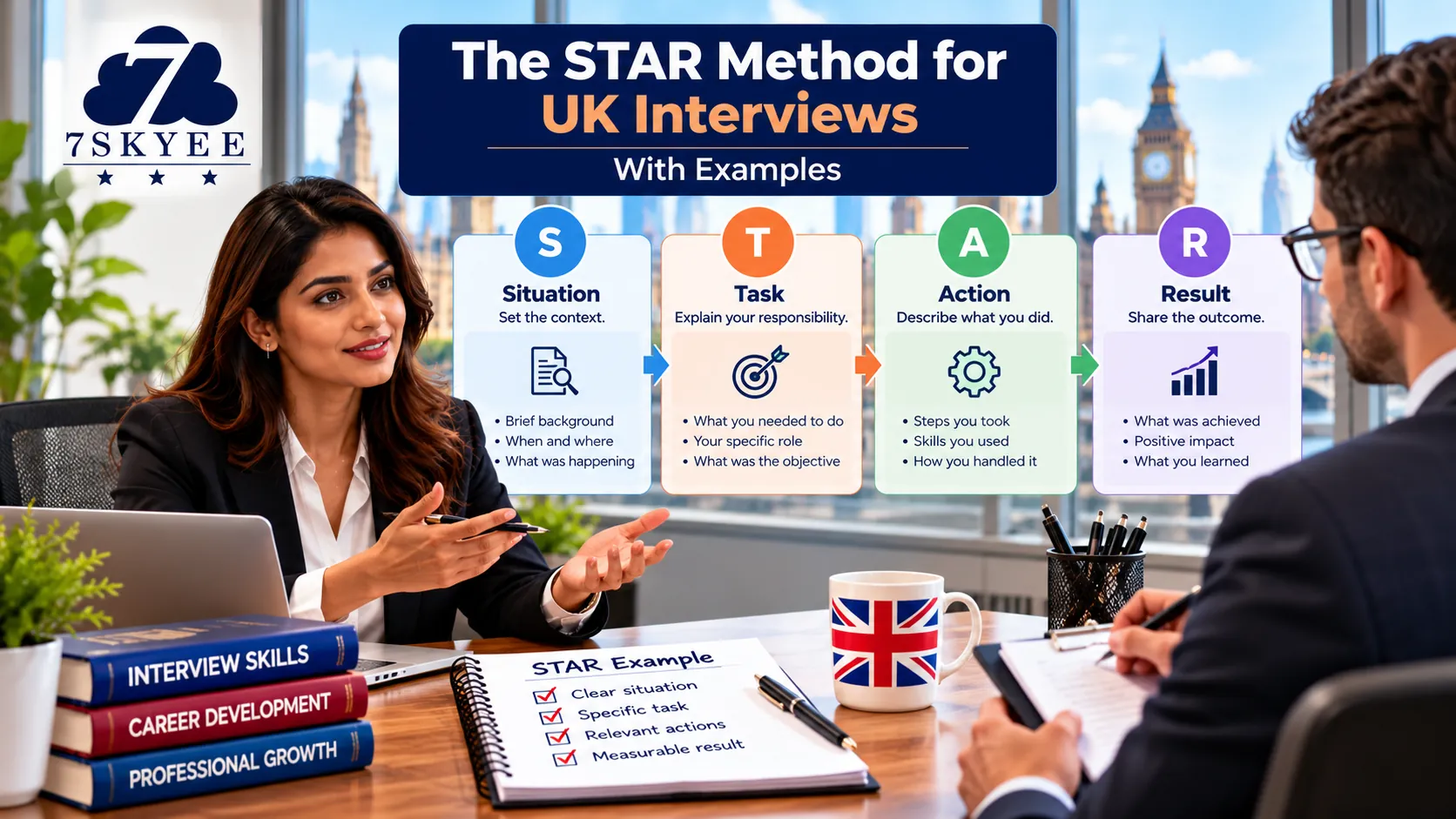
The STAR method can help you organise your answers.
Situation: Explain the relevant background.
Task: Describe your responsibility or objective.
Action: Explain the specific steps you took.
Result: Share the outcome and, where possible, what you learned.
Suppose an interviewer asks how you handled a missed deadline. You could explain the circumstances, your responsibility for getting the work back on track, the actions you took to coordinate the team and the final outcome.
Focus particularly on your own contribution. If you worked as part of a team, make that clear while explaining what you personally did.
Where possible, include evidence such as time saved, errors reduced, customer feedback improved or a target achieved. Use accurate figures only.
For more detailed examples and answer structures, read The STAR Method for UK Interviews — With Examples.
5. Prepare for Common UK Interview Questions
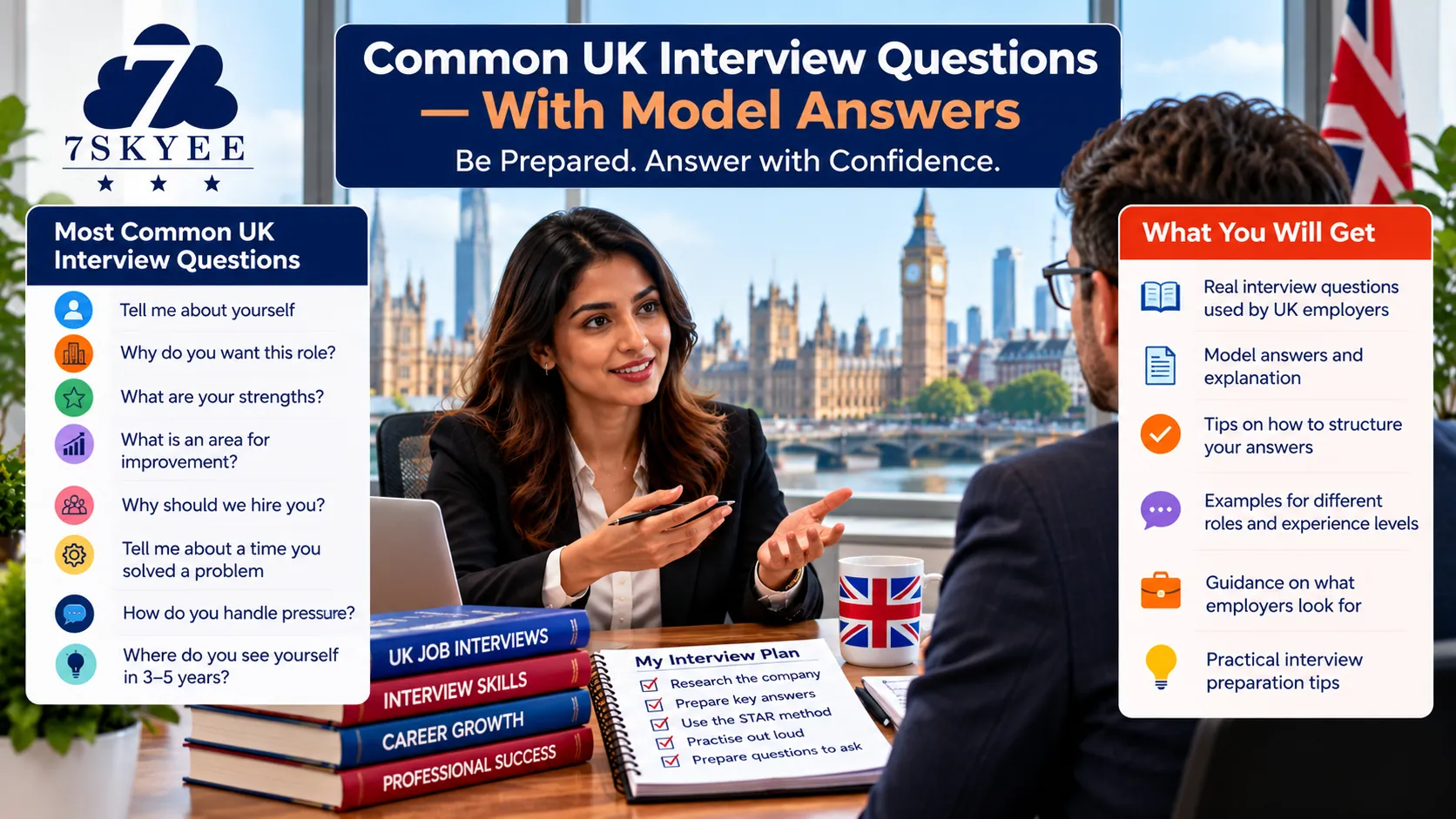
You cannot predict every question, but you can prepare for common themes.
Why are you interested in this role?
Explain how the responsibilities, organisation and opportunity fit your skills and career objectives.
What are your main strengths?
Choose strengths that are relevant to the role. Support each one with a brief example rather than relying on adjectives alone.
What is an area you are working to improve?
Choose a genuine development area and explain the steps you are taking to improve. Avoid presenting a disguised strength as a weakness.
Why are you considering leaving your current job?
Keep your answer professional and focused on what you are looking for next. Avoid criticising former managers or colleagues.
Tell me about a professional challenge you faced.
Choose a relevant example that demonstrates judgement, accountability, problem-solving or resilience.
Why should we hire you?
Connect the employer's requirements with your most relevant experience, skills and achievements.
You can explore more examples in Common UK Interview Questions — With Model Answers.
Practise answering aloud. This helps you notice whether your answers are too long, vague or difficult to follow.
6. Prepare Examples That Demonstrate Your Skills
Interviewers need evidence that you can perform the work, not just assurances that you possess the required skills.
Prepare a small collection of examples from your professional, academic, voluntary or other relevant experience.
Consider examples that demonstrate:
Problem-solving.
Teamwork and collaboration.
Communication.
Planning and organisation.
Leadership or initiative.
Adaptability.
Customer or stakeholder management.
Learning from mistakes.
You do not need a completely different example for every possible question. One strong example may demonstrate several skills, provided you adapt your explanation to the question being asked.
For each example, remember the situation, your responsibility, the action you took and the result.
If you are early in your career, examples from education, placements, projects or volunteering may be appropriate. Explain what you contributed and what the experience demonstrates about your abilities.
7. Prepare Questions to Ask the Interviewer
An interview is also an opportunity to decide whether the role and organisation suit you.
Prepare a few thoughtful questions based on your research and the information already shared during the interview.
For example:
What would success look like in the first three to six months?
What are the main priorities for the person joining this role?
How is the team structured?
What are the most important challenges the team is currently addressing?
How would you describe the working relationship between this team and other departments?
What are the next stages of the recruitment process?
Choose questions that are relevant to the conversation. You do not need to ask every question on your list.
Listen carefully throughout the interview so you do not ask something the interviewer has already answered.
8. Plan the Practical Details
Good preparation includes making sure you can attend the interview without unnecessary last-minute stress.
For an in-person interview:
Confirm the address and interview time.
Check your route and likely travel time.
Allow a reasonable buffer for delays.
Review any visitor or building-entry instructions.
Choose appropriate clothing for the organisation and role.
Bring any documents specifically requested by the employer.
For a virtual interview:
Test your internet connection, camera and microphone.
Check the meeting link and platform.
Choose a quiet, well-lit location.
Position your camera at a comfortable height.
Close unnecessary applications and notifications.
Keep your CV, the job description and brief notes accessible.
For either format, follow the employer's instructions about identification, portfolios, presentations or other materials.
If the interview involves a presentation, case study, technical test or practical exercise, clarify the requirements in advance where possible.
9. How to Handle Difficult Interview Questions
Some questions may require you to discuss a setback, employment gap, career change or area where you have limited experience.
The most useful approach is to answer honestly, remain relevant and explain what you learned or how you are addressing the issue.
Employment gaps
Explain the gap briefly and accurately. If you used the time for caring responsibilities, study, recovery, travel or another legitimate purpose, share only the information you are comfortable discussing and that is relevant.
Then bring the conversation back to your readiness for the role.
Career changes
Explain what attracts you to the new field, which transferable skills you can bring and what you have done to prepare for the transition.
Focus on the connection between your previous experience and the employer's requirements.
Limited experience
Acknowledge the gap without exaggerating your abilities. Highlight related experience, relevant learning and how you would approach developing the required skill.
Previous mistakes or setbacks
Choose an appropriate example that shows accountability, reflection and improvement. Explain what you changed as a result.
Avoid blaming other people or presenting yourself as having never made a mistake.
10. Adapt Your Preparation to the Interview Format
Not all interviews assess candidates in the same way.
Telephone interviews
Prepare a concise summary of your background, keep the job description nearby and choose a quiet place where you can concentrate.
Video interviews
Practise speaking to the camera, check your equipment and avoid reading answers directly from a script.
Panel interviews
Address the person asking the question while remaining engaged with the other panel members. If several people are present, listen carefully to each question and avoid rushing your answer.
Technical or practical interviews
Review the relevant knowledge and practise the types of tasks you may be asked to complete. Be ready to explain your reasoning, not just your final answer.
Senior-level interviews
Prepare examples that demonstrate strategic thinking, leadership, commercial judgement, decision-making and the ability to deliver results. Connect your answers to the scale and responsibilities of the position.
11. Common Interview Preparation Mistakes to Avoid
Even experienced professionals can undermine their preparation by overlooking basic details.
Avoid these mistakes:
Giving generic answers: Connect your experience to the actual role and employer.
Memorising scripts word for word: Practise key points rather than trying to reproduce a perfect speech.
Talking for too long: Give enough detail to answer the question, then allow the interviewer to ask follow-up questions.
Making unsupported claims: Use credible examples and accurate achievements.
Speaking negatively about former employers: Explain difficult circumstances professionally and focus on what you learned.
Failing to research the organisation: Demonstrate a genuine understanding of the opportunity.
Not preparing questions: Use the interview to understand the responsibilities, expectations and working environment.
Ignoring the interview format: Prepare differently for a technical assessment, panel interview, telephone screening or presentation.
Forgetting to follow up: If appropriate, send a brief thank-you message and follow any instructions provided about next steps.
12. Your UK Job Interview Preparation Checklist
Use this checklist in the days before your interview.
Research
Read the job description carefully.
Research the employer and role.
Identify the most important selection criteria.
Prepare a clear explanation of why you want the position.
Answers
Practise your professional introduction.
Prepare examples using the STAR method.
Review common interview questions.
Prepare evidence of your skills and achievements.
Plan how to discuss career changes, gaps or development areas if relevant.
Practical arrangements
Confirm the date, time and format.
Check travel arrangements or the virtual meeting link.
Prepare any requested documents.
Test equipment if attending online.
Choose suitable clothing.
Final preparation
Prepare questions for the interviewer.
Practise your answers aloud.
Review your notes without trying to memorise everything.
Allow enough time to arrive or connect.
Get adequate rest before the interview.
13. When Can Professional Interview Coaching Help?
Self-preparation is valuable, but you may benefit from additional guidance if you are unsure how to structure answers, struggle to explain your achievements or repeatedly find interviews difficult.
Professional interview coaching can help you practise responses, identify areas for improvement and communicate your experience more effectively.
It may be particularly useful when you are:
Preparing for a promotion or senior-level position.
Moving into a new industry or career.
Returning to interviews after a long break.
Preparing for competency-based or technical interviews.
Finding it difficult to communicate your value clearly.
Looking for structured practice and feedback.
The purpose is not to make you sound rehearsed. It is to help you present genuine experience clearly, confidently and relevantly.
Explore 7Skyee's UK Interview Coaching service if you would like structured support with your preparation.
Final Thoughts
Successful interview preparation starts with understanding the role and employer, identifying relevant examples and practising how to communicate your experience.
You do not need a perfect answer for every possible question. You need a clear understanding of your strengths, credible evidence of your abilities and the confidence to explain how you could contribute.
Prepare early, practise aloud and use the interview as an opportunity to assess whether the role is right for you as well.
With a structured approach, you can enter your next UK job interview better prepared to demonstrate what you offer.