The STAR method is a practical way to answer competency-based interview questions with clear, relevant examples. Instead of simply telling an interviewer that you are a good problem-solver, team player or leader, you can demonstrate those qualities through a real experience.
UK employers may use competency-based or behavioural questions to understand how you have handled situations at work. These questions are common in many professional environments, although the format varies by employer and role.
You might be asked to describe a time you resolved a problem, worked under pressure, managed a difficult stakeholder or achieved a challenging objective.
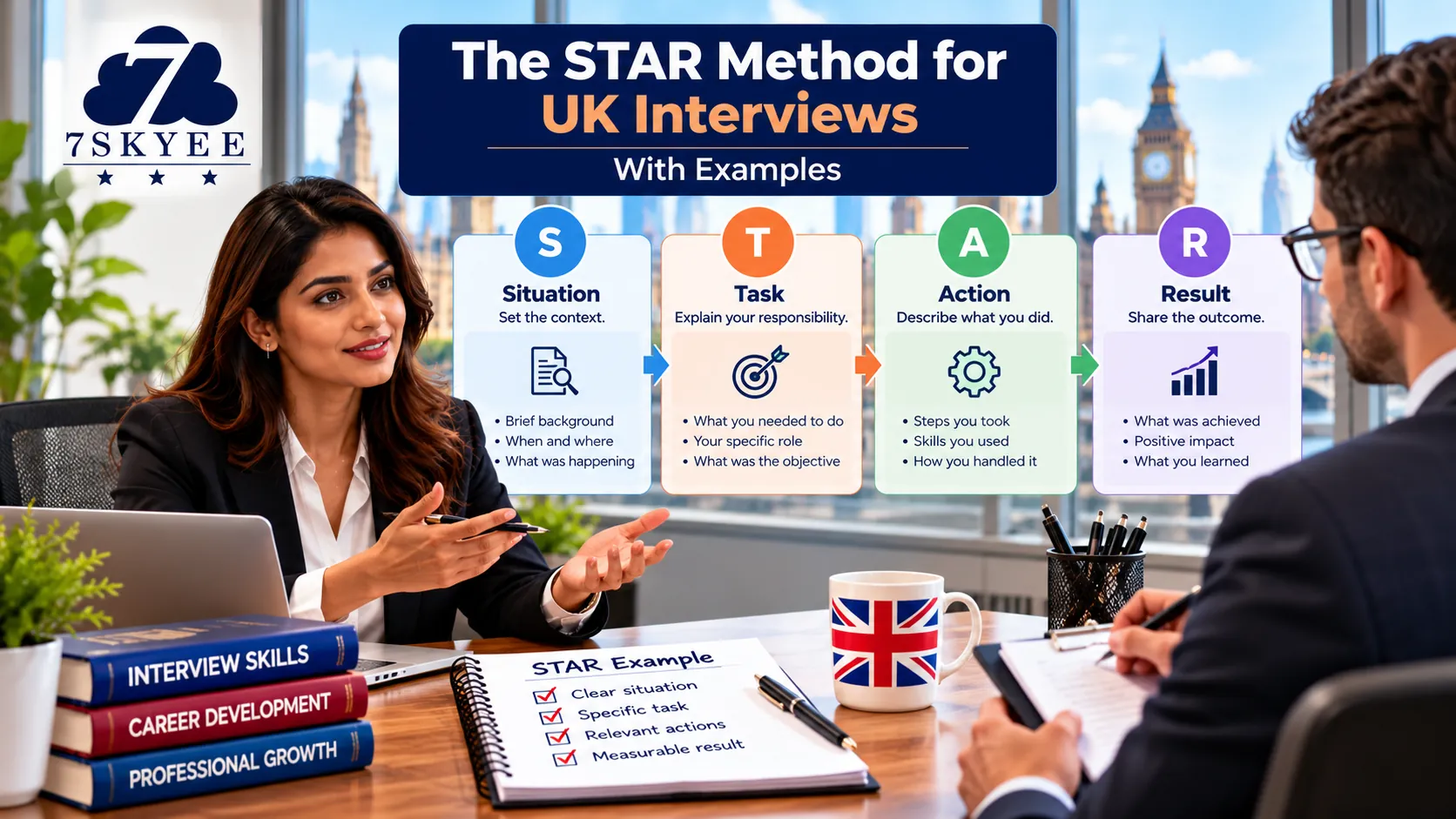
The STAR method helps you organise your answer into four parts: Situation, Task, Action and Result.
In this guide, you will learn how the STAR interview technique works, how to structure answers and how to apply it to realistic interview questions.
What Is the STAR Method?
STAR stands for:
Situation: Explain the circumstances or background.
Task: Describe your responsibility or objective.
Action: Explain the specific steps you took.
Result: Share the outcome and what you learned.
The method gives your answer a logical structure. It helps the interviewer understand the context, your contribution and the outcome without having to work through an unstructured story.
For example, if an interviewer asks, "Tell me about a time you solved a difficult problem at work," you should briefly explain the problem, clarify your responsibility, describe what you did and finish with the result.
The STAR method is particularly useful for competency-based questions, but it can also help with questions about achievements, teamwork, leadership, communication and decision-making.
If you are preparing for an interview more generally, our guide on how to prepare for a UK job interview covers employer research, practical preparation and other interview essentials.
1. Situation: Set the Context
Start by explaining what was happening.
Give the interviewer enough information to understand the challenge, but avoid spending too much time on background details.
You might explain:
The team or department involved.
The project or responsibility.
The problem or challenge.
The circumstances that made the situation important.
Example:
"In my previous role, our team was receiving an increasing number of customer complaints about delayed responses. The delays were affecting customer satisfaction and creating additional work for the support team."
This gives the interviewer a clear picture of the problem.
Avoid lengthy explanations about the company's entire history or unrelated events. Focus on the details that help explain your actions.
2. Task: Explain Your Responsibility
Next, explain what you were expected to achieve or what responsibility you had in that situation.
The task should make your role clear. This is especially important when the example involved several colleagues or departments.
Example:
"I was responsible for reviewing the team's response process, identifying the main causes of the delays and recommending improvements that could be introduced without increasing staffing costs."
This tells the interviewer what you needed to accomplish.
Do not confuse the task with the action. The task describes your responsibility; the action explains what you did to fulfil it.
3. Action: Describe What You Did
The Action section is usually the most important part of a STAR answer because it shows how you approached the situation.
Explain the specific steps you personally took.
Depending on the question, these might include:
Analysing information to identify a problem.
Speaking with colleagues or stakeholders.
Comparing possible solutions.
Changing a process or introducing a new approach.
Resolving a disagreement.
Planning and coordinating work.
Monitoring progress and making adjustments.
Example:
"I reviewed the response logs to identify when delays were occurring. I then discussed the findings with the team, introduced a clearer system for prioritising urgent requests and created a shared tracking sheet so outstanding cases could be monitored more consistently."
Notice that this explanation focuses on actions rather than vague claims such as "I worked hard" or "I showed leadership".
Use "I" when explaining your personal contribution, even if the wider achievement was a team effort. You can acknowledge the team's involvement while making your own role clear.
4. Result: Explain the Outcome
Finish by describing what happened as a result of your actions.
Where possible, include a specific and verifiable outcome, such as:
A reduction in processing time.
Fewer errors or complaints.
Improved customer feedback.
A project delivered on schedule.
Better coordination between teams.
A target achieved.
A useful lesson that influenced your later work.
Example:
"The new process helped the team identify overdue cases earlier and manage priorities more consistently. We also established a clearer way to monitor response times, which helped us identify further improvements."
If you have reliable figures, include them. For example, you might state that processing time fell by 15% if you can substantiate that figure.
Never invent percentages, savings or business results to make an answer sound more impressive. A credible qualitative outcome is better than a fabricated statistic.
You can also mention what you learned, particularly if the interviewer asks about reflection or professional development.
STAR Method Example 1: Tell Me About a Time You Solved a Problem
Interview question: "Describe a time you identified and solved a problem at work."
Situation: In a previous operations role, the team regularly missed internal deadlines because information was arriving from different departments at inconsistent times.
Task: I needed to identify the main cause of the delays and improve coordination without disrupting the team's existing responsibilities.
Action: I mapped the information flow, spoke with the departments involved and identified two recurring bottlenecks. I introduced a shared deadline tracker, clarified ownership for key tasks and arranged brief progress checks for time-sensitive work.
Result: The team gained better visibility of outstanding tasks and could identify potential delays earlier. The new process also made responsibilities clearer across departments.
Why this answer works: It explains the problem, establishes the candidate's responsibility, describes specific actions and finishes with a relevant outcome. It does not rely on unsupported numerical claims.
Use this structure as a guide, replacing the example with an authentic situation from your own experience.
STAR Method Example 2: Tell Me About a Time You Worked Under Pressure
Interview question: "Give me an example of when you had to deliver something under pressure."
Situation: My team had to prepare an important client report while also managing its normal workload. Several pieces of information were still outstanding close to the deadline.
Task: I was responsible for coordinating the report and ensuring that the final version was accurate and submitted on time.
Action: I identified the information that was essential to completing the report, contacted the relevant colleagues to confirm delivery times and divided the remaining work into clear priorities. I also checked the data as it arrived rather than leaving all the verification until the end.
Result: We submitted the report within the required timeframe and reduced the risk of last-minute errors. The experience reinforced the value of prioritisation and early communication.
Why this answer works: It demonstrates planning, communication and judgement under pressure rather than merely claiming to be good at handling stressful situations.
STAR Method Example 3: Tell Me About a Time You Worked in a Team
Interview question: "Describe a situation where you worked with others to achieve a shared goal."
Situation: My department was preparing to introduce a revised internal process that affected several teams.
Task: I needed to coordinate with colleagues, gather their feedback and help ensure the change could be implemented with minimal disruption.
Action: I arranged discussions with the teams involved, documented their concerns and identified areas where responsibilities were unclear. I shared the feedback with the project lead and helped communicate the revised process before implementation.
Result: Team members had a clearer understanding of their responsibilities, and the implementation was better coordinated. The discussions also helped identify issues that could be addressed before the new process went live.
Why this answer works: It shows collaboration through specific actions and explains how those actions supported the wider objective.
STAR Method Example 4: Tell Me About a Time You Showed Leadership
Interview question: "Give me an example of when you took the initiative or demonstrated leadership."
Situation: In a previous role, the team was experiencing recurring problems because new colleagues were receiving inconsistent guidance.
Task: I wanted to help improve consistency and make it easier for new team members to understand the required procedures.
Action: I reviewed the recurring questions, documented the main procedures and worked with experienced colleagues to create a practical reference guide. I also encouraged new team members to raise questions so that unclear instructions could be improved.
Result: The team had a more consistent reference point, and new colleagues could find answers more easily. The exercise also highlighted areas where our documentation needed further improvement.
Why this answer works: Leadership does not always mean managing a large team. This example demonstrates initiative, collaboration and a focus on helping others succeed.
Adapt the example to your actual level of responsibility. Do not imply that you managed employees if you did not.
STAR Method Example 5: Tell Me About a Time You Made a Mistake
Interview question: "Describe a mistake you made and what you learned from it."
Situation: During a project, I underestimated the time required to obtain input from another department.
Task: I needed to address the delay, communicate the impact and help the project return to its planned schedule.
Action: I informed the project lead, confirmed when the outstanding information would be available and reviewed the remaining tasks to see which could proceed in parallel. After the project, I updated my planning approach to include earlier requests for external input and more realistic time allowances.
Result: We were able to reorganise the remaining work and reduce the impact of the delay. I also improved how I planned tasks that depended on other teams.
Why this answer works: It demonstrates accountability, problem-solving and learning. The candidate explains the mistake honestly rather than blaming colleagues or avoiding responsibility.
Choose a genuine example that is appropriate to discuss in an interview. Focus on what you learned and changed.
How Long Should a STAR Interview Answer Be?
There is no universal time limit, but a practical target is around one to two minutes for many competency-based questions. More complex examples may need additional explanation.
As a starting point, allocate your time roughly as follows:
STAR sectionSuggested emphasisSituationBrief contextTaskYour responsibilityActionMost of the detailResultClear outcome and learning
Do not treat these proportions as rigid rules. The complexity of the question and the level of the role should guide your answer.
For a straightforward example, keep the background short and move quickly to what you did. For a senior-level role, you may need to explain the reasoning behind your decisions, the stakeholders involved and the wider business impact.
If your answer becomes too long, remove background details that do not help the interviewer understand your contribution.
Common STAR Method Mistakes to Avoid
Spending too long on the Situation
Candidates sometimes describe the entire history of a project before explaining their role. Keep the context relevant and concise.
Failing to explain the Task
The interviewer should understand what you were personally responsible for achieving.
Being vague about your Actions
Statements such as "we worked together" or "I handled the issue" do not explain what you actually did. Describe the decisions, steps and skills involved.
Forgetting the Result
Always explain what happened. If the outcome was mixed, be honest about it and discuss what you learned.
Using examples that do not answer the question
Choose an example that demonstrates the specific competency being assessed. A teamwork story may not be the best evidence for a question about analytical problem-solving.
Memorising answers word for word
Memorised scripts can sound unnatural and become difficult to adapt when the interviewer asks a slightly different question. Prepare key points instead.
Inventing achievements
Do not exaggerate your responsibility or claim results you cannot support. Interviewers may ask follow-up questions about the details.
Reusing the same example for every question
A strong example may demonstrate several skills, but prepare a range of experiences so you can choose the most relevant one for each question.
For more question-specific guidance, read Common UK Interview Questions — With Model Answers.
How to Prepare Your Own STAR Examples
You do not need to write a complete script for every possible interview question. Instead, prepare a small bank of real examples from your experience.
Start with these steps:
1. Review the job description. Identify the main skills and competencies the employer is seeking.
2. Recall relevant experiences. Think about projects, challenges, achievements, disagreements and situations where you learned something important.
3. Match examples to competencies. Select experiences that demonstrate problem-solving, communication, teamwork, leadership or other relevant skills.
4. Write four short prompts. Note the Situation, Task, Action and Result for each example.
5. Practise aloud. Explain each example in your own words, aiming for clarity rather than perfect memorisation.
6. Check the evidence. Make sure your account is accurate and that you can answer follow-up questions about your decisions and results.
7. Refine your answer. Remove unnecessary background and strengthen the explanation of your personal contribution.
Practise adapting your examples to different questions. This will help you respond more naturally when the wording differs from what you expected.
Does the STAR Method Work for Every Interview Question?
No. The STAR method is especially useful when an interviewer asks for evidence from your past experience.
It is less suitable for every type of question.
For example:
"Tell me about a time you resolved a conflict." STAR is useful.
"What do you know about our organisation?" A direct, researched answer is more appropriate.
"Why do you want this role?" Explain your motivation and how the position fits your experience and goals.
"What would you do in this hypothetical situation?" Explain your proposed approach and reasoning. You can refer to past experience where relevant, but do not force the answer into STAR.
"What are your salary expectations?" Give a considered response based on the role, your experience and available market information.
Use STAR when it helps organise evidence, not as a formula that must be applied to every question.
Final Thoughts
The STAR method can help you give clearer, more structured answers in UK job interviews. By explaining the situation, your responsibility, the actions you took and the result, you make it easier for an interviewer to understand your experience.
The most effective answers are specific, relevant and honest. They demonstrate what you did, why you did it and what happened as a result.
Prepare several real examples, practise explaining them aloud and adapt each answer to the question being asked.
If you would like help improving your interview answers, structuring competency-based examples or preparing for a particular role, explore 7Skyee's UK Interview Coaching service.