Applying for multiple jobs can be time-consuming, particularly when each employer expects candidates to demonstrate different skills, experience and professional capabilities.
Many candidates prepare one resume and send the same document to every employer. Although this approach saves time, it can make an otherwise qualified candidate appear less relevant to a particular opportunity.
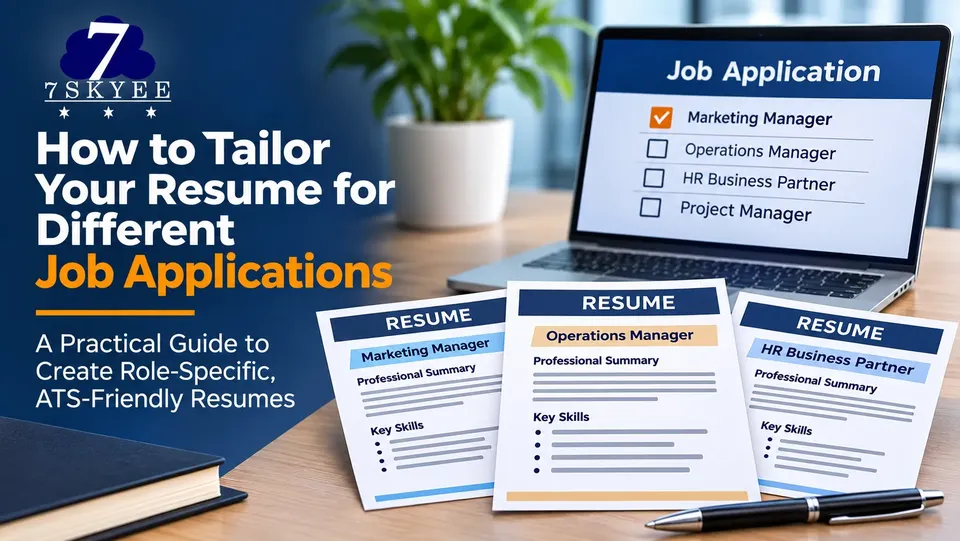
For example, an Operations Manager applying for a manufacturing leadership position may need to highlight production planning, operational efficiency, quality management and team leadership. The same professional applying for a supply chain management position may need to emphasise procurement, vendor management, inventory control and logistics.
The candidate's experience has not changed. What changes is the way that experience is presented.
Learning how to tailor your resume for different job applications helps you communicate your suitability more clearly while maintaining an accurate representation of your professional background.
What Does It Mean to Tailor Your Resume?
Tailoring your resume means adjusting its content and emphasis to match the requirements of a particular job opportunity.
It does not mean creating an entirely different employment history for every application. Instead, you select and prioritise the most relevant information from your actual experience.
This may involve adjusting:
Professional summary.
Key skills and areas of expertise.
Employment responsibilities.
Achievements and measurable results.
Relevant projects and certifications.
Keywords used in the job description.
The order in which information appears.
The objective is to help recruiters understand why your experience is relevant to the position they are hiring for.
Why Should You Customise Your Resume for Each Job?
Employers recruit for specific business requirements. Two positions with similar job titles may involve very different responsibilities.
A company hiring a Sales Manager for a new market may prioritise business development, client acquisition and revenue generation. Another organisation may need a Sales Manager focused on account management, customer retention and team performance.
A generic resume may not highlight the experience that matters most to either employer.
Customising your resume can help you:
Demonstrate a closer match with the job requirements.
Highlight relevant skills and achievements.
Improve the clarity of your professional positioning.
Include appropriate terminology from the job description.
Make it easier for recruiters to understand your suitability.
Resume customisation does not guarantee an interview. Employers also consider experience, qualifications, competition and their specific recruitment requirements.
How to Tailor Your Resume for Different Job Applications
Use the following practical process before submitting your next application.
Step 1: Read the Job Description Carefully
Do not start editing your resume immediately.
First, understand what the employer is looking for.
Read the job description and identify:
Primary responsibilities.
Essential qualifications.
Required technical skills.
Industry experience.
Leadership or management expectations.
Relevant certifications.
Preferred experience and competencies.
Separate essential requirements from desirable ones.
For example, a Manufacturing Operations Manager vacancy may emphasise production planning, plant operations, quality management, cost control and workforce productivity.
A supply chain management vacancy may place greater emphasis on procurement, inventory planning, logistics, vendor relationships and distribution.
This initial assessment will help determine which parts of your experience deserve greater visibility.
Step 2: Identify the Most Relevant Keywords
Many employers use Applicant Tracking Systems (ATS) to organise and process applications.
Relevant terminology can help communicate the relationship between your experience and the job requirements.
For example, a job description may mention:
Talent acquisition.
Workforce planning.
Employee engagement.
HR operations.
Performance management.
If you have genuine experience in these areas, use the appropriate terminology in your resume.
However, avoid copying every keyword from the job description. Only include skills, responsibilities and qualifications that accurately reflect your background.
The purpose is relevance, not keyword stuffing.
Step 3: Rewrite Your Professional Summary
Your professional summary should reflect the type of position you are applying for.
Consider this example.
Candidate background: An HR professional with eight years of experience across recruitment, HR operations and employee engagement.
Application A: Talent Acquisition Manager
The summary could emphasise recruitment strategy, hiring delivery, stakeholder management and talent acquisition.
Application B: HR Operations Manager
The summary could emphasise HR processes, employee lifecycle management, HR administration, policy implementation and operational efficiency.
Both summaries describe the same professional background, but each highlights different strengths.
Your summary should remain truthful and consistent with your employment history.
Step 4: Prioritise Relevant Skills
Avoid presenting every skill you have ever acquired in one long list.
Instead, prioritise the capabilities most relevant to the position.
For example:
For an Operations Manager role:
Production Planning
Process Improvement
Quality Management
Operational Efficiency
Team Leadership
Cost Control
For a Supply Chain Manager role:
Procurement Management
Inventory Control
Vendor Management
Logistics Coordination
Demand Planning
Supply Chain Optimisation
If you possess additional relevant skills, you can retain them in an appropriate section without allowing them to distract from the most important competencies.
Step 5: Adjust Your Work Experience
Your employment history should remain accurate, but the way you present responsibilities and achievements can be adjusted.
Suppose you previously worked as an Operations Manager with responsibilities covering production, quality, procurement and workforce management.
For a production-focused role, give greater prominence to:
Production planning and scheduling.
Plant operations.
Productivity improvements.
Quality control.
Workforce utilisation.
For a procurement-focused role, emphasise:
Vendor coordination.
Procurement planning.
Cost management.
Supplier relationships.
Inventory availability.
Do not remove important employment information merely because it is less relevant. Prioritise the most relevant achievements and responsibilities while maintaining a complete and accurate career history.
Step 6: Highlight Relevant Achievements
Achievements can demonstrate how your experience has contributed to business outcomes.
For example, a generic responsibility might read:
"Responsible for managing production operations."
A more effective achievement-based statement could be:
"Managed production operations, coordinated cross-functional teams and implemented process improvements to support productivity and delivery targets."
Where you have verified results, include measurable outcomes.
Examples include:
Reduced operational costs by 12%.
Improved production efficiency by 15%.
Managed a team of 45 employees.
Increased customer retention by 18%.
These figures are illustrative. Always use your own accurate results rather than copying sample numbers.
Step 7: Review the Resume Format and Structure
Your resume should be easy to navigate.
A professional structure generally includes:
Name and contact information.
Professional summary.
Key skills.
Employment history.
Education and qualifications.
Certifications and relevant projects, where applicable.
Use clear headings, consistent formatting and readable fonts.
Avoid unnecessary graphics, complicated layouts and decorative elements that make information difficult to read or process.
The best format also depends on the candidate's career history and the requirements of the target role.
Step 8: Check ATS Compatibility
An ATS-friendly resume should be easy for recruitment software to process.
Consider these practices:
Use standard section headings.
Include relevant job-related terminology naturally.
Maintain a clear document structure.
Use readable fonts and consistent formatting.
Avoid placing essential information only inside graphics.
Follow the employer's requested file format.
Review the final document for formatting errors.
There is no universal ATS score that guarantees selection. Different employers use different systems and screening processes.
The goal is to create a readable, relevant resume that works for both recruitment systems and human reviewers.
Step 9: Review Your Resume Against the Job Description
Before submitting the application, compare the final document with the vacancy requirements.
Ask yourself:
Does the professional summary reflect the target position?
Are the most relevant skills easy to identify?
Does the work experience demonstrate suitable responsibilities?
Are important achievements clearly presented?
Have I included relevant keywords naturally?
Is all information accurate?
Is the document easy to read?
If important requirements are missing, review whether you have relevant experience that needs to be presented more clearly.
Do not claim qualifications or skills you do not possess.
Step 10: Save Each Version Carefully
If you apply for different roles, maintain separate versions of your resume.
For example:
Resume_Operations_Manager
Resume_Supply_Chain_Manager
Resume_Production_Manager
Resume_General_Management
Keep one master resume containing your complete career history, achievements and skills. Use it as the source when preparing role-specific versions.
This approach helps maintain consistency and reduces the risk of accidentally submitting the wrong document.
Example: Tailoring One Resume for Different Job Roles
Consider a professional with ten years of experience in manufacturing operations.
The candidate has worked across production planning, quality management, procurement coordination and team leadership.
The candidate is applying for three different positions.
Target position, What to emphasise, Production Manager, Production planning, productivity, quality and workforce management, Supply Chain Manager, Procurement, inventory, vendor management and logistics, Operations Manager, Operational performance, cost control, process improvement and leadership
The candidate should not invent different experience for each position.
Instead, the professional summary, skills and order of achievements should reflect the most relevant aspects of the candidate's actual background.
If you need help presenting your experience for a specific career direction, explore our resume writing support for your target role.
Common Mistakes to Avoid When Tailoring Your Resume
1. Sending the Same Resume to Every Employer
A generic resume may not communicate your suitability for different roles effectively.
2. Copying the Job Description Word for Word
Using job-description language without demonstrating actual experience can make your resume sound artificial and misleading.
3. Adding Skills You Do Not Possess
Never include skills simply because they appear in the vacancy. Employers may assess them during interviews or practical evaluations.
4. Changing Your Job Titles Incorrectly
Do not change your official job title to match the advertised position. You can clarify your responsibilities, but your employment history must remain accurate.
5. Removing Too Much Relevant Experience
Tailoring does not mean deleting your entire career history. Keep relevant information and prioritise what matters most.
6. Ignoring Achievements
A resume that only lists responsibilities may not demonstrate the impact of your work. Include meaningful achievements wherever possible.
7. Forgetting to Proofread
Check spelling, grammar, dates, formatting and consistency before submitting your application.
Should You Maintain One Resume or Multiple Versions?
The best approach is to maintain one comprehensive master resume and prepare customised versions for different job categories.
Your master resume should contain:
Complete employment history.
All relevant skills.
Major projects.
Certifications.
Professional achievements.
Education and qualifications.
You can then select and prioritise information from the master document for specific applications.
For example, a finance professional applying for Financial Controller, Finance Manager and Accounts Manager positions may use different summaries and achievement priorities while maintaining the same accurate employment history.
This approach saves time and makes resume customisation more manageable.
When Should You Consider Professional Resume Writing Support?
Customising a resume can become challenging when you have extensive experience, multiple career responsibilities or are applying for positions across different functions.
Professional guidance may be useful if:
You struggle to identify your strongest achievements.
Your resume does not clearly communicate your experience.
You are applying for managerial or senior positions.
You are changing industries or career direction.
Your applications are not receiving the response you expected.
You need help presenting your experience in an ATS-friendly format.
If you need help presenting your professional background more effectively, explore 7Skyee Professional Resume Writing Services.
You can also review the available resume writing packages and pricing to understand the support options.
Frequently Asked Questions
Should I change my resume for every job application?
You should review and customise your resume for each relevant opportunity. The level of adjustment depends on how closely the job requirements match your existing professional background.
How do I tailor my resume for different positions in the same industry?
Identify the different responsibilities and skills required for each position. Then adjust your professional summary, key skills and achievement priorities while keeping your employment history accurate.
Can I use the same work experience for different job applications?
Yes. Your actual work experience remains the same. You can change the emphasis and order of relevant responsibilities and achievements to reflect the target position.
Does tailoring a resume improve ATS performance?
Using relevant terminology and a clear structure can make your resume easier for recruitment systems to process. However, it does not guarantee a particular ATS score, ranking or interview.
How long should it take to tailor a resume?
The time depends on the complexity of your background and how different the target roles are. Having a comprehensive master resume makes the process easier.
Should I maintain separate resumes for different job roles?
Yes, if you regularly apply for substantially different positions. Keep one master resume and prepare accurate role-specific versions.
Final Thoughts
Tailoring your resume is not about changing your professional identity to suit every vacancy. It is about presenting the most relevant parts of your actual experience in a way that helps employers understand your suitability.
A well-targeted resume communicates your professional strengths, highlights relevant achievements and makes your career story easier to follow.
Before submitting your next application, take the time to understand the role, review its requirements and adjust your resume accordingly.
If you need professional support in presenting your experience, explore 7Skyee Resume Writing Services and review the available packages.