Many resumes describe what candidates were responsible for, but fail to explain what they actually accomplished.
A candidate may write that they managed a team, handled customer accounts, supervised production or coordinated recruitment activities. These responsibilities provide useful information, but they do not necessarily show the value the candidate brought to the organisation.
Recruiters and hiring managers also want to understand the contribution behind the job title.
Did you improve a process? Reduce operating costs? Increase revenue? Complete a major project? Improve customer satisfaction? Build a team or introduce a more effective way of working?
These are examples of professional achievements that can make a resume more meaningful.
Learning how to write resume achievements helps you communicate your experience through results, contributions and measurable outcomes rather than relying only on routine job descriptions.
What Are Resume Achievements?
Resume achievements are specific contributions or results that demonstrate what you accomplished during your professional experience.
They explain how your work made a difference to a team, department, organisation, customer or business operation.
Examples include:
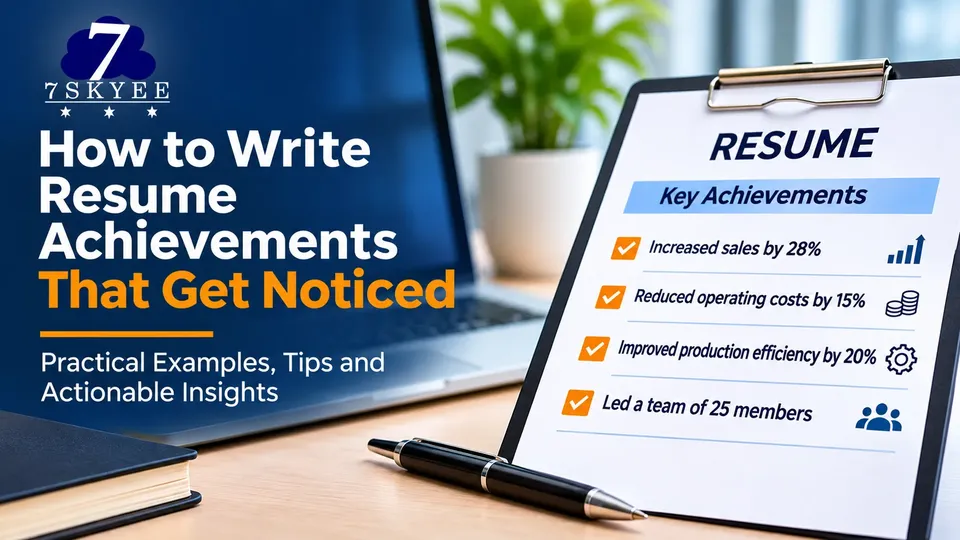
Increasing sales or revenue.
Reducing operating costs.
Improving production efficiency.
Completing projects within deadlines.
Managing and developing teams.
Improving recruitment turnaround time.
Strengthening customer relationships.
Introducing process improvements.
Improving quality or service delivery.
An achievement does not always need to be expressed as a percentage or financial figure. A successful project, improved process or significant responsibility can also demonstrate professional contribution.
The important point is to describe what you did and why it mattered.
Why Are Achievements Important in a Resume?
Two candidates may have similar job titles and years of experience, but their professional contributions may be very different.
Consider these two statements:
Responsibility-based statement:
"Responsible for managing production operations and supervising employees."
Achievement-focused statement:
"Managed daily production operations, coordinated workforce allocation and implemented process improvements to support production targets and delivery schedules."
The second statement gives a clearer picture of the candidate's contribution.
Well-written achievements can help:
Demonstrate your professional capabilities.
Highlight your contribution to business outcomes.
Differentiate your experience from generic job descriptions.
Communicate your suitability for a target position.
Make your resume more specific and credible.
Achievements should always be genuine. Do not add figures or results that you cannot substantiate.
How to Write Effective Resume Achievements
Use the following approach to identify and present your accomplishments.
Step 1: Review Your Previous Responsibilities
Start by reviewing your employment history and identifying the work you performed.
Ask yourself:
Which projects did I successfully complete?
What processes did I improve?
Did I help increase revenue or reduce costs?
Did I manage or develop a team?
Did I resolve an important operational problem?
Did I improve customer or employee experience?
Did I introduce a new system or working method?
Your regular responsibilities can help you identify achievements that may otherwise be overlooked.
Step 2: Identify the Result of Your Work
Think about what changed because of your contribution.
For example:
A process became faster.
A department achieved its targets.
Recruitment vacancies were closed more efficiently.
Production delays were reduced.
Customer complaints decreased.
A project was completed successfully.
A team became more productive.
Try to identify the business or operational impact rather than simply repeating your daily duties.
Step 3: Use Numbers Where Available
Measurable achievements can make your resume more specific.
For example:
"Reduced recruitment turnaround time by 20% through improved candidate coordination and hiring process management."
This communicates a result more clearly than:
"Handled recruitment activities."
Useful measurements may include:
Revenue growth.
Cost savings.
Productivity improvements.
Number of employees managed.
Recruitment volumes.
Project delivery timelines.
Customer retention.
Quality improvements.
Only use figures that are accurate and that you can reasonably explain if asked during an interview.
Step 4: Explain Your Contribution
A result is more meaningful when the reader understands your role in achieving it.
For example:
"Supported the implementation of a new inventory tracking process that improved stock visibility and coordination between procurement and warehouse teams."
This explains the candidate's contribution and the operational benefit.
Use action verbs such as:
Improved
Delivered
Implemented
Reduced
Increased
Developed
Coordinated
Managed
Established
Streamlined
Introduced
Achieved
Choose verbs that accurately describe what you did.
Step 5: Align Achievements With Your Target Position
Not every achievement deserves equal space in every application.
A candidate applying for a Finance Manager position should prioritise financial planning, reporting, cost control and business analysis.
The same candidate applying for a Commercial Manager position may need to highlight commercial performance, stakeholder management, business planning and contract-related contributions.
Select achievements that demonstrate the capabilities required for the role.
For more guidance, read How to Tailor Your Resume for Different Job Applications.
Step 6: Keep Each Achievement Clear and Concise
An achievement should communicate one main contribution.
Avoid lengthy paragraphs that combine unrelated responsibilities.
A useful structure is:
Action + What You Did + Result or Business Impact
For example:
"Introduced a structured vendor review process, improving supplier coordination and supporting more consistent procurement planning."
You do not need to force every achievement into this structure, but it is a useful starting point.
Resume Achievement Examples for Different Professions
The following examples demonstrate how achievements can be presented across different functions.
These are illustrative examples. Candidates should replace the sample results and responsibilities with their own verified experience.
1. Sales and Business Development
Responsibility:
"Responsible for sales activities and client relationship management."
Achievement-focused examples:
Expanded the customer base by developing new business relationships and strengthening existing accounts.
Achieved assigned sales targets through structured lead management and client engagement.
Supported revenue growth by identifying new market opportunities and coordinating business development initiatives.
Where accurate figures are available, include sales value, growth percentage, account numbers or target achievement.
2. Human Resources and Talent Acquisition
Responsibility:
"Handled recruitment and HR activities."
Achievement-focused examples:
Coordinated recruitment activities across multiple departments to support workforce requirements.
Improved candidate coordination and interview scheduling through a more structured hiring process.
Supported employee engagement initiatives and HR operations across the employee lifecycle.
Relevant measurements may include hiring volumes, recruitment turnaround time, positions closed or workforce size.
3. Operations and Manufacturing
Responsibility:
"Managed production operations and supervised employees."
Achievement-focused examples:
Coordinated production planning and workforce allocation to support operational targets.
Introduced process improvements to strengthen production workflow and reduce avoidable delays.
Worked with quality and maintenance teams to support consistent production and delivery performance.
Relevant measurements may include production output, rejection rates, downtime, cost savings and productivity.
4. Finance and Accounts
Responsibility:
"Handled financial reporting and accounting activities."
Achievement-focused examples:
Coordinated monthly financial reporting and supported timely preparation of management information.
Strengthened reconciliation and reporting processes to improve financial data accuracy.
Supported budget monitoring and expense analysis to assist departmental cost control.
Where appropriate, include reporting timelines, budgets managed, audit outcomes or process improvements.
5. Information Technology
Responsibility:
"Worked on software development and application maintenance."
Achievement-focused examples:
Developed and maintained application features to support business requirements.
Resolved technical issues and coordinated testing to improve application reliability.
Collaborated with cross-functional teams to deliver software enhancements within project timelines.
Relevant measurements may include application performance, defect reduction, deployment frequency or project delivery.
6. Marketing
Responsibility:
"Handled digital marketing and promotional activities."
Achievement-focused examples:
Coordinated digital campaigns across relevant channels to support lead generation and brand visibility.
Improved campaign performance through regular analysis of audience engagement and conversion data.
Supported content planning and marketing initiatives aligned with business objectives.
Useful measurements may include qualified leads, conversion rates, campaign engagement and acquisition costs.
7. Project Management
Responsibility:
"Managed projects and coordinated team members."
Achievement-focused examples:
Coordinated cross-functional teams to deliver project milestones within agreed timelines.
Monitored project progress, identified delivery risks and supported corrective actions.
Improved project coordination through structured reporting and stakeholder communication.
Where accurate, include project budgets, team size, timelines and delivery outcomes.
8. Customer Service
Responsibility:
"Handled customer queries and complaints."
Achievement-focused examples:
Coordinated customer issue resolution to support service quality and timely responses.
Strengthened customer communication and follow-up processes.
Supported service improvement initiatives through analysis of recurring customer concerns.
Relevant measurements may include resolution time, customer satisfaction, complaint reduction or retention.
How to Write Resume Achievements Without Exact Numbers
Not every professional has access to business performance figures.
This is particularly common when working with confidential information, supporting a larger team or contributing to projects where results are not individually measured.
You can still communicate meaningful achievements.
For example:
Instead of:
"Improved the recruitment process."
Write:
"Introduced a more structured candidate coordination process to support interview scheduling and hiring communication."
Another example:
Instead of:
"Worked on improving customer service."
Write:
"Strengthened customer follow-up and issue coordination to support a more consistent service experience."
These statements describe contributions without inventing numerical outcomes.
How to Identify Achievements From Your Existing Job Responsibilities
If you find it difficult to identify accomplishments, use the following questions for each previous role.
AreaQuestions to ask yourselfProductivityDid I help improve output or efficiency?CostDid I contribute to reducing expenses or resource wastage?RevenueDid my work support sales or business growth?QualityDid I improve quality or reduce errors?PeopleDid I lead, train or develop employees?ProjectsDid I successfully complete an important project?ProcessesDid I introduce or improve a working process?CustomersDid I improve customer experience or relationships?
Review your previous projects, performance reviews, appraisal documents and work records where available.
These can help you recall achievements that may not be immediately obvious.
Common Resume Achievement Mistakes to Avoid
1. Listing Responsibilities Instead of Results
A long list of daily duties does not necessarily demonstrate professional impact.
Identify the contributions that made a difference.
2. Inventing Numbers or Percentages
Never add impressive-looking figures without evidence.
If you cannot verify a result, describe the contribution accurately without a number.
3. Using Generic Statements
Statements such as "excellent performer", "hardworking employee" and "highly dedicated professional" do not explain what you accomplished.
Use specific examples instead.
4. Including Irrelevant Achievements
An achievement should support your professional positioning.
Prioritise accomplishments relevant to the job you are applying for.
5. Writing Extremely Long Bullet Points
Recruiters should be able to understand each achievement quickly.
Keep the wording focused and remove unnecessary explanations.
6. Taking Credit for Team Results Incorrectly
If an outcome was achieved by a team, describe your actual contribution rather than claiming sole responsibility.
For example, use "Contributed to", "Coordinated" or "Led the team responsible for" where appropriate.
7. Repeating the Same Achievement
Avoid repeating identical accomplishments in your professional summary and every employment entry.
Use the summary to introduce your strongest professional value and the employment section to provide supporting evidence.
Where Should You Place Achievements in Your Resume?
Achievements can appear in different sections depending on their relevance.
Professional Summary
Include one or two particularly strong accomplishments if they help establish your professional value.
Work Experience
Place role-specific achievements under the relevant employer and position.
This is generally the most useful place for explaining your contribution within a particular job.
Key Achievements Section
Candidates with significant accomplishments across several organisations may benefit from a separate section highlighting selected achievements.
Use it selectively. Avoid duplicating the same information throughout the document.
How Professional Resume Writing Can Help Present Your Achievements
Many professionals have valuable accomplishments but struggle to identify, structure and communicate them effectively.
A recruiter-oriented resume review can help assess:
Whether your achievements are specific and relevant.
Whether your professional contribution is clear.
Whether important results are easy to identify.
Whether your experience is aligned with your target position.
Whether the language is credible and professional.
Whether the resume is structured for readability and ATS compatibility.
The objective is not to exaggerate your experience. It is to make your genuine professional contributions easier to understand.
If you need support in presenting your career experience more effectively, explore 7Skyee Professional Resume Writing Services.
You can also review the available Resume Writing Packages and Pricing.
Frequently Asked Questions
What are good achievements to include in a resume?
Good achievements demonstrate relevant contributions such as revenue growth, cost savings, productivity improvements, successful projects, team leadership, customer retention and process improvements.
How many achievements should I include in my resume?
There is no fixed number. Prioritise the most relevant accomplishments for each role. A few strong, specific achievements are generally more useful than a long list of repetitive statements.
Can I write resume achievements without numbers?
Yes. You can describe improvements, projects, responsibilities and contributions without numerical figures. Never invent statistics to make an achievement appear more impressive.
What is the difference between responsibilities and achievements?
Responsibilities explain what you were expected to do in a position. Achievements explain what you contributed, improved, delivered or accomplished while performing that work.
Should freshers include achievements in their resumes?
Yes. Freshers can highlight academic projects, internships, certifications, competitions, leadership activities and other relevant accomplishments.
Should I customise my resume achievements for every job?
You should prioritise achievements relevant to each opportunity. Keep the underlying facts accurate while adjusting the emphasis to match the target role.
Can AI help write resume achievements?
AI tools can help organise information and improve sentence structure. However, you must verify every statement to ensure it reflects your actual work, contribution and results.
If you are struggling to turn your responsibilities into clear, achievement-focused career statements, our achievement-focused resume writing service can help present your professional contribution more effectively.
Final Thoughts
Your resume should communicate more than your job titles and responsibilities. It should help employers understand what you have contributed throughout your career.
Take time to review your previous roles, identify meaningful accomplishments and explain the value of your work through clear, specific statements.
Whether you are a fresher, an experienced professional or a senior manager, well-presented achievements can make your professional profile more informative and relevant.
If you need help presenting your experience and accomplishments in a structured, recruiter-oriented format, explore 7Skyee Resume Writing Services and review the available packages and pricing.