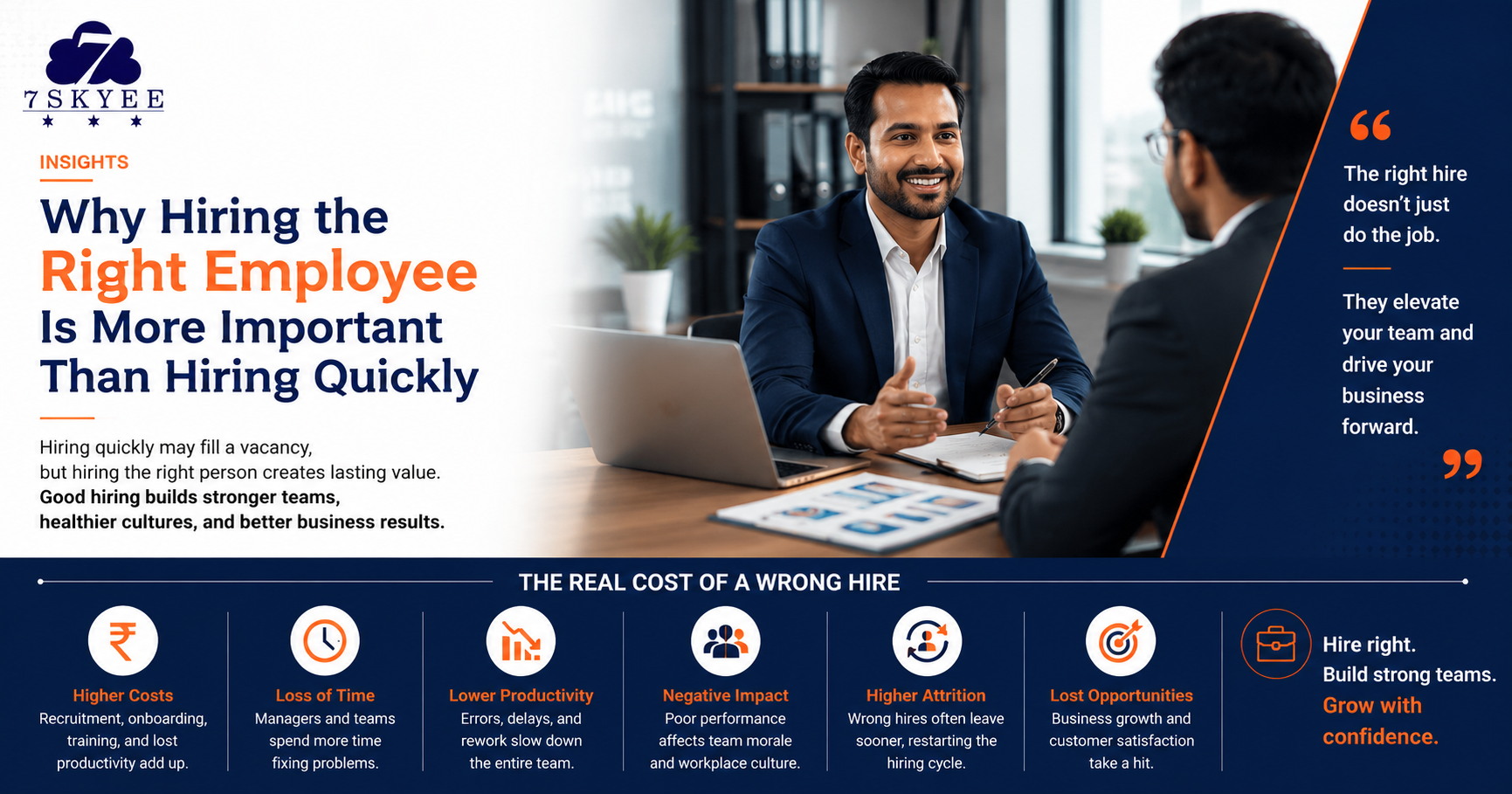
Why Hiring the Right Employee Is More Important Than Hiring Quickly
Hiring quickly may fill a vacancy, but hiring the right employee creates lasting business value. Learn why thoughtful recruitment leads to stronger teams, better retention, and sustainable business growth.
Every business owner understands that vacant positions need to be filled. A delayed hire can slow production, increase workload for existing employees, and affect customer service. Because of this pressure, many organizations focus on one goal—fill the vacancy as quickly as possible.
While speed certainly matters, it should never come at the expense of hiring quality.
A rushed hiring decision may solve today's staffing problem, but it can create far bigger challenges in the months ahead. The wrong employee can affect productivity, increase costs, lower team morale, disrupt workplace culture, and delay business growth. In many cases, replacing a poor hire costs significantly more than waiting a little longer to find the right one.
Successful companies understand an important principle:
Hiring isn't about filling a position. It's about strengthening the business.
The Hidden Cost of a Wrong Hire
Most organizations think about recruitment costs in terms of advertising, interviews, or agency fees. However, these expenses are only a small part of the overall investment.
When the wrong person joins your organization, the actual cost begins after they are hired.
Managers spend additional time supervising and correcting mistakes. Team members often have to compensate for poor performance, increasing their own workload and frustration. Training resources are invested in someone who may never become fully productive. Projects slow down, customer satisfaction may decline, and if the employee eventually leaves, the entire recruitment process starts again.
Beyond financial costs, poor hiring decisions also consume something that is much harder to recover—management time.
Every hour spent replacing an unsuitable employee is time that could have been invested in improving operations, serving customers, or growing the business.
Why Hiring Delays Feel Expensive
No business likes an empty position.
When an important role remains vacant, existing employees often work overtime to manage additional responsibilities. Deadlines become harder to meet, supervisors become stretched, and business opportunities may be postponed.
This pressure sometimes encourages organizations to lower their hiring standards simply to fill the vacancy.
Unfortunately, this approach often creates a much bigger problem.
Hiring someone who isn't suited to the role rarely removes the workload. Instead, it transfers the problem into the workplace, where correcting poor performance becomes far more difficult than waiting a little longer for the right candidate.
The objective should never be fast hiring.
It should be effective hiring within a reasonable timeframe.
Great Employees Improve Team Productivity
An experienced employee contributes far more than completing assigned tasks.
Strong performers solve problems, support colleagues, improve processes, and often raise the performance of everyone around them.
On the other hand, an unsuitable hire can unintentionally reduce the productivity of an entire department.
Managers spend more time monitoring work.
Senior employees spend time providing repeated guidance.
Team members become frustrated when responsibilities are unevenly distributed.
Eventually, productivity begins to decline—not because of the workload, but because of the additional effort required to compensate for one poor hiring decision.
Recruitment should therefore be viewed as a long-term investment in team performance rather than simply filling an organisational chart.
Skills Can Be Developed. Attitude Is Harder to Change.
Technical skills are important, but they are only one part of successful hiring.
Many employers have discovered that employees with the right attitude often outperform technically stronger candidates who struggle with accountability, teamwork, communication, or adaptability.
Positive work ethic, willingness to learn, ownership of responsibilities, and professionalism influence long-term success far more than many organisations realise.
Training can improve technical abilities.
Changing someone's mindset is much more difficult.
That is why experienced recruiters evaluate both competence and cultural fit during the hiring process.
Company Culture Matters More Than Ever
Every organisation has its own way of working.
Some businesses value speed and innovation.
Others focus on precision, compliance, collaboration, or customer relationships.
Hiring candidates whose values align with the organisation creates stronger teams and healthier workplaces.
Employees who fit the company culture generally adapt faster, build better relationships, and remain with the organisation for longer periods.
Conversely, even highly qualified professionals may struggle if their working style conflicts with the company's expectations.
Successful hiring therefore involves evaluating not only whether a candidate can do the job, but also whether they are likely to succeed within your organisation.
Better Hiring Improves Employee Retention
Employee retention begins much earlier than most companies realise.
It starts during recruitment.
When candidates clearly understand the role, reporting structure, expectations, work environment, and growth opportunities before joining, they make better career decisions.
Likewise, employers who carefully assess motivation, career goals, and cultural alignment are more likely to hire individuals who remain committed over the long term.
Replacing employees repeatedly is expensive and disruptive.
Investing additional time during recruitment often reduces turnover, strengthens organisational stability, and creates better long-term results.
Leadership Hiring Requires Greater Precision
Hiring for leadership positions demands a completely different approach from entry-level recruitment.
Managers, department heads, plant leaders, finance controllers, HR heads, and senior executives influence not only their own performance but also the performance of entire teams.
One ineffective leadership appointment can affect operations, employee engagement, customer relationships, strategic planning, and business profitability.
Senior hiring decisions require careful assessment of leadership style, decision-making ability, communication, industry expertise, stakeholder management, and long-term organisational fit.
This is one reason executive search differs significantly from traditional recruitment.
Leadership positions rarely succeed through mass hiring approaches.
They require focused research, confidential networking, and careful evaluation.
Why Rushed Hiring Usually Fails
Under pressure, companies sometimes believe that interviewing more candidates automatically leads to better hiring decisions.
In reality, quality matters far more than quantity.
Rushed recruitment often results in:
Limited candidate assessment. Incomplete reference verification. Poor cultural fit. Unrealistic salary expectations. Weak onboarding preparation. Higher early attrition.
When hiring becomes reactive rather than strategic, organisations increase the likelihood of repeating the same recruitment process within a few months.
Taking slightly more time to identify the right professional usually produces significantly better long-term outcomes.
Recruitment Should Support Business Growth
Every hiring decision influences the future direction of a business.
The right employee brings new ideas, improves customer relationships, strengthens internal processes, and contributes to organisational growth.
The wrong employee creates uncertainty, additional management effort, and unnecessary operational challenges.
As businesses expand, recruitment becomes less about replacing employees and more about building capable teams that can support future growth.
That is why successful organisations treat recruitment as a strategic business function rather than an administrative activity.
The Right Hire Creates Long-Term Value
Finding exceptional talent isn't always the fastest process, but it is almost always the most valuable.
Businesses that consistently hire well tend to experience stronger productivity, healthier workplace cultures, lower employee turnover, better customer experiences, and sustainable long-term growth.
Speed has its place in recruitment.
However, lasting business success comes from making thoughtful hiring decisions that balance efficiency with quality.
The best recruitment process isn't necessarily the one that fills vacancies first.
It's the one that places the right person in the right role—someone who contributes not only to today's workload but also to tomorrow's business success.
For employers, recruitment should never be viewed simply as filling an empty chair.
It should be viewed as an investment in people, performance, and the future of the organisation.
About the Author
Sarfraz Alam is the Founder of 7Skyee Consultancy Pvt. Ltd. With more than 16 years of experience in executive search, permanent recruitment, and leadership hiring, he has helped manufacturing and service organizations across India build high-performing teams. His insights focus on recruitment strategy, career growth, and practical hiring solutions based on real-world experience.
Need Help Hiring the Right Talent?
Whether you're hiring a Plant Head, Finance Controller, HR Manager, Sales Leader, or senior executive, our recruiter-led executive search process helps you connect with professionals who match your business needs.
Explore our Employer Services: https://7skyee.net/employers