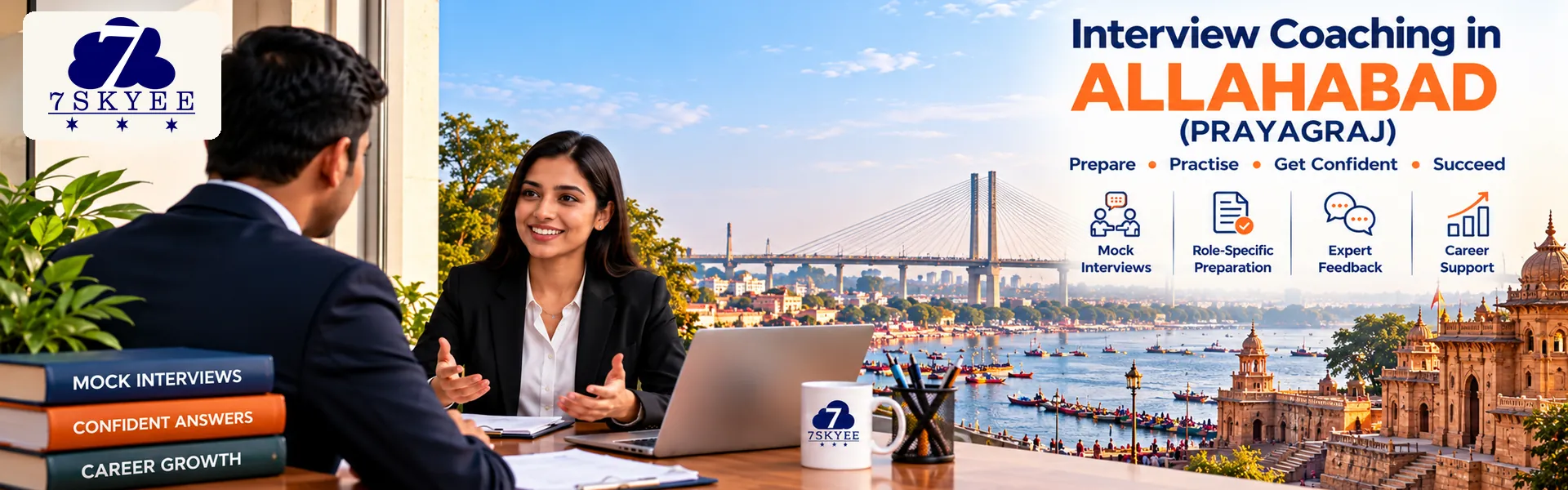
Knowing your subject is important, but explaining your abilities clearly under interview pressure is a different skill. You may have the right qualifications, relevant experience and a strong understanding of the job, yet still struggle to communicate your strengths when an interviewer asks an unexpected question.
7Skyee provides interview coaching to help candidates prepare more effectively, practise realistic interview questions and present their experience with greater confidence. Through structured preparation, mock interviews and personalised feedback, you can identify weaknesses in your answers and develop a clearer approach to your next interview.
Whether you are a fresher preparing for your first opportunity, a professional considering a career move or an experienced candidate targeting a more senior position, our interview coaching service can help you prepare around your specific goals.
Interview Preparation for Candidates in Allahabad (Prayagraj)
Prayagraj has a distinctive professional environment shaped by education, public administration, legal services, banking, healthcare, commerce and other service-sector activities. Candidates may be applying for government-related opportunities, private-sector positions, academic roles, corporate jobs or opportunities elsewhere in India.
Each recruitment process has different expectations. A graduate attending an entry-level interview will not necessarily face the same questions as an experienced professional applying for a management position.
Effective preparation starts with understanding the role, reviewing the skills the employer needs and practising how to communicate your suitability.
At 7Skyee, interview preparation can help you work on:
Answering common HR and introductory questions.
Explaining your qualifications, projects and professional experience.
Preparing examples that demonstrate practical skills and achievements.
Responding to behavioural and situational questions.
Improving the structure, relevance and clarity of your answers.
Handling difficult questions without losing focus.
Communicating your strengths without exaggerating your experience.
The objective is not to memorise a perfect script. It is to become better prepared to answer questions naturally, accurately and with a clear purpose.
Interview Coaching for Freshers and Graduates
Your first few interviews can be challenging, particularly when you have limited work experience. You might know your academic subjects well but find it difficult to explain what makes you a suitable candidate.
Interview coaching can help you connect your education, projects, internships and transferable skills to the requirements of the position.
You can practise questions such as:
Tell me about yourself.
Why have you applied for this position?
What are your strengths and weaknesses?
What did you learn from your academic projects?
Why should we hire you?
How would you handle a challenging situation at work?
Instead of giving generic answers, learn to select relevant examples and explain what they demonstrate about your abilities.
For help with one of the most common opening questions, read our guide on how to answer “Tell me about yourself” in an interview.
Interview Preparation for Experienced Professionals
For experienced candidates, an interview is an opportunity to demonstrate not only what they have done but also how they approach responsibilities, solve problems and contribute to business outcomes.
Simply listing your duties may not show the interviewer why your experience matters. Stronger answers explain the challenge you faced, the decisions you made, the actions you took and the results you achieved.
Your preparation may focus on:
Explaining professional achievements with relevant examples.
Discussing projects, responsibilities and measurable outcomes.
Describing how you handled conflict or competing priorities.
Demonstrating collaboration and stakeholder management.
Explaining career changes or employment gaps constructively.
Preparing for leadership and management questions.
Communicating why you are suitable for the next stage of your career.
If you are preparing for a promotion or a move into management, practise discussing your judgement, accountability and contribution rather than relying solely on technical knowledge.
Prepare for Different Types of Interviews
The interview format influences the kind of preparation you need. Understanding what the employer is likely to assess can help you use your preparation time more effectively.
HR interviews
HR interviews may cover your background, motivation, communication, strengths, career plans and expectations. Practise giving concise answers that address the question directly and remain consistent with your CV.
Technical and role-specific interviews
These interviews assess knowledge and the ability to apply it. Depending on the role, preparation may involve technical concepts, practical scenarios, project discussions, case questions or explanations of your working methods.
Practise explaining your reasoning, not just stating the final answer. If you do not know something, learn how to respond honestly and explain how you would approach finding the answer.
Behavioural interviews
Behavioural questions ask you to describe how you handled situations in the past. Employers may want to understand how you solve problems, manage pressure, work with others or learn from mistakes.
The STAR method can help you structure these responses by covering the Situation, Task, Action and Result. Our guide to the STAR method for behavioural interview questions explains how to use this approach without making your answers sound rehearsed.
Situational interviews
Situational questions ask what you would do in a hypothetical workplace scenario. A useful response demonstrates a logical approach, sound judgement and awareness of the people or business outcomes involved.
Take a moment to understand the situation, explain your priorities and describe the steps you would take.
Build Confidence Through Mock Interviews
Reading interview advice is useful, but it cannot fully reproduce the experience of answering questions aloud while someone evaluates your responses.
A mock interview gives you an opportunity to practise before the actual recruitment process. It can reveal whether your answers are too long, whether your examples are relevant and whether you have explained your contribution clearly.
Depending on your needs, mock interview practice may cover:
General HR and introductory questions.
Questions related to your target job.
Technical or professional subject areas.
Behavioural and situational scenarios.
Career transitions and employment gaps.
Questions about achievements, weaknesses and professional goals.
Follow-up questions that require more detailed explanations.
Feedback helps you identify what to improve and prioritise the changes that matter most. You can then refine your answers and practise again where necessary.
Explore the 7Skyee interview coaching packages to understand the available preparation options.
How 7Skyee Interview Coaching Works
The most useful coaching is based on your career stage, target position and preparation needs. A candidate attending a first interview may need help with introductions and basic HR questions, while an experienced professional may need to focus on achievements and leadership examples.
A structured preparation process can include the following steps.
1. Understand your target opportunity
Start with the job description, expected responsibilities and the experience you bring. Identify the areas where you feel prepared and the questions that make you less confident.
2. Develop stronger answers
Work on answers that are relevant to the role and grounded in your actual experience. Focus on clarity, supporting examples and a logical structure rather than memorising complete paragraphs.
3. Practise realistic questions
Use mock interview practice to become more comfortable answering questions aloud and responding to follow-ups. Where relevant, include technical, behavioural or role-specific scenarios.
4. Receive constructive feedback
Review your answers to identify missing details, unclear explanations and opportunities to demonstrate your skills more effectively.
5. Refine your interview approach
Use the feedback to strengthen weaker answers, improve your introduction and prepare examples that demonstrate your suitability for the position.
The precise format and number of sessions depend on the package you select. Visit the main interview coaching page for current package details.
Common Interview Mistakes to Avoid
Even well-qualified candidates can make avoidable mistakes during interviews. Preparing for these situations can help you communicate more effectively.
Giving answers that are too long: Provide enough detail to answer the question, but avoid unrelated information that obscures your main point.
Memorising complete scripts: Memorised answers can sound unnatural and may be difficult to adapt when the interviewer asks a follow-up question.
Making unsupported claims: If you describe yourself as a strong problem-solver or team player, be ready to support that statement with a relevant example.
Speaking negatively about previous employers: Explain difficult professional situations calmly and focus on what you learned rather than assigning blame.
Failing to explain your contribution: When discussing a team project, make it clear which actions and decisions were yours.
Ignoring the job description: Preparation should reflect the role's actual responsibilities rather than rely exclusively on common interview questions.
Not preparing questions for the interviewer: Thoughtful questions about the role, team or expectations can help demonstrate that you have considered the opportunity carefully.
Frequently Asked Questions
Is interview coaching in Allahabad suitable for freshers?
Yes. Freshers can practise introductions, common HR questions, academic project discussions and ways to communicate their strengths when they have limited professional experience.
Can I prepare for a specific job interview?
Yes. Preparation can focus on your target role, experience and areas for improvement. Sharing the job description before coaching can help identify relevant questions and examples to practise.
Does 7Skyee provide mock interview practice?
Mock interviews are an important part of interview preparation. The format and number of sessions depend on the selected package. Check the interview coaching service page for package details.
Can interview coaching help if I feel nervous?
Preparation and practice can help you become more familiar with common questions and improve the structure of your answers. The aim is not to eliminate every sign of nervousness, but to help you respond more thoughtfully and communicate your experience clearly.
Can experienced professionals benefit from interview coaching?
Yes. Experienced professionals may need to demonstrate achievements, decision-making, collaboration, leadership or readiness for greater responsibility. Targeted practice can help them explain these areas more effectively.
Should I prepare my CV before interview coaching?
It is helpful to review the CV you submitted so your interview answers remain consistent with your qualifications and experience. If you need assistance with your CV, explore resume writing in Allahabad.
Prepare for Your Next Interview with 7Skyee
Your next interview is an opportunity to show how your skills, experience and approach match the employer's needs. Thoughtful preparation can help you make that opportunity count.
If you are looking for interview coaching in Allahabad (Prayagraj), 7Skyee can help you practise relevant questions, improve your answers and identify areas where further preparation may be useful.
Ready to prepare for your next opportunity?
Explore 7Skyee Interview Coaching to review the available packages and choose an option suited to your career stage.